
![[IPWatchdog Logo]](https://ipwatchdog.com/wp-content/themes/IPWatchdog%20-%202023/assets/images/temp/logo-small@2x.png)
All Posts
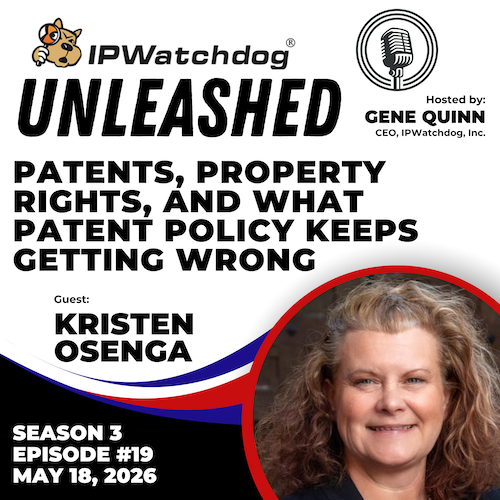
Patents, Property Rights, and What Patent Policy Keeps Getting Wrong | IPWatchdog Unleashed
This week on IPWatchdog Unleashed, I spoke with Kristen Osenga, who is a Professor of Law and Associate Dean for Academic Affairs at the University of Richmond School of Law. Kristen is a familiar voice to many in the patent community. She has been a regular participant in serious conversations about patent law, standard essential patents (SEPs), antitrust, competition policy, injunctions, and the broader innovation ecosystem.
Gene Quinn
May 20, 2026
 1
1
NO FAKES Reintroduced with More Protections for Libraries and Researchers
A bipartisan, bicameral group of Congress members today reintroduced the “Nurture Originals, Foster Art, and Keep Entertainment Safe Act of 2026” (NO FAKES Act), a bill that would create a federal IP right to an individual’s voice and likeness. Senators Marsha Blackburn (R-TN), Chris Coons (D-DE), Thom Tillis (R-NC) and Amy Klobuchar (D-MN), joined Representatives Maria Salazar (R-FL) and Madeleine Dean (D-PA) to sponsor the bill.
Eileen McDermott
May 20, 2026
0
Destroying the Intended Purpose of a Reference May Not Be a ‘Golden Ticket’ to Patentability
A patent claim of invention is considered obvious, and thus unpatentable, in light of a combination of prior art references if a person of ordinary skill in the art (POSITA) would have had a reason, or motivation, to combine the references as recited in the claim. There are responses, or defenses, to such a finding of obviousness, including if the combination renders the reference unsatisfactory or inoperable for its intended purpose – also called “frustration of purpose.
Bayes PLLC is Seeking a Patent Preparation and Prosecution Attorney or Agent
Bayes PLLC is looking for a Patent Preparation and Prosecution Attorney or Agent who wants more than a job. Bayes offers direct access to technically rich work, flexible scheduling, and a close-knit team environment where your contributions actually matter. At Bayes, you will draft and prosecute patent applications across some of the most exciting technology spaces today: semiconductors, AI, telecommunications, medical devices, consumer electronics, and renewable energy. As you grow, you will have the opportunity to expand into invalidity proceedings, patent litigation support, and IP due diligence. This is a full-time or part-time, hybrid position.
JobOrtunities Help Wanted
May 20, 2026
0
CAFC Clarifies Statutory Versus Constitutional Standing Jurispridence
The U.S. Court of Appeals for the Federal Circuit (CAFC) today issued a precedential opinion authored by Judge Chen that clarified its case law on statutory versus constitutional standing analyses. The decision ultimately reversed and remanded a district court ruling that had dismissed a plaintiff’s patent infringement suit for lack of constitutional standing.
Eileen McDermott
May 19, 2026
0
CAFC Reverses Dismissal of Medtronic’s Patent Infringement Counterclaims, Finds Standing Intact Under A.L.M.
The U.S. Court of Appeals for the Federal Circuit (CAFC) issued a decision today in Recor Medical, Inc. v. Medtronic Ireland Manufacturing Unlimited Co., reversing a ruling from the United States District Court for the Northern District of California and holding that Medtronic Ireland Manufacturing Unlimited Co. retained sufficient exclusionary rights to satisfy Article III constitutional standing, even after licensing certain patent rights to an affiliated entity. The ruling came after a precedential opinion issued today on the same topic.
Rose Esfandiari
May 19, 2026
0
Insourcing of Corporate IP Work in the Age of AI: More Reasons to Say Yes
“Should we insource IP work?” This perennial question is posed by in-house professionals and organizational leaders in corporations, universities, and other institutions—and dreaded by outside IP counsel, who fear loss of insourced client business. Deceptively binary and straightforward, the insourcing question often can’t be answered without in-house teams first exploring a host of underlying considerations. Their decision-making calculus may confront grey areas and vexing tradeoffs, ultimately coming down to rough cost-benefit analyses and gut instincts.
Carlo Cotrone
May 19, 2026
1
Squires and Stewart Hear Panelist Views on Desired PTAB Changes
The U.S. Patent and Trademark Office (USPTO) today held its third PTAB Listening Session, this one focused on Patent Trial and Appeal Board (PTAB) Administration and Reform. Panelists on both the petitioner and patent owner sides, as well as academics, IP policy experts and judges, weighed in on what changes need to be made to the PTAB to strike the balance that will most benefit the U.S. IP system. While the suggestions varied, most of the panelists agreed that greater clarity and consistency is what’s urgently needed at the moment.
Eileen McDermott
May 18, 2026
2
SCOTUS Denies Cert to Pharma Industry Challenges to IRA’s Negotiation Program, USAA’s Section 101 Patent Appeal
Today, the U.S. Supreme Court issued an order list showing that the nation’s highest court had denied a series of petitions for writ of certiorari filed by major pharmaceutical developers to challenge the Medicare negotiation program established by the Inflation Reduction Act (IRA). The Supreme Court also denied cert to an appeal of Section 101 patent-eligibility issues from a Federal Circuit ruling involving mobile banking technology, as well as a pro se cert appealing copyright and intentional infliction of emotional distress (IIED) against Disney.
Steve Brachmann
May 18, 2026
4
Squires’ Latest Precedential Decision Slams Use of IPR for ‘Litigation Leverage’
On Thursday, May 14, U.S. Patent and Trademark Office (USPTO) Director John Squires issued a Director Discretionary Decision in which he denied institution of an inter partes review (IPR) petition and marked the opinion precedential, underscoring six key principles that should guide whether the Office institutes America invents Act (AIA) proceedings.
Eileen McDermott
May 18, 2026
1
CAFC Reverses Attorney’s Fees, Sanctions, While Affirming Obviousness in E-Banking Patent Case
On May 15, the U.S. Court of Appeals for the Federal Circuit (CAFC) issued a precedential ruling in mCom IP, LLC v. City National Bank of Florida affirming the Southern District of Florida’s dismissal of patent owner mCom IP’s complaint after finding the asserted patent claims obvious on the same grounds as related patent claims invalidated at the Patent Trial and Appeal Board (PTAB). However, the Federal Circuit found that the district court improperly concluded that the case was exceptional, leading the appellate court to reverse the attorney’s fee award and attorney sanctions after finding the plaintiff did not develop evidence of frivolous litigation conduct.
Steve Brachmann
May 17, 2026
0
Patent Law Firms Face the AI Squeeze as Clients Internalize More Work
As in-house patent teams rethink how work is allocated, the implications for outside counsel are unavoidable. Corporate clients are asking whether work being done by outside counsel is being performed as efficiently as possible and even starting to ask whether it needs to be performed by outside counsel at all. At least some in-house teams are wondering whether the same or better result can be achieved internally using AI-enabled tools. If the answer is yes, then clients can be expected to decrease reliance on outside counsel, looking to law firm attorneys for targeted support, not end-to-end project management.
Gene Quinn
May 15, 2026
4
Other Barks & Bites for Friday, May 15: PTAB Decisions on Inconsistent Claim Arguments Marked Informative; Bill Moving Copyright Office to Executive Branch Moves to House Floor; CJEU Upholds Right of Fair Compensation for Publishers
This week in Other Barks & Bites: the Legislative Branch Agencies Clarification Act moves one step closer toward enactment; the Federal Circuit reverses attorney’s fees award and attorney sanctions in a patent case over e-banking technology; the Court of Justice for the European Union finds that a publisher’s right to fair compensation established by EU member states is permissible if qualifying as consideration for the right to republish; Nokia earns a stay of UK court rulings in its RAND licensing battle over video codec patents with Acer and Asus; the U.S. Patent and Trademark Office places informative designations on a trio of Patent Trial and Appeal Board decisions applying agency precedent on inconsistent claim construction positions; Cisco announces 4,000 layoffs on the same day that it reported a 12% year-over-year jump in quarterly revenues; top Congressional Democrats publicly opposed President Trump’s ouster of the National Science Board membership; and the European General Court tells the European Union Intellectual Property Office that it did not sufficiently analyze links between an ammunition trademark and a famous French comic serial.
Steve Brachmann
May 15, 2026
0
Beware the Siren’s Call of Industrial Policy
To say we live in perplexing times is an understatement. Everything seems to be shifting beneath our feet, often with seemingly little thought. One example is the move to change how the federal government supports research. It wasn’t until the passage of the Bayh-Dole Act in 1980, which injected the incentives of patent ownership into the system, that the situation changed. And the result was dramatic.
Joseph Allen
May 14, 2026
3
Evaluating the Business Case for AI in Patent Practice
Artificial intelligence has moved beyond the experimental phase in legal practice. The legal industry is no longer debating whether lawyers can or should use AI tools, or whether AI will affect the economics of law firm and in-house legal department operations. Those questions have been answered. AI is already reshaping how legal work is performed, how legal departments manage demand, how law firms are expected to price services, how patent teams analyze portfolios, and how clients evaluate outside counsel.
Gene Quinn
May 14, 2026
0
Varsity Sponsors
![[Advertisement]](https://ipwatchdog.com/wp-content/uploads/2026/05/Patent-Masters-2026-sidebar-700x500-rev1.jpg)
![[Advertisement]](https://ipwatchdog.com/wp-content/uploads/2026/05/Protege-in-PatentSight-typographic-350x250-Ad-C.png)

Latest Podcasts


IPWatchdog Events
Webinar: How AI Is Reshaping Global IP Strategy for Japanese Companies
June 2 @ 8:00 am - 9:00 am EDTPatent Masters™ 2026 – Portfolios, Licensing and Enforcement
June 8 @ 8:00 am - June 10 @ 5:00 pm EDTWebinar: How AI Is Transforming IP Strategy Across the Patent Lifecycle
June 11 @ 12:00 pm - 1:00 pm EDTWebinar: AI in Patent Drafting – When to Use Generative AI – and When Not To
June 25 @ 12:00 pm - 1:00 pm EDT