
![[IPWatchdog Logo]](https://ipwatchdog.com/wp-content/themes/IPWatchdog%20-%202023/assets/images/temp/logo-small@2x.png)
All Posts
Unjust Enrichment Under the DTSA: A Nascent Circuit Split and Its Practical Implications
The U.S. Supreme Court has been asked to grant certiorari to resolve whether the Defend Trade Secrets Act (DTSA) permits an unjust enrichment award without any showing of actual loss resulting from the defendant’s misappropriation of trade secrets. The defendant in Tata Consultancy Services Ltd. v. Computer Sciences Corp. has petitioned for certiorari, arguing that actual loss is a prerequisite for an unjust enrichment award. The petition challenges a Fifth Circuit decision affirming a $56 million unjust enrichment award and a $112 million punitive award in favor of Computer Sciences Corp. (“CSC”), measured by the costs Tata Consultancy Services (TCS) avoided through its trade secret theft rather than by any proven actual loss to CSC.
Peter J. Toren
May 7, 2026
 1
1
Fourth Circuit Says USPTO Can Withhold Documents in Repaneled Centripetal Networks IPR Featuring Alleged APJ Bias
On Tuesday, the U.S. Court of Appeals for the Fourth Circuit issued a published opinion in Malone v. U.S. Patent and Trademark Office affirming the Eastern District of Virginia’s grant of summary judgment to the USPTO after finding that the agency properly withheld documents sought by US Inventor’s Josh Malone pursuant to a Freedom of Information Act (FOIA) request related to administrative patent judge (APJ) paneling at the Patent Trial and Appeal Board (PTAB). The Fourth Circuit found that decision drafts circulated to nonpanel APJs were subject to FOIA’s exemption for predecisional and deliberative documents and were not unprotected ex parte communications.
Steve Brachmann
May 7, 2026
2
CAFC Affirms PTAB Ruling That DraftKings Failed to Prove Unpatentability of Gaming Patent Claim
The U.S. Court of Appeals for the Federal Circuit (CAFC) issued a decision today in DK Crown Holdings Inc. v. AG 18, LLC, affirming a final written decision of the Patent Trial and Appeal Board (PTAB) and holding that DK Crown Holdings Inc., formerly known as DraftKings, Inc. (DK), failed to prove that claim 18 of U.S. Patent No. 9,978,205 was unpatentable during inter partes review (IPR).
Rose Esfandiari
May 6, 2026
1
Raskin Presses Squires on Motives for Board of Peace Trademark Filings
On Tuesday, May 5, Representative Jamie Raskin (D-MD), Ranking Member of the House Judiciary Committee, sent a letter to U.S. Patent and Trademark Office (USPTO) Director John Squires pressing him to answer questions about the Office’s role in filing a trademark application on behalf of the Trump Administration for Trump’s “Board of Peace.”
Eileen McDermott
May 6, 2026
1
Google’s Challenge to PTAB Limits Puts Reliance and Balance on the Line
In its recent petition to the U.S. Supreme Court, Google argues that patents can be invalid at any time, even decades after issuance, and therefore should remain open to inter partes review (IPR) challenges, regardless of age or how long they have been relied upon. At first glance, this sounds like a defense of patent quality. Coming from one of the most frequent users of the Patent Trial and Appeal board (PTAB) over the past decade — and arriving just as the U.S. Patent and Trademark Office’s (USPTO’s) “settled expectations” doctrine begins to limit late-stage IPR challenges — it raises a sharper question: why now?
Federal Circuit Affirms 101 Dismissal for Google in Distracted Driving Patent Suit
The U.S. Court of Appeals for the Federal Circuit (CAFC) issued a decision today in TJTM Technologies, LLC v. Google LLC, affirming the U.S. District Court for the Northern District of California’s dismissal of a patent infringement lawsuit and holding that the asserted patent claims are directed to patent-ineligible subject matter under 35 U.S.C. § 101. The nonprecedential decision was authored by Judge Chen and joined by Judges Dyk and Stark.
Rose Esfandiari
May 5, 2026
5
As Congress Considers PERA, It Should Allow the Frustrated Inventor to Be Heard
A person recently approached me at church with excitement regarding a software process he developed. His company was so pleased with the result that it is filing a patent, listing him as the inventor. This person knew that I had some kind of patent backstory, so he asked for my thoughts. My name is Jeffrey A. Killian, and I am the patent applicant in the Federal Circuit Court case # 2021 -2113 (In Re: Killian). I took no pleasure in telling my friend at church that his patent application will be rejected. Plus, the official notice will have my precedential case quoted all over his rejection. With friends at church like me, who needs enemies?
Jeffrey Killian
May 5, 2026
4
Trademark Claims Against Netflix Dismissed Due to One-Letter Typo in Court Order
Trademark claims against Netflix concerning its popular “Running Point” comedy series were recently dismissed at the pleadings stage due to a one-letter misarticulation of applicable First Amendment law. The case, soon to be litigated on appeal, highlights the need to clarify the contours of trademark liability arising from creative works. Pepperdine University filed the lawsuit last year against Netflix and co-defendants Warner Bros. and Kaling International, just one week before the “Running Point” series premiere. Loosely based on the life of Los Angeles Lakers owner Jeanie Buss, the series stars Kate Hudson as the owner of the fictional basketball team the Los Angeles Waves. The popular series, which amassed instant popularity and ranked as Netflix’s #1 TV show, was quickly ordered for a second season that premiered April 23, 2026.
Sara Gold
May 5, 2026
0
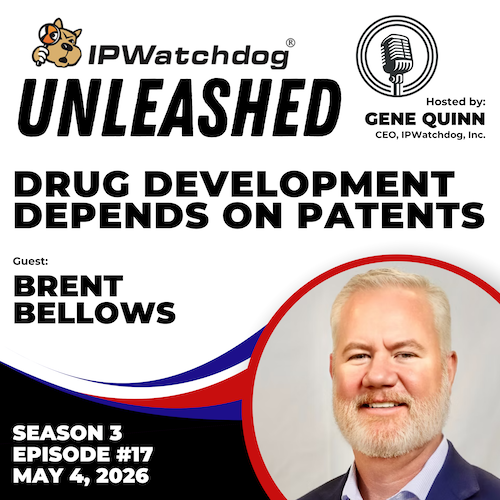
Patents, Drug Prices, Clinical Trials and the Economics of Medicine | IPWatchdog Unleashed
This week on IPWatchdog Unleashed, I spoke with Brent Bellows, a partner with Knowles Intellectual Property Strategies (KIPS). We discussed a variety of issues including Hatch-Waxman, Orange Book listings, paragraph IV certifications, skinny labels, generic entry, clinical trial costs, regulatory exclusivity, and the enormous financial risk associated with bringing new drugs to market. Gene and Brent explore the tension between public demand for lower drug prices and the need for durable incentives that make high-risk drug development economically viable, particularly for oncology, Alzheimer’s, Parkinson’s, antibiotic resistant bacteria, and other difficult-to-treat conditions. The episode closes with a broader innovation-policy message: patents are not a peripheral feature of drug development—they are a core operating asset that enables private-sector investment, supports breakthrough therapies, and ultimately drives the availability of future generic medicines.
Gene Quinn
May 4, 2026
1
CAFC Says ‘Words of Approximation’ in Patent Claims Must Be Sufficiently Explained to Avoid Indefiniteness
The U.S. Court of Appeals for the Federal Circuit (CAFC) on Monday in a precedential decision authored by Judge Lourie affirmed a district court’s ruling determining certain claims of Enviro Tech Chemical Services, Inc.’s patent for a method of poultry treatment indefinite. Enviro Tech’s U.S. Patent No.10,912,321is titled “Methods of Using Peracetic Acid to Treat Poultry in a Chill Tank During Processing.” Enviro Tech sued Safe Foods Corp. for infringement of a number of claims of the patent in the U.S. District Court for the Eastern District of Arkansas.
Eileen McDermott
May 4, 2026
6
EU Returns to Special 301 Report’s Watch List for First Time Since 2006
On April 30, the Office of the U.S. Trade Representative (USTR) released this year’s Special 301 Report, which surveys the effectiveness of intellectual property (IP) rights and enforcement abroad and identifies foreign nations where IP protections are uncertain or disregarded. The 2026 report marks the first time in 13 years that a Priority Foreign Country (PFC) has been named, with Vietnam being identified as a PFC for persistent failures to address several long-standing IP concerns. The USTR has also added the European Union (EU) to the Special 301 Report’s Watch List, the first time since 2006 that the continental government has been identified for IP-related concerns in addition to individual European nations.
Steve Brachmann
May 4, 2026
0
What the USPTO’s Reexamination Remand for HID Means for Estoppel, Timing and Strategy
The U.S. Patent and Trademark Office (USPTO) issued a significant Decision on Remand on Monday, April 27, 2026, clarifying when estoppel under 35 U.S.C. § 315(e)(1) attaches and—critically—what it means to “request” a proceeding “before the Office.” The ruling arises from an increasingly common set of circumstances—HID had initially filed an inter partes review (IPR) against CPC Patent Technologies’ U.S. Patent No. 9,665,705, and subsequently requested ex parte reexamination requests of that same patent. Monday’s decision clarifies that a party is estopped from “requesting” ex parte reexam at the moment the IPR final written decision issues when the USPTO has yet to order ex parte reexam.
Other Barks & Bites for Friday, May 1: EU Lands on USTR’s Special 301 Watch List; Battery Recycling Patent Families Increase Seven-Fold in Past Decade; and Google Cert Petition Challenges Settled Expectations Doctrine
This week in Other Barks & Bites: the U.S. Trade Representative issues its annual Special 301 Report listing the European Union as a Watch List nation for IP-related issues; Senators Dick Durbin (D-IL) and Maria Cantwell (D-WA) publicly oppose the Trump Administration’s decisions to cut federal funding for science and upend the National Science Board; and more.
Steve Brachmann
May 1, 2026
2
UNC Charlotte Highlights the Power of Invention at 2026 Invention of the Year Awards
The University of North Carolina at Charlotte brought together leaders from government, academia, industry, and the defense community for its 2026 Invention of the Year Awards, an evening that showcased the university’s growing role as a national engine of innovation, commercialization, and technological impact.
IPWatchdog
May 1, 2026
1
The Latest Attempt to Expose SAWS Highlights Structural Flaws at the USPTO
Whether or not the United States Patent and Trademark Office (USPTO) wants to admit it, over most of the last generation there has been a secret examination docket. Not surprisingly, such a secret examination docket is strictly prohibited by federal law. A newly filed joint status report in Morinville v. USPTO brings this issue to the fore and underscores the lack of transparency and accountability of secret internal patent review programs at the USPTO. Procedurally, the latest filing seeks to expose the USPTO shadow docket through a new round of discovery, which is currently being considered by the United States District Court for the District of Columbia.
Gene Quinn
April 30, 2026
13
Varsity Sponsors
![[Advertisement]](https://ipwatchdog.com/wp-content/uploads/2026/05/Patent-Masters-2026-sidebar-700x500-rev1.jpg)
![[Advertisement]](https://ipwatchdog.com/wp-content/uploads/2026/05/Protege-in-PatentSight-typographic-350x250-Ad-C.png)

Latest Podcasts



IPWatchdog Events
Webinar: How AI Is Reshaping Global IP Strategy for Japanese Companies
June 2 @ 8:00 am - 9:00 am EDTPatent Masters™ 2026 – Portfolios, Licensing and Enforcement
June 8 @ 8:00 am - June 10 @ 5:00 pm EDTWebinar: How AI Is Transforming IP Strategy Across the Patent Lifecycle
June 11 @ 12:00 pm - 1:00 pm EDTWebinar: AI in Patent Drafting – When to Use Generative AI – and When Not To
June 25 @ 12:00 pm - 1:00 pm EDT