
![[IPWatchdog Logo]](https://ipwatchdog.com/wp-content/themes/IPWatchdog%20-%202023/assets/images/temp/logo-small@2x.png)
All Posts
Federal Circuit Finds In-Store Product Locator Patents Ineligible as Abstract
The U.S. Court of Appeals for the Federal Circuit (CAFC) on Friday affirmed a district court’s summary judgment ruling that six patents owned by Innovaport LLC are invalid for claiming ineligible subject matter under 35 U.S.C. § 101. The Federal Circuit agreed that the patents, which are directed to systems and methods for providing in-store product location information, claimed an abstract idea without adding a sufficient inventive concept to make them patent-eligible.
Rose Esfandiari
February 9, 2026
 0
0
How Temu Works With Brands to Protect Intellectual Property Rights
When Temu launched in September 2022, it set out to connect consumers with sellers offering quality, affordable products. Today, the platform has built out a comprehensive system to keep counterfeit goods at bay. The number of brands Temu actively scans for fakes has grown from 3,000 to more than 5,000 over the past year. Temu now resolves more than 99% of requests to remove unauthorized products within three business days—most in under 24 hours.
Temu
February 9, 2026
0
Patent Portfolio Economics: Balancing Quality, Cost and Market Coverage
Patent portfolios are frequently discussed in terms of size, technological breadth, or litigation potential. Those characteristics may be easy to measure, but they are not what determines whether a portfolio succeeds or fails. At their core, patent portfolios are business assets that must be managed deliberately and strategically. When they are not, they become cost centers that quietly consume resources without delivering meaningful competitive advantage.
Gene Quinn
February 8, 2026
4
Other Barks & Bites for Friday, February 6: Counterfeit Study Shows 41% Fail Product Safety Standards; USPTO De-Designates PTAB Precedentials on RPI Amendments
This week in Other Barks & Bites: Senator Ted Cruz (R-TX) calls for a federal framework for deploying self-driving cars to replace the state patchwork negatively impacting U.S. dominance in the field; a major apparel industry organization releases a study showing that nearly half of counterfeit products test positively for high levels of hazardous chemicals; Novartis issues guidance calling for its first annual operating profit loss in a decade due to patent expirations to blockbusters Entresto and Xolair; and more.
Steve Brachmann
February 6, 2026
0
CAFC Agrees Content Sharing Patents are Ineligible in Win for Walmart
he U.S. Court of Appeals for the Federal Circuit (CAFC) on Thursday affirmed a Western District of Texas decision granting Walmart, Inc. summary judgment that Q Technologies’ content sharing patents are invalid as patent ineligible. The opinion was authored by Judge Lourie. Q Technologies owns U.S. Patent 9,635,108, 10,567,473 and 10,594,774, all of which are titled “Systems and Methods for Content Sharing Using Uniquely Generated Identifiers” and share a common specification.
Eileen McDermott
February 5, 2026
2
Federal Circuit Affirms Noninfringement Finding in Ladder Patent Dispute
The U.S. Court of Appeals for the Federal Circuit (CAFC) on Thursday affirmed a district court’s grant of summary judgment of noninfringement in favor of Tricam Industries, Inc. in a patent infringement suit brought by Little Giant Ladder Systems, LLC. The decision held that Tricam’s ladders did not infringe Little Giant’s patent, either literally or under the doctrine of equivalents, and that the district court correctly construed the key claim term “cavity.”
Rose Esfandiari
February 5, 2026
1
CAFC Affirms Summary Judgment Ruling in Patent Suit Against NASA Mars Helicopter Subcontractor
The U.S. Court of Appeals for the Federal Circuit (CAFC) on Wednesday affirmed a district court’s grant of summary judgment in favor of AeroVironment, Inc. in a patent infringement suit brought by inventors Paul and David Arlton. The decision held that AeroVironment’s affirmative defense under 28 U.S.C. § 1498 covered all of its alleged infringing activities related to the Ingenuity Mars helicopter. AeroVironment cross-appealed the district court’s denial of its motion for attorneys’ fees.
Rose Esfandiari
February 4, 2026
0
Judge Wolson Issues Key Summary Judgment Ruling on Eve of Trial in Arbutus v. Moderna
On February 2, 2026, U.S. District Court for the Eastern District of Pennsylvania Judge Joshua D. Wolson, sitting by designation in the U.S. District Court for the District of Delaware, made several key summary judgment rulings in advance of trial in Arbutus Biopharma Corporation and Genevant Sciences GmbH (collectively “Arbutus”) v. Moderna, Inc. and ModernaTx, Inc.
Dan Shores
February 4, 2026
0
USPTO De-Designates Two PTAB Decisions on RPIs in Light of Corning Optical
The U.S. Patent and Trademark Office (USPTO) de-designated two decisions having to do with real-parties-in interest from precedential status on Tuesday. The Office de-designated Proppant Express Invests., LLC v. Oren Techs., LLC, IPR2017-01917, Paper 86 (PTAB Feb. 13, 2019); and Adello Biologics LLC v. Amgen Inc., PGR2019-00001, Paper 11 (PTAB Feb. 14, 2019). According to a USPTO email sent Tuesday, both decisions conflict with the decision in Corning Optical Communications RF, LLC v. PPC Broadband Inc., IPR2014-00440, Paper 68 (PTAB Aug. 18, 2015) (precedential).
Eileen McDermott
February 4, 2026
0
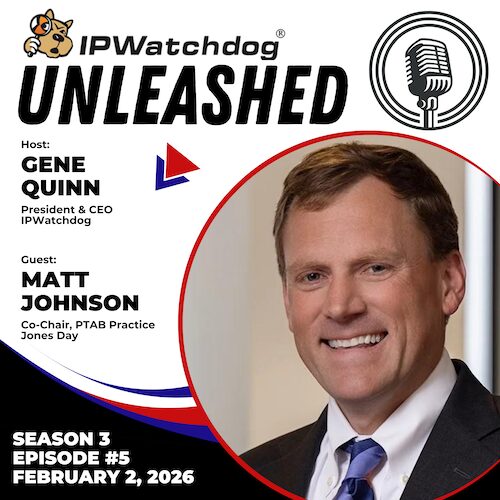
Inside the PTAB Reset: Practical Fixes for a Reengineered PTAB | IPWatchdog Unleashed
In this episode of IPWatchdog Unleashed, I speak with Matt Johnson, Co-Chair of the PTAB Practice at Jones Day, and we take an in-depth look at the Patent Trial and Appeal Board (PTAB) nearly a decade and a half after its launch. Johnson and I discuss the ongoing PTAB reset at the United States Patent and Trademark Office (USPTO) and suggest practical fixes for a better, reengineered PTAB. The majority of the conversation is devoted to concrete, targeted reform suggestions that would lead to a better functioning PTAB and more streamlined IPR review system. Instead of abstract complaints, Johnson proposes narrowing PGR estoppel to encourage early challenges, moving IPR estoppel to the point of institution to eliminate gamesmanship, separating institution decisions from full merits adjudication to reduce confirmation bias, and rethinking quiet-title concepts to better align notice to implementers with settled expectations of patent owners.
Gene Quinn
February 3, 2026
2
Federal Circuit Upholds PTAB Finding that Aerial Imaging Patents are Obvious
The U.S. Court of Appeals for the Federal Circuit (CAFC) on Tuesday affirmed two final written decisions from the Patent Trial and Appeal Board (PTAB) in inter partes review (IPR) proceedings, concluding that the board did not err in finding claims of two Eagle View Technologies, Inc. patents unpatentable as obvious. Eagle View Technologies, Inc. had appealed the PTAB’s decisions, which held that claims of its U.S. Patent Nos. 8,670,961 and 8,078,436 were obvious over a combination of prior art references. The patents, both titled “Aerial Roof Estimation Systems and Methods,” share a common specification and relate to systems and methods that allow estimates involving roofs on buildings to be created remotely. The patents teach remotely generating a roof estimate report by analyzing multiple aerial images of a building to determine the area, shape, and slope of the roof.
Rose Esfandiari
February 3, 2026
0
Moore Dissent Says CAFC Created Design Patent Law Problem in Egyptian Goddess
The U.S. Court of Appeals for the Federal Circuit (CAFC) on Monday issued a precedential decision affirming a district court’s grant of summary judgment of non-infringement to Armaid Company, Inc. that its massage product did not infringe Range of Motion Products LLC’s (RoM’s) design patent claims. The opinion was authored by Judge Cunningham and Chief Judge Moore delivered a dissent in which she claimed her court has caused “the legal frame of reference” in design patent law cases to become “askew.”
Eileen McDermott
February 2, 2026
0
Congratulations to the 2024 and 2025 IPWatchdog Dog of the Year!
Although IPWatchdog has the word “Dog” in it’s name and logo, the publication is in no way associated with dogs. However, Gene and I have a shared love of dogs and have SIX German shorthaired pointers (3 sets of male/female siblings) ranging in age from 11 months to 6 years old. We love dogs so much that when we posted our first job post in 2020, one of the job “requirements” was “must love dogs” (Plural). Today, the majority of our employees share this same love of dogs and most have dogs of their own.
Renee C. Quinn
February 2, 2026
1
EUIPO-EPO Joint Report Finds IP-Driven Industries Contribute Nearly Half of EU GDP, One-Third of Total Jobs
On Thursday, the European Union Intellectual Property Office (EUIPO) and the European Patent Office (EPO) issued a joint report on IP and innovation in various industrial sectors of the European economy. Identifying IP-driven industries by analyzing registrations for IP rights within the EU, the agencies conclude that such industries contribute nearly half of the entire European gross domestic product (GDP) while also providing a third of the EU’s jobs, which offer workers larger wages on average when compared to total EU employment.
Steve Brachmann
February 2, 2026
1
PTAB Masters Panelists Predict Rough Road for Pending Patent Bills, Tough Questions from Congress on USPTO Rules, Warn of Widening Gap Between CAFC and USPTO
Panelists at IPWatchdog’s Virtual PTAB Masters Program 2026 last week had some cynical views on chances for pending patent reform bills, while on Friday other experts offered insights into developments at the U.S. Court of Appeals for the Federal Circuit (CAFC) with respect to review of Patent Trial and Appeal Board (PTAB) cases. Speaking on Thursday’s panel, titled “Capitol Hill & PTAB Politics: Innovation Policy, Congressional Oversight and Mid-term Elections,” panelists first addressed the chances of bills such as the Patent Eligibility Restoration Act (PERA) and the Promoting and Respecting Economically Vital American Innovation Leadership (PREVAIL) Act advancing this year.

Latest Podcasts


IPWatchdog Events
IPWatchdog LIVE 2026 at the Renaissance Arlington Capital View
March 22 @ 1:00 pm - March 24 @ 7:00 pm EDT