


 3
3 What does it mean to be a prolific inventor in an era of corporate retrenchment, weakened patent rights, and risk-averse innovation culture?
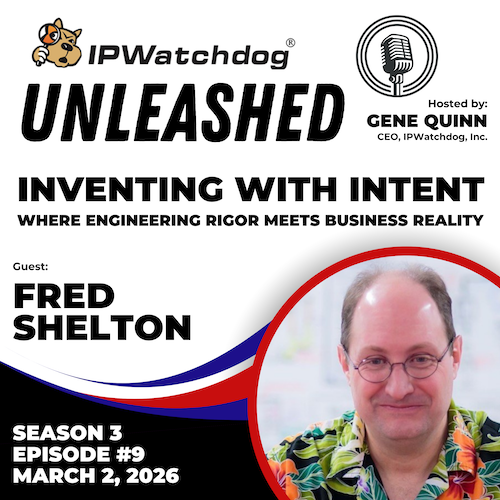
This week on IPWatchdog Unleashed, I had the opportunity to explore that question with Fred Shelton—an engineer who has accumulated more than 3,000 patents over roughly two decades, primarily during his career at Johnson & Johnson. Shelton describes himself not as an IP professional, but as an engineer who “documents engineering through patents.” That distinction is more than semantic. It reflects a philosophy of invention that is structured, disciplined, and deeply contextual.
At a time when many companies are cutting patent budgets and questioning the ROI of intellectual property, Shelton’s approach offers a compelling counterpoint: invention must be engineered from the outset with business reality, market forces, and patent strategy embedded into the process.
Engineering, Not Blue Sky
Shelton rejects the romanticized notion of invention as unconstrained creativity. He explains that he is not a fan of “blue sky” brainstorming sessions detached from operational constraints. In his view, unconstrained ideation often produces shallow ideas that collapse under real-world scrutiny. Instead, he deliberately over-constrains the problem.
Technical constraints. Regulatory constraints. Cost constraints. Operational bottlenecks. Competitive barriers. Existing prior art. All of it goes into the box. And when something emerges it is generally not only new, but it is also the very antithesis of obvious.
By pushing against the walls of those constraints, Shelton explains that he finds the gaps—assumptions that are not entirely true, limitations that are conditional rather than absolute. That is where invention resides. When constraints are treated not as barriers but as structural parameters, solutions become deeper, more workable, more defensible, and ultimately far more likely to be patentable.
This mindset distinguishes engineering from pure science. Scientists often ask what is possible. Engineers ask what is workable, scalable, and monetizable. Shelton’s evolution as an inventor came when he realized that the second question matters just as much as the first.
Finding the Real Problem
 A recurring theme in our conversation was the importance of identifying the correct problem before attempting to solve it. Too often, inventors respond to what customers say they want rather than what they actually need. The difference can be subtle but profound. Shelton described an example in bariatric medicine, where he has recently been active and has filed his first patent application on his own behalf several weeks ago.
The rise of GLP-1 inhibitors expanded the number of patients seeking weight-loss interventions, but high discontinuation rates and side effects left many patients searching for alternatives after failing on GLP-1 inhibitors for one reason or another. At the same time, surgical robotics has slowed operating room throughput, reducing capacity for traditional procedures. Bariatric centers could easily accommodate increased demand except for the fact that many bariatric procedures require inpatient stays, which is not possible if the surgery occurs in an outpatient center.
Shelton explains the real problem was not simply “how do we perform bariatric surgery better?” Instead, the real problem was how to create a treatment modality that simultaneously addresses patient demand, procedural throughput, reimbursement realities, and which is outpatient feasible.
Once the entire landscape was understood in its entirety, the solution space changed. Combining existing tools in a novel configuration produced a minimally invasive, durable, reversible intervention that could be delivered in outpatient settings. No stakeholder had expressed the need, or this desired solution. Still, the innovation emerged as an obvious answer to the real, underlying problem once the entire system was understood.
This is inventing in context. It is not about creating a clever widget. It is about identifying systemic misalignment and resolving it.
Business Literacy as an Innovation Multiplier
Shelton readily admits that earlier in his career he focused almost exclusively on technical problem-solving. Over time, however, he immersed himself in business training—market mastery programs, commercialization frameworks, cross-functional collaboration with marketing and sales teams. And that immersion changed his inventive output.
Understanding who pays, who benefits, how reimbursement works, how regulatory approval affects adoption, and how operational throughput impacts margins fundamentally alters how solutions are designed. An invention that solves five people’s problems elegantly may be intellectually satisfying. An invention that solves one million people’s problems economically changes industries.
Shelton laments that engineering education rarely, if ever, teaches an integrated approach to problem solving. Engineers are not trained to think in terms of capital allocation, customer pull, or revenue models. Yet those dimensions determine whether a patent becomes a strategic asset, an archival document, or worse just a drain on resources.
For startups and growth companies in particular, this insight is critical. Too many early-stage ventures treat patents as fundraising checkboxes rather than strategic instruments. They file a narrow application to signal defensibility, without fully articulating embodiments, variations, or continuation pathways. By the time the technology proves viable, they have left protection on the table and it is too late to circle back to do anything about it.
Patent Strategy at Inception
Perhaps the most compelling portion of our discussion centered on Shelton’s approach to patent strategy. He does not view patents as an after-the-fact documentation exercise. Instead, he explains, he purposefully architects patent strategy into the invention phase itself.
That means identifying multiple embodiments from day one. It means isolating the conceptual core that differentiates the invention. It means anticipating which elements are likely to become commercially central and which may become fallback positions. It means understanding continuation strategy before filing.
In one recent filing after leaving Johnson & Johnson, Shelton developed more than a dozen independent claim sets covering different embodiments, then strategically chose which to prosecute first while preserving others for future continuations. The result was not a single patent application—it was a long-term platform strategy.
This approach aligns perfectly with how startups must operate. Capital is finite. Patent prosecution is expensive. Filing everything aggressively at once is impractical. But failing to lay the structural groundwork at inception will permanently foreclose options.
Collaboration as Competitive Advantage
The most encouraging aspect of Shelton’s philosophy is his emphasis on collaboration. The patent system works best when inventors and counsel operate as strategic partners rather than transactional service providers.
Inventors must articulate not just what they built, but why it matters, how it can vary, and where it may evolve. Patent professionals must translate that vision into durable claim architecture. Business leaders must align prosecution decisions with market realities.
This triad—technical depth, legal strategy, commercial context—is what transforms patents into strategic assets.
The Road Ahead
Fred Shelton’s career illustrates that prolific invention is not the product of luck or raw creativity. It is the result of disciplined problem identification, constraint-driven ideation, market realities, and intentional IP architecture.
In an environment where corporations are retrenching and startups face growing capital constraints; his approach offers a blueprint. Invent in context. Embed business understanding into engineering. Build patent strategy at inception. Preserve optionality through continuation planning. Treat intellectual property as structured capital, not paperwork.
And although we do spend some time talking about the weakened state of the U.S. patent system over the last generation, Shelton leaves us on an optimistic note. The patent system is not broken, he says. It remains a powerful mechanism for rewarding ingenuity. But extracting value from it requires deliberate strategy and cross-disciplinary fluency, which too often are missing from the equation.
Innovation does not happen in a vacuum. It happens where engineering rigor meets business reality and where invention is documented not as an afterthought, but as a strategic foundation. If more inventors approached the process with that mindset, and if more companies treated patents as long-term assets rather than line items, the innovation ecosystem would be stronger for it.
More IPWatchdog Unleashed
You can listen to the entire podcast episode by downloading it wherever you normally access podcasts or by visiting IPWatchdog Unleashed on Buzzsprout. You can also listen to IPWatchdog Unleashed conversations on the IPWatchdog YouTube channel. For more IPWatchdog Unleashed, see below for our growing archive of previous episodes.
![[Advertisement]](https://ipwatchdog.com/wp-content/uploads/2026/10/ClaimHit-Oct-28-2026-sidebar-700x500-1.jpg)
![[Advertisement]](https://ipwatchdog.com/wp-content/uploads/2026/10/Patsnap-Oct-29-2026-sidebar-700x500-1.jpg)
![[Advertisement]](https://ipwatchdog.com/wp-content/uploads/2026/09/Life-Sciences-2026-sidebar-early-bird-ends-Oct-25-700x500-1.jpg)
![[Advertisement]](https://ipwatchdog.com/wp-content/uploads/2024/09/Patent-Prosecution-Training-sidebar-700x500-2025-03-27.jpg)







![[Advertisement]](https://ipwatchdog.com/wp-content/uploads/2021/12/WEBINAR-336-x-280-px.png)
![[Advertisement]](https://ipwatchdog.com/wp-content/uploads/2021/12/Ad-4-The-Invent-Patent-System™.png)






Join the Discussion
3 comments so far.
Anon
March 9, 2026 07:07 pmGreat conversation and intriguing perspective.
Michael Schober
March 5, 2026 02:25 pmAwesome discussion and very helpful!!! Thank you. 🙂
Bruce Berman
March 4, 2026 09:09 amExcellent, thoughtful interview with a leading inventor.