



Recent Episodes
October 27, 2026
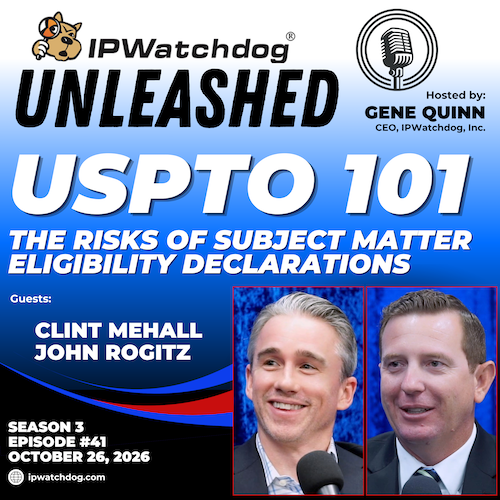
USPTO 101: Understanding the Risks of Subject Matter Eligibility Declarations | IPWatchdog Unleashed
 Play Episode
The USPTO deserves some credit for recognizing that applicants may at times need an opportunity to explain technical improvements that examiners have failed to appreciate, but there is real risk associated with filing a SMED that should cause practitioners to pause rather than race forward without serious consideration. And despite some difference of opinion, we all agreed on an essential point: Filing a SMED should not be the first line of defense against an eligibility rejection; it should should be treated as a last resort. Filing a SMED requires serious consideration of the advantages, disadvantages, and alternatives. Examiner interviews, arguments grounded in the existing specification, appropriate claim amendments, and appeals all deserve careful consideration before ever adding sworn statements to the prosecution history. The question must be whether the declaration supplies something genuinely necessary to advance the case, and even then must be intentionally specific and narrow.
Play Episode
October 20, 2026
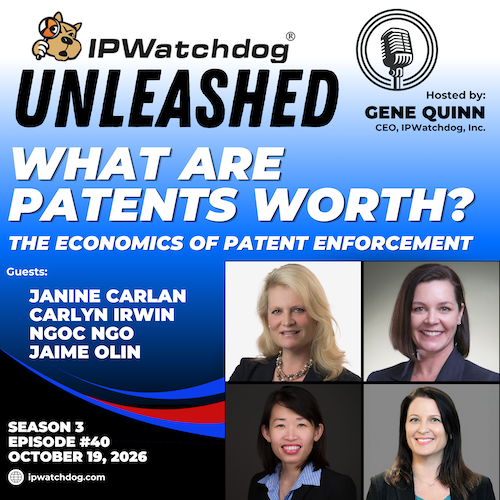
Patent Value and Licensing Price: What is a Patent Really Worth?| IPWatchdog Unleashed
Play Episode
A patent’s economic value and the price it commands in a licensing negotiation can be very different things. The technology may deliver substantial commercial benefits, yet the amount a patent owner can capture depends on legal risk, enforcement costs, negotiating leverage, and each party’s business objectives. This week on IPWatchdog Unleashed, we ask how much a patent is really worth, and how to prove it at a negotiating table or in court. This conversation, which occurred as part of IPWatchdog’s 2026 Women’s IP Forum, examines how sophisticated licensors, licensees, counsel, and valuation professionals assess patent value in real-world transactions and disputes. The conversation explored royalty structures, comparable licenses, portfolio strength, litigation and validity risk, damages principles, standard-essential patent (SEP) licensing, and the practical factors that drive parties toward—or away from—a deal.
Play Episode
October 13, 2026
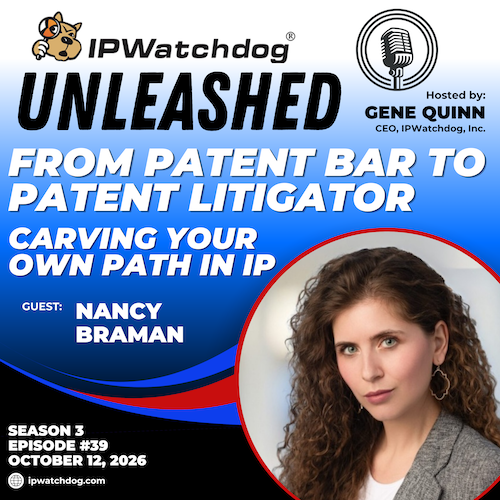
From Patent Bar to Patent Litigator: Carving Your Own Path in IP | IPWatchdog Unleashed
Play Episode
This week on IPWatchdog Unleashed, I speak with Nancy Braman. Recorded before a live audience at IPWatchdog’s 2026 Women’s IP Forum, our conversation explores how practitioners create opportunities, develop professional relationships, and build the skills necessary to succeed in patent law. From taking PLI patent bar review course before law school, to attending Franklin Pierce Law School, to spending more than three years writing and researching for IPWatchdog and now litigating high-stakes patent and intellectual property disputes for life sciences and technology companies. She has already had quite the journey, and I sense it is really just beginning.
Play Episode
October 6, 2026
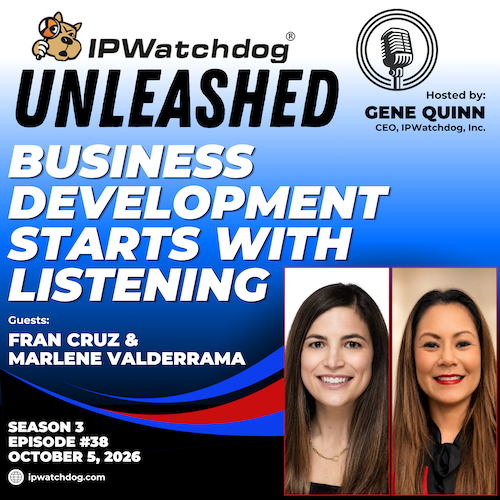
Building Business and Careers Starts with Listening | IPWatchdog Unleashed
Play Episode
This week on IPWatchdog Unleashed, I spoke with Fran Cruz and Marlene Valderrama. Recorded before a live audience following IPWatchdog’s Women’s IP Forum, our conversation explored how professionals build relationships that lead to business, career opportunities, and better ways of doing their jobs. Drawing on their perspectives at Juristat and Halliburton, respectively, Fran and Marlene returned to a fundamental point: earning someone’s attention begins with understanding what matters to them. That requires asking questions and actually listening.
Play Episode
September 29, 2026
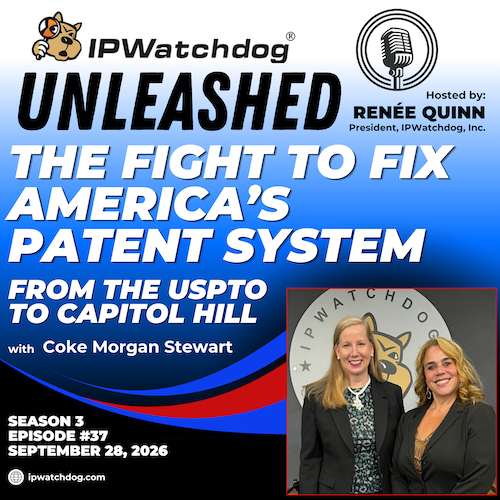
The Fight to Fix America’s Patent System | IPWatchdog Unleashed
Play Episode
This week on IPWatchdog Unleashed, IPWatchdog President Renée C. Quinn spoke with Coke Morgan Stewart. Formerly Acting Director and Deputy Director of the U.S. Patent and Trademark Office (USPTO), Stewart is now president and CEO of the Council for Innovation Promotion (C4IP). Their conversation, recorded at IPWatchdog’s 2026 Women’s IP Forum, examines what she learned while leading the agency, why she believes the patent system needs legislative reform, and how her experience has shaped her approach to leadership and advocacy.
Play Episode
September 15, 2026
Can the Patent System Keep Pace with Life Sciences Innovation? | IPWatchdog Unleashed
Play Episode
This week on IPWatchdog Unleashed, I spoke with Steve Caltrider, Vice President and Chief Intellectual Property Officer at Dana-Farber Cancer Institute, and a former General Patent Counsel at Eli Lilly. The discussion also examined patent quality and the role of examination. Caltrider’s view is that the best time to establish confidence in a patent is when the USPTO examines it—not years later through PTAB review or district court litigation, after investment decisions have already been made. He recognized the need for an error-correction mechanism, while cautioning that review should not become so extensive or unpredictable that it undermines the value of issued patents.
Play Episode
September 9, 2026
Will AI Data Centers Become the Next Patent Battleground? | IPWatchdog Unleashed
Play Episode
This week on IPWatchdog Unleashed, I spoke with Hilary Preston. Our conversation focused on the rapidly expanding AI data center ecosystem and the technology, infrastructure, and intellectual property risks emerging as billions of dollars flow into the sector.
Play Episode
September 1, 2026
The Video Game AI Conundrum: Can Lawmakers Regulate AI Without Stifling Innovation? | IPWatchdog Unleashed
Play Episode
This week on IPWatchdog Unleashed, I spoke with Bijou Mgbojikwe, who serves as Senior Policy Counsel for the Entertainment Software Association. Our conversation examined the rapidly expanding intersection of artificial intelligence, intellectual property, and video game policy. The central challenge is that legislation often treats very different technologies and use cases as though they present the same risks. Mgbojikwe discussed the distinction between harmful deepfakes and digital replicas used in legitimate creative works, including films and video games. Those concepts can implicate different legal frameworks, including right-of-publicity laws, copyright, consumer-protection statutes, and the First Amendment. When lawmakers combine them through broad definitions that are intended to prevent fraud, for example, legislation aimed at deception or abuse can inadvertently reach fictional characters, realistic game environments, and other expressive content.
Play Episode
August 24, 2026
The AI Patent Gold Rush: Volume, Value and Patent Strategy | IPWatchdog Unleashed
Play Episode
This week on IPWatchdog Unleashed, I spoke with Robert Plotkin, a patent attorney, computer scientist, and longtime software and AI practitioner. In what turned into a wide ranging conversation about artificial intelligence, Plotkin, who is the author of The Genie in the Machine and AI Armor: Securing the Future of Your AI Company with Strategic Intellectual Property, discusses the legal and strategic challenges confronting AI innovation. We discuss why companies should be cautious about treating AI patent counts as evidence of innovation leadership and why the most valuable AI patent portfolios are built around technology that matters to the business for a specific, articulable reason.
Play Episode
August 18, 2026
AI Won’t Replace Patent Lawyers—But it is Coming for Commodity Patent Work | IPWatchdog Unleashed
Play Episode
This week on IPWatchdog Unleashed, I explain why I believe artificial intelligence is unlikely to eliminate experienced patent lawyers. That being said, AI is already transforming prior-art searching, claim comparison, application drafting, office-action responses, and portfolio analysis. But the strategic opportunity for competently using AI is not simply to produce more patents faster, but to reach a substantially better work product within the time and budget previously required to reach an acceptable but incomplete result. With that in mind I predict that AI will expose practitioners whose work consists primarily of commodity production.
Play Episode
August 11, 2026
Patent Count vs. Patent Value: Patent Strategy in the Age of AI | IPWatchdog Unleashed
Play Episode
In the latest episode of IPWatchdog Unleashed, I speak with Joel Meyer, an IP attorney and innovation strategist with more than 30 years of experience building and monetizing technology portfolios. Our conversation is about moving from patent count to patent value—and using IP strategy to preserve business optionality. That leads to a broader discussion about the role of IP counsel. A young company may not yet know whether its future lies primarily in products, services, licensing, acquisition or some combination of those paths. We discuss why the strongest IP strategies anticipate that uncertainty rather than prematurely narrowing the company’s options, and how AI can give sophisticated IP professionals better information and tools to help innovators build protection around what actually creates competitive value.
Play Episode
August 5, 2026
The Patent Enforcement Economy Is Leaving Inventors Behind/ IPWatchdog Unleashed
Play Episode
The patent system makes a promise that has become increasingly conditional. An inventor discloses an invention to the public and, in return, receives a limited right to exclude. On paper, that bargain remains intact. In the real world, however, a patent owner often discovers that functionally the right is only defensible if the infringement is large enough (but not too large), the damages are high enough (but not too high), the portfolio is deep enough, and somebody is willing to finance years of litigation. Our conversation this week for IPWatchdog Unleashed is about what happens after a patent owner has completed the tedious work of understanding what is actually owned and is now ready to pursue a licensing or enforcement campaign.
Play Episode
July 28, 2026
The Greatest Threat to IP Is Misunderstanding What It Does | IPWatchdog Unleashed
Play Episode
This week on IPWatchdog Unleashed, I speak with Martin Correa. Correa, who leads foresight work at the World Intellectual Property Organization (WIPO). Correa’s job is not to predict the future of IP, but to consider what futures are possible so WIPO and Member States can be better prepared for whatever eventuality does materialize. And since there is no data about the future—as he puts it—his work uses signals of change, horizon scanning and competing scenarios to expose assumptions and identify the decisions that could push the IP system in one direction or another.
Play Episode
July 20, 2026
Patent Damages After Rule 702: Will Your Expert Survive Daubert? | IPWatchdog Unleashed
Play Episode
Recent amendments to Federal Rule of Evidence 702 did not invent the trial judge’s gatekeeping obligation, nor did they transform economic analysis. They did, however, sharpen the focus on the burden of establishing admissibility and whether an expert has reliably applied a valid methodology to the facts. Combined with the Federal Circuit’s increasingly demanding review of patent damages opinions, the practical message is unmistakable: the economic case must be engineered from the beginning, or you will surely suffer the consequences only after it is too late.
Play Episode
July 14, 2026
Why Patented Inventions Fail: The Hard Truth About Patents, Products and Commercialization | IPWatchdog Unleashed
Play Episode
The mythology surrounding the act of invention tends to concentrate on the breakthrough moment. There is a flash of insight, a sketch is made on a cocktail napkin, the prototype is assembled in a garage to prove the brilliance of the concept. Unfortunately, commercial markets are considerably less romantic. They do not reward ideas merely because they are clever, patentable or even technically superior. They reward products that work, solve a problem customers recognize, can be manufactured at an economically sustainable price and generate an acceptable return for whoever assumes the risk of bringing them to market.
Play Episode
About This Podcast
Each week we journey into the world of intellectual property to discuss the law, news, policy and politics of innovation, technology, and creativity. With analysis and commentary from industry thought leaders and newsmakers from around the world, IPWatchdog Unleashed is hosted by world renowned patent attorney and founder of IPWatchdog.com, Gene Quinn.
Varsity Sponsors
![[Advertisement]](https://ipwatchdog.com/wp-content/uploads/2026/10/ClaimHit-Oct-28-2026-sidebar-700x500-1.jpg)
![[Advertisement]](https://ipwatchdog.com/wp-content/uploads/2026/10/Patsnap-Oct-29-2026-sidebar-700x500-1.jpg)
![[Advertisement]](https://ipwatchdog.com/wp-content/uploads/2026/09/Life-Sciences-2026-sidebar-regular-price-700x500-1.jpg)
From the IPWatchdog Institute
![[Advertisement]](https://ipwatchdog.com/wp-content/uploads/2024/09/Patent-Prosecution-Training-sidebar-700x500-2025-03-27.jpg)

Latest IPW Posts
USPTO 101: Understanding the Risks of Subject Matter Eligibility Declarations | IPWatchdog Unleashed
October 27, 2026 @ 04:15 pmInventor Advocacy Groups File Amici Briefs Supporting Centripetal’s Claim Construction Challenge at SCOTUS
October 27, 2026 @ 02:15 pmU.S. Chamber Index Finds 8 of 12 Sampled Economies Score Below 50% in Benchmark of Trade in Unsafe Medicines
October 26, 2026 @ 05:15 pmCAFC Affirms Ticketing Companies’ Motions to Dismiss Due to Pro Se Plaintiff’s Failure to Timely Oppose
October 26, 2026 @ 02:15 pmUnderstanding the Entire Market Value Rule: Legal Foundations and Evolution
October 26, 2026 @ 10:15 am
Latest Podcasts

IPWatchdog Events
Webinar: AI for Patent Licensing – Beyond Statistical Triage to Evidence-Grounded Product Analysis
October 28 @ 12:00 pm - 1:00 pm EDTWebinar: Building Verifiable AI Intelligence – Connecting Tools, Data and Workflows with MCP
October 29 @ 12:00 pm - 1:00 pm EDTWebinar: The Rise of Patent Reexamination – CRU Trends, Strategy and Data-Driven Insights
November 11 @ 1:00 pm - 2:00 pm ESTFrom IPWatchdog
![[Advertisement]](https://ipwatchdog.com/wp-content/uploads/2021/12/WEBINAR-336-x-280-px.png)
![[Advertisement]](https://ipwatchdog.com/wp-content/uploads/2021/12/Ad-4-The-Invent-Patent-System™.png)