
![[IPWatchdog Logo]](https://ipwatchdog.com/wp-content/themes/IPWatchdog%20-%202023/assets/images/temp/logo-small@2x.png)

 0
0 “Without realizing it, in Egyptian Goddess, we meaningfully changed the substantial similarity test.” – CAFC Chief Judge Moore
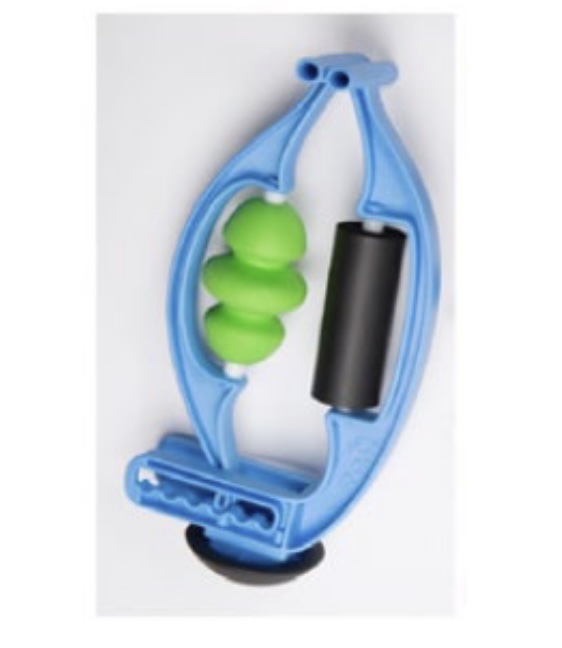
The original version of the Rolflex. Source: CAFC opinion.
The U.S. Court of Appeals for the Federal Circuit (CAFC) on Monday issued a precedential decision affirming a district court’s grant of summary judgment of non-infringement to Armaid Company, Inc. that its massage product did not infringe Range of Motion Products LLC’s (RoM’s) design patent claims. The opinion was authored by Judge Cunningham and Chief Judge Moore delivered a dissent in which she claimed her court has caused “the legal frame of reference” in design patent law cases to become “askew.”
RoM owns U.S. Design Patent No. D802,155, titled “Body Massaging Apparatus,” and sued Armaid in the U.S. District Court for the District of Maine, alleging that Armaid’s Armaid2 device infringed the claims of its patent, which are embodied in RoM’s Rolflex massage product. The district court determined that “many, but not all, of the design features in the D’155 patent—which the Rolflex embodied—are driven by function,” and that “the overall . . . scope of the claim is accordingly narrow,” and ultimately granted Armaid’s request for summary judgment of non-infringement.
On appeal, RoM argued that the district court erred in its claim construction “by eliminating entire structural elements from the claimed design.” But even if the claim construction was correct, RoM said the design of Armaid’s accused product is substantially similar to the Rolflex.
The CAFC agreed with the district court that the evidence in the record supported the finding that the shape of the arms claimed in the design patent is functional. The claims cover “limb-massaging apparatus[es]” with arms that “are shaped and dimensioned to adjustably clamp a limb between said first and second massaging members.”
Terry Cross, the owner of Armaid, obtained U.S. Patent No. 5,792,081, a utility patent that was titled “Limb Massager” and embodied by an earlier version of the accused product, the Armaid1. Cross provided an affidavit identifying “functional aspects of the Rolflex that enabled it to massage the entire body, as opposed to just the arms, such as ‘the overall clamshell appearance of the arms, including an increased curve of the therapy arm.’”
To the extent the D‘155 patent is the progeny of the ‘081 patent, the district court reasoned that the D‘155 patent inherited these functional aspects. RoM additionally provided marketing materials that explained that Rolflex’s “clam-shaped roller arms provide significant leverage.” The district court therefore concluded that “the ‘clamshell’ shape of the arms was functional, but that other features ‘appear to be largely ornamental,’ such as ‘the thick ridged outline’ of the design (which includes the arms).”
RoM argued on appeal, however, that the evidence “unambiguously demonstrates that the shape of the arms is ornamental.” RoM said that the drawings in the D’155 patent depict the claimed design in solid lines and depict “material disclaimed from the invention” in dashed lines. RoM also relied on the ‘081 patent, cited as prior art by the D‘155 patent, to prove that there are “clear examples of alternative designs for the D’155 patent.”
The CAFC rejected RoM’s arguments, first explaining that its assertion about the patent drawings “effectively contends that all elements depicted by the solid lines are ornamental, and all elements depicted by the dotted lines are functional,” which would suggest courts have to accept such depictions without question and “would render meaningless the ‘helpful’ practice of distinguishing between functional and ornamental aspects of the design.” RoM’s reasoning would also mean courts are bound by examiner findings on functionality and would make moot the factors set forth in PHG Techs., LLC v. St. John Cos., 469 F.3d 1361, 1366–67 (Fed. Cir. 2006) for determining functionality.
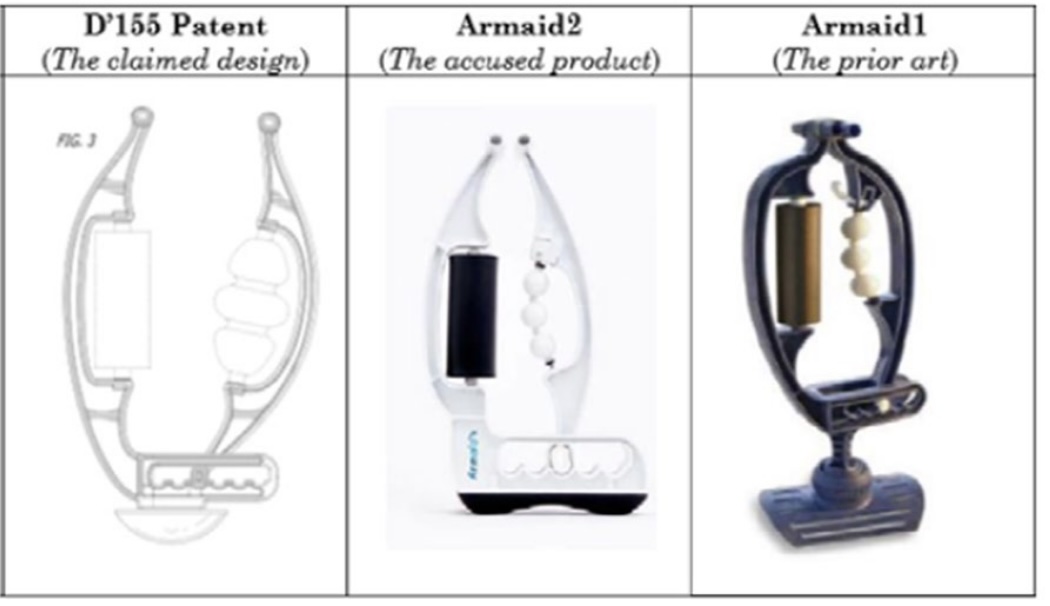
The CAFC further ejected the suggestion that the existence of alternative designs is dispositive as to functionality. “RoM’s position is based on a misreading of our case law,” said the opinion. “The case on which RoM primarily relies, Ethicon, does not support the existence of alternative designs as a threshold inquiry.” While it is a factor, the existence of alternative designs is just one factor courts can consider. The court also disagreed that the ‘081 patent was a feasible alternative design given it was titled “Limb Massager” while the D’155 patent is titled “Body Massaging Apparatus.”
As to whether the designs of the two products were substantially similar enough to withstand summary judgment of non-infringement, the majority said that “RoM and the dissent advocate for an approach that fails to respect the limits on a design patent’s scope.”
The CAFC said that RoM and Moore both argued that a mere side by side comparison of the two designs could determine that there is “substantial evidence of infringement” but that this approach does not take into account claim construction or separate out functional aspects. “By failing to ensure that functional aspects of a design do not play a role in the infringement analysis, the test endorsed by RoM and the dissent improperly seeks ‘to extend the scope of the patent far beyond the statutorily protected ‘new, original and ornamental design,’” wrote the CAFC.
Such reasoning would rule out summary judgment whenever functional aspects result in two designs sharing similarities, and would “render pointless our requirement to construe the claim.” The majority explained: “We reject the proposal to establish what amounts to an oversimplified version of the ordinary observer test that effectively eliminates the step of claim construction.” Detailing the district court’s analysis, the majority then concluded that the court did not reversibly err.
Moore Dissent: We’ve Created a Problem
In her dissent, Chief Judge Moore disagreed and said the district court erred by taking away the fact question of whether an ordinary observer would find the two designs to be substantially the same. Moore also identified a broader problem with the CAFC’s design patent jurisprudence:
“I confess that I considered ending the dissent here….
But alas, I have more to say. I believe there exists a small and easily solved problem in our design patent law that led the district court astray. A problem, which I confess, has infected several of our cases and which has been the subject of several amicus briefs to our court….
Without realizing it, in Egyptian Goddess, we meaningfully changed the substantial similarity test. We changed the frame of reference from whether two designs are substantially similar in overall appearance to whether two designs are ‘sufficiently distinct’ or ‘plainly dissimilar.’”
According to Moore, recent briefs and surveys presented to the CAFC underscore this problem, and the court’s tendency to affirm summary judgment and take the decision away from jurors in design patent cases “appears representative of a much broader trend.”
Moore added: “I think we ought to correct our error in Egyptian Goddess and reaffirm that the substantially similar test, announced by the Supreme Court in Gorham, is ‘the sole test.’”
![[Advertisement]](https://ipwatchdog.com/wp-content/uploads/2026/04/ClearstoneIP-May-14-2026-sidebar-700x500-1.jpg)
![[Advertisement]](https://ipwatchdog.com/wp-content/uploads/2026/04/Virtual-AI-2026-May-18-19-2026-sidebar-700x500-1.jpg)
![[Advertisement]](https://ipwatchdog.com/wp-content/uploads/2026/05/Patent-Masters-2026-sidebar-early-bird-price-700x500-1.jpg)








![[Advertisement]](https://ipwatchdog.com/wp-content/uploads/2021/12/WEBINAR-336-x-280-px.png)
![[Advertisement]](https://ipwatchdog.com/wp-content/uploads/2021/12/Ad-4-The-Invent-Patent-System™.png)






Join the Discussion
No comments yet.