
![[IPWatchdog Logo]](https://ipwatchdog.com/wp-content/themes/IPWatchdog%20-%202023/assets/images/temp/logo-small@2x.png)
All Posts
The Patent Estate Problem: Why Litigation Finance Is the Only Preservation Tool American Inventors Actually Have
Congress and the courts have spent two decades treating patents as active weapons in an ongoing commercial fight. That framing misses what patents actually are to most of the people who own them: inheritable property. Twenty-year terms outlast careers. Portfolios pass to spouses, children, foundations, and trusts. Licensing income can support a family for a generation after the inventor stops working…. The pending fights over funder disclosure — Suggestion 26-CV-8 before the Advisory Committee on Civil Rules, the USITC’s proposed 19 C.F.R. § 210.14a, and S.3826, the Litigation Funding Transparency Act of 2026 — are not really arguments about transparency. They are arguments about whether a solo inventor’s family keeps what the inventor spent 30 years building.
Scott Moskowitz
September 10, 2026
 5
5
What Does a Patent Notice Letter Actually Require? Understanding ‘Actual Notice’
To prevent innocent individuals from being held liable while acting in good faith, the patent statute requires that patent owners put would-be infringers on notice of their intellectual property rights before they are able to hold them liable for any acts of infringement. But what does a notice letter need for it to count? How granular must it be? Are claim charts required?
Will AI Data Centers Become the Next Patent Battleground? | IPWatchdog Unleashed
This week on IPWatchdog Unleashed, I spoke with Hilary Preston. Our conversation focused on the rapidly expanding AI data center ecosystem and the technology, infrastructure, and intellectual property risks emerging as billions of dollars flow into the sector.
Gene Quinn
September 9, 2026
0
China Outshines U.S. With More Top Innovation Clusters in WIPO Global Innovation Index
Yesterday, the World Intellectual Property Organization (WIPO) released its 2026 Global Innovation Index (GII) identifying metropolitan clusters around the world seeing the highest levels of innovation activity as judged by publications and R&D investments. This year’s Index underscores the growing tech dominance of China, which accounted for one-quarter of the top 100 innovation clusters in this year’s survey of top tech and innovation hubs around the world.
Steve Brachmann
September 9, 2026
1
ARIPO vs. OAPI: What U.S. Companies Need to Know Before Building an Africa IP Strategy
Every year, U.S. companies expanding into Africa make the same planning mistake: they treat the continent as though it has one intellectual property system. It has two, and choosing the wrong one, or failing to choose at all, can leave a brand or invention unprotected across dozens of countries a company assumed it had already covered. Africa is the only continent with two regional IP registration systems operating side by side. Understanding the difference between them is not a technical footnote. It is one of the first strategic decisions a U.S. company should make before it files anything.
Amara Oparah
September 9, 2026
0
CAFC Affirms Fee Award Over Deficient Patent Pre-Suit Investigation
The U.S. Court of Appeals for the Federal Circuit (CAFC) issued a decision today in Viavi Solutions Inc. v. Platinum Optics Technology Inc., affirming a Northern District of California ruling that awarded attorney’s fees to Platinum Optics Technology Inc. (PTOT) after finding Viavi Solutions Inc. litigated its patent infringement claims in a manner that met the standard for an “exceptional” case under 35 U.S.C. Section 285.
Rose Esfandiari
September 8, 2026
0
Smucker’s Survives Motion to Dismiss: What the Uncrustables Trade Dress Fight Means for the Private Label Economy
On September 1, a federal judge in the Northern District of Ohio J.M. Smucker Co.‘s trademark and trade dress claims over its crustless, crimped-edge peanut butter and jelly sandwiches. The ruling allows that was filed last October against Trader Joe’s private-label “Crustless Peanut Butter & Strawberry Jam Sandwiches” to proceed to discovery and, potentially, a merits determination on whether a sealed, circular sandwich shape can function as a protectable trademark.
Grace Lamendola
September 8, 2026
2
Correcting the Uncorrectable: AI-Assisted Inventorship and Section 256
Under 35 U.S.C. Section 256, one can only correct an inventorship error when the underlying facts and the affected parties can actually be identified, and when the statutory correction procedure can be completed. AI-assisted invention is starting to produce cases where none of that is possible: the development record shows plenty of human activity, but nothing in it establishes which person actually conceived the claimed invention. After Fortress Iron, LP v. Digger Specialties, Inc., No. 2024-2313 (Fed. Cir. Apr. 2, 2026, that kind of gap can turn into a validity problem, not just a paperwork one.
Paul Atamewan
September 8, 2026
3
How to Outsmart the Trap of Chinese Support Requirements
In a previous article, the authors showed that Chinese courts ask a different question than U.S. courts — not whether the inventor possessed what is recited in the claim, but whether the scope of the claim matches the Technical Solution that the invention actually contributed to the advance of the art. This difference in underlying premise leads to one conclusion: a U.S.-style specification needs to be adjusted when filed in China. Below, the authors propose several strategies, offered as their personal views.
Other Barks & Bites for Friday, September 4: D.C. Circuit Affirms Medical Device TPM Circumvention; U.S. Earns High Ratings in IP Index Statistic Annex; and Microsoft Edge is Not Important Gatekeeper Under DMA
This week in Other Barks & Bites: a House IP Subcommittee hearing on restoring the USPTO’s fee-setting authority turns heated over the original intention behind the America Invents Act; the Eleventh Circuit affirms a permanent injunction and trademark cancellation in an infringement case brought by the maker of “Wolf”-brand electric scooters; the United States scores high marks across 33 economic indicators in the U.S. Chamber of Commerce’s recently released Statistical Annex to the International IP Index; the European General Court finds that Microsoft’s Edge browser is not an important gateway subject to regulations under the Digital Markets Act; the D.C. Circuit Court of Appeals affirms the Library of Congress’ recent triennial rulemaking allowing circumventions to technological protection measures for medical devices; and Microsoft breaks out financial figures for its Azure cloud division for the first time in its most recent quarterly earnings report.
Steve Brachmann
September 4, 2026
0
Federal Circuit Affirms Judgment that Swiss Pharma Company Did Not Infringe Iron Deficiency Therapy Patent Claims
The U.S. Court of Appeals for the Federal Circuit (CAFC) issued a decision today in Biofer S.p.A. v. Vifor (International) AG affirming a judgment of non-infringement by the U.S. District Court for the Eastern District of New York in favor of Swiss Pharmaceutical company, Vifor (International) AG. The dispute centered on the construction of a claimed pH range recited in a patent covering a process for producing iron-sugar complexes used to treat iron deficiency.
Rose Esfandiari
September 3, 2026
0
CAFC Finds Most Patent Owner Arguments Forfeited in Vitamin D Baby Drops Appeal from PTAB
Yesterday, the U.S. Court of Appeals for the Federal Circuit issued a ruling in Vieth v. MOM Enterprises, LLC affirming the Patent Trial and Appeal Board’s (PTAB) invalidation of Elaine and Dr. Reinhold Veith’s patent claims to methods of administering vitamin D to human beings. The Federal Circuit agreed that most of the claim construction and prior art arguments raised by the Vieths on appeal were forfeited for not being properly developed in the proceedings below, and also dismissed the Vieths’ contentions that they had established nexus between industry praise for its products and the challenged method claims.
Steve Brachmann
September 3, 2026
0
DOJ Sides with OpenAI, Warns Obstacles to AI Development Threaten National Security
On September 1, the U.S. Department of Justice (DOJ) filed a Statement of Interest urging the U.S. District Court for the Southern District of New York to hold that using copyrighted written works to train large language models (LLMs) is fair use, arguing that a contrary result would distort copyright law, suppress innovation and weaken U.S. competitiveness and national security. The statement was filed in reference to the multidistrict copyright litigation against OpenAI, although it specifically addressed claims by The New York Times and said its reasoning also applies to the related cases involving book authors and publishers.
Eileen McDermott
September 3, 2026
0
Issa Hesitant to Renew USPTO Fee-Setting Authority Amid PTAB Changes
The House Judiciary Committee’s Subcommittee on Courts, Intellectual Property, Artificial Intelligence, and the Internet held an oversight hearing today to consider its role in renewing the U.S. Patent and Trademark Office’s (USPTO’s) fee setting authority. Throughout the hearing, Subcommittee Chairman Darrel Issa (R-CA) expressed skepticism about USPTO Director John Squires’ recent changes to discretionary denial practice at the Patent Trial and Appeal Board (PTAB) and wondered whether renewal of such authority under the America Invents Act (AIA) should be conditioned on reforms to the agency’s policy.
Eileen McDermott
September 2, 2026
4
OpenAI Sued Over AI Patents Covering Retrieval, Personalization and Content Generation
Many Worlds 2T Innovations LLC has filed a patent infringement lawsuit against OpenAI OpCo, LLC, alleging that OpenAI’s artificial intelligence products and services infringe five AI patents covering personalized search, vector-based retrieval, recommendation systems and probabilistically controlled content generation. The complaint, filed August 31, 2026, in the U.S. District Court for the Eastern District of Texas, Marshall Division, seeks a jury trial, monetary damages in the form of past and continuing royalties, enhanced damages for alleged willful infringement, and an injunction prohibiting continued infringement.
Gene Quinn
September 2, 2026
0
Varsity Sponsors
![[Advertisement]](https://ipwatchdog.com/wp-content/uploads/2026/09/WE-BUY-PATENTS-SIM-IP-Ad-1-700x500-1.jpeg)
![[Advertisement]](https://ipwatchdog.com/wp-content/uploads/2026/09/Life-Sciences-2026-sidebar-early-bird-price-700x500-1.jpg)
From the IPWatchdog Institute
![[Advertisement]](https://ipwatchdog.com/wp-content/uploads/2024/09/Patent-Prosecution-Training-sidebar-700x500-2025-03-27.jpg)

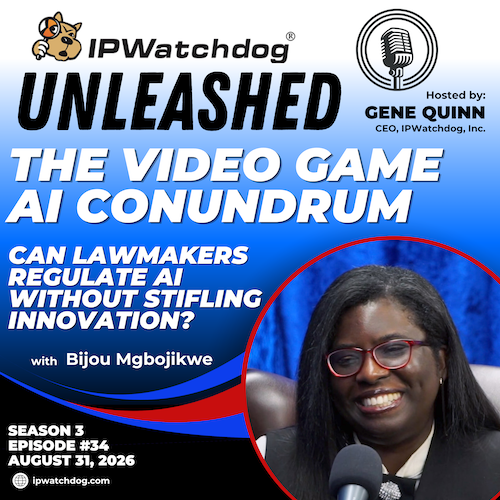
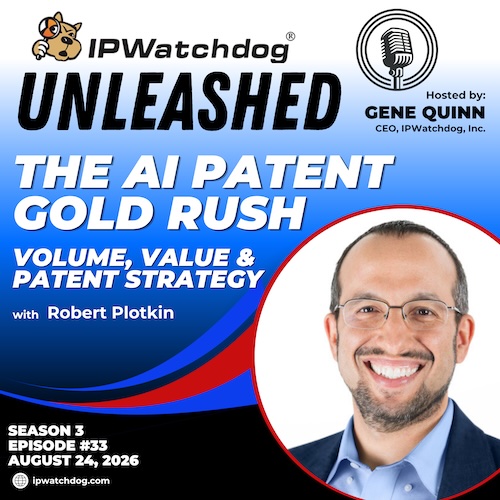
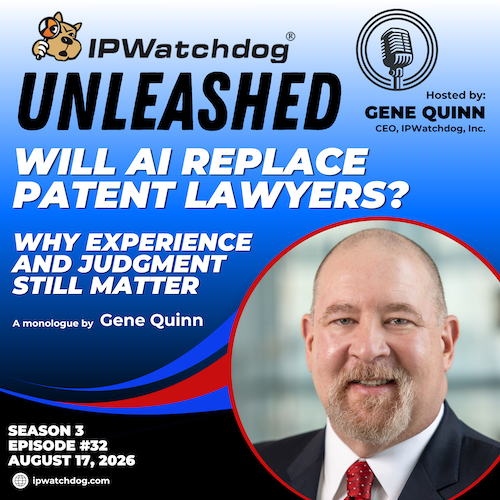
Latest Podcasts




IPWatchdog Events
Webinar: AI for Patent Licensing – Beyond Statistical Triage to Evidence-Grounded Product Analysis
October 1 @ 12:00 pm - 1:00 pm EDTCLE Webinar: Protecting the Product – Mapping Features to Patent Claims and Closing Coverage Gaps
October 13 @ 12:00 pm - 1:00 pm EDTCLE Webinar: How to Prompt AI – University IP Workflows in Action
October 15 @ 12:00 pm - 1:00 pm EDT