
![[IPWatchdog Logo]](https://ipwatchdog.com/wp-content/themes/IPWatchdog%20-%202023/assets/images/temp/logo-small@2x.png)

 6
6 “Every judge who gets crosswise with her chief judge or her colleagues must now worry whether similar tactics could be used to remove them.” – NCLA Supreme Court petition
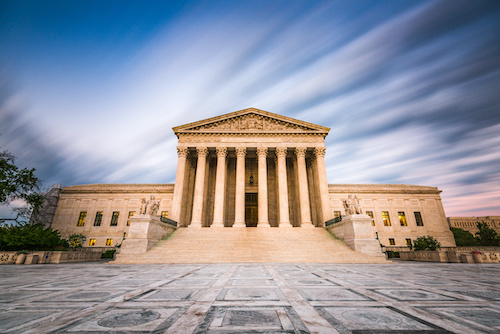 The New Civil Liberties Alliance (NCLA) has filed a petition for a writ of certiorari asking the U.S. Supreme Court to review its case against U.S. Court of Appeals for the Federal Circuit (CAFC) Chief Judge Kimberly Moore for what the NCLA dubs the “unlawful” removal of Newman from her duties on the court.
In August 2025, the U.S. Court of Appeals for the D.C. Circuit affirmed a district court’s dismissal of Newman’s case against Moore, but the D.C. Circuit noted that “Judge Newman has posed important and serious questions about whether these Judicial Conduct and Disability Act proceedings comport with constitutional due process principles and whether her ongoing suspension comports with the structure of our Constitution.”
Newman has been battling Moore and the CAFC since April 2023. IPWatchdog was the first to break the news.
The Special Committee of the Judicial Council of the CAFC that is investigating Newman consists of Moore and Judges Prost and Taranto. In August 2023, the panel issued a 319-page report recommending the sanction of suspension and characterizing Newman’s refusal to submit to medical testing by the Committee’s selected doctors as “serious misconduct” that has “[t]hwarted the process Congress created for determining whether a life-tenured judge suffers from a disability.”
In May 2023, Newman filed a complaint in the United States District Court for the District of Columbia against the Special Committee, calling Moore’s original March 24, 2023, Order characterizing Newman as being unfit to carry out her duties on the court “riddled with errors” and cited 12 counts warranting claims for relief.
Newman appealed the July 2024 dismissal of her case against the CAFC in early December 2024, after the U.S. District Court for the District of Columbia in July of that year dismissed the remaining counts in her challenge.
The D.C. Circuit in its August 2025 decision agreed with the district court that it is 1) precluded by precedent in McBryde v. Committee to Review Circuit Council Conduct & Disability Orders of the Judicial Conference of the United States, 264 F.3d 52 (D.C. Cir. 2001) from deciding Newman’s statutory and as-applied constitutional challenges to the Judicial Conduct and Disability Act of 1980 and 2) that Newman’s facial constitutional challenge to the Act’s case-suspension provision fails because even Newman agreed that it has other constitutional applications. But the court also took pains to point out that it was not commenting on the merits of Judge Newman’s case or whether McBryde is good law.
The NCLA’s Supreme Court petition, filed Thursday night, poses two questions to the Court:
- Does 28 U.S.C. § 357(c)’s bar on judicial review of previously issued “orders” and “determinations” apply to ultra vires acts that exceed the scope of authority conferred by the Disability Act and the Constitution?
- Does 28 U.S.C. § 357(c)’s bar on judicial review of previously issued “orders” and “determinations” deprive a court of jurisdiction to consider claims that seek forward-looking relief to enjoin future unlawful actions?
“For three years the Federal Circuit has been operating short-handed because the judges of that court have summarily removed its longest-serving and most storied jurist (its ‘Great Dissenter’) from the bench,” said the NCLA petition.
“Every judge who gets crosswise with her chief judge or her colleagues must now worry whether similar tactics could be used to remove them,” it continued.
The petition argues in part that the orders and sanctions against Newman are ultra vires and thus not authorized by the Disability Act, but that “even if section 357(c) can be viewed as limiting the judiciary from disturbing the past orders or determinations of the judicial council, it allows litigants to seek prospective judicial relief that prevents the issuance of unlawful (or allegedly unlawful) orders in the future.”
The Judicial Council has so far issued three one-year suspension orders against Newman that bar her from hearing or taking part in cases, including en banc cases. The petition is seeking relief from the High Court to “hold that section 357(c) does not preclude jurisdiction over challenges to ultra vires orders and determinations” and to “hold that section 357(c) allows litigants to seek prospective relief that enjoins the issuance of future orders or determinations.”
The petition also argues that cert should be granted in light of the intervening decision in Bowe v. United States, 146 S. Ct. 447 (2026), which held that Congress must speak unambiguously about “jurisdiction-stripping provisions,” which must otherwise “be construed according to their enacted language…”
“Like the statute at issue in Bowe, the language of section 357 is ‘both narrow and specific,’ as it insulates only previously issued ‘orders and determinations’ from judicial review,” wrote the NCLA.
Finally, the petition argued that, since Newman, who was known as the court’s “great dissenter,” has been absent from cases, there has been a “dramatic effect on the number of dissents issued in the Federal Circuit.” According to a study by Professor Dennis Crouch cited in the petition, the rate of dissent in the Federal Circuit has dropped from 12% before Newman’s removal to 4%.
“This means that other judges are dissenting less often than they used to when Judge Newman was actively participating and setting a good example,” said the petition.
In a press release issued Thursday, NCLA President and Chief Legal Officer, Mark Chenoweth,called Newman’s case “the most important battle in America to restore judicial independence. If the Great Dissenter’s colleagues can remove her from the bench in this slipshod fashion, then other federal judges cannot be secure in their lifetime tenure. Judges everywhere are watching the Supreme Court closely to see what it does.” —
![[Advertisement]](https://ipwatchdog.com/wp-content/uploads/2026/05/Protege-in-PatentSight-product-350x250-Ad-A.png)
![[Advertisement]](https://ipwatchdog.com/wp-content/uploads/2026/05/LexisNexis-Jun-11-2026-sidebar-700x500-1.jpg)






![[Advertisement]](https://ipwatchdog.com/wp-content/uploads/2021/12/WEBINAR-336-x-280-px.png)
![[Advertisement]](https://ipwatchdog.com/wp-content/uploads/2021/12/Ad-4-The-Invent-Patent-System™.png)





Join the Discussion
6 comments so far. Add my comment.
Ron Katznelson
March 17, 2026 05:07 pmWell-meaning comments by Curious and supporters are unfortunately detached from reality.
Adequate familiarity with technical issues is not a unique requirement in patent law–it is required in adjudicating disputes in many other areas of commerce, trade secrets, health, and sciences. Singling-out the Federal Circuit for judge tenure reform is equally misinformed, because any such change requires a Constitutional amendment away from appointments for life: “The Judges, both of the supreme and inferior Courts, shall hold their Offices during good Behaviour, and shall, at stated Times, receive for their Services, a Compensation, which shall not be diminished during their Continuance in Office.” U.S. Const., Art. III, §(1) (my emphasis). The Founders were well aware of the limits of age but also recognized the wisdom and experience that comes with it. More importantly, they recognized the loss of independence in judgement, were judges to expect term limits and subsequent careers in industries affected by their decisions while in office.
Rather, the reform necessary in Federal Circuit jurisdictional law should be by preventing this single group of a few judges from having an exclusive chokehold on all patent appeals while suppressing internal dissents, thereby thwarting basic checks on their decisions. This is particularly problematic given the lack of “Circuit Splits” to encourage Supreme Court intervention. These problems at the Federal Circuit became more severe in the last decade, and it is time to seriously consider returning jurisdiction on patent appeals to the individual Circuits from which they arise. This venue diversity reform would inherently increase the pool and age diversity of appellate judges reviewing patent cases, just as the practice in non-patent cases.
Pro Say
March 16, 2026 08:51 pmBig +1 Curious.
BobM
March 16, 2026 01:42 pmI agree with most of what Curious says, and I’d apply this to the Supreme Court too. Some age (70?) should be the limit. I think the time limit might be longer, like 6 years. But there should be some limit.
And technology is advancing so quickly, it’s hard for even people like me, who draft in high tech areas all the time, to keep up. I can’t see judges keeping up.
Curious
March 16, 2026 10:42 amTo be clear, I have the utmost respect for Judge Newman — I would have loved to have her on any of the cases I’ve brought before the Federal Circuit. I also think she was grossly wronged by the CAFC, and actions like what the CAFC did should not go unchallenged.
All that being said, I believe the CAFC desperately needs new (younger) blood.
By next year, 3 out of the 12 judges (Newman, Lourie, Dyk) will be at least 90 years old and 6 out of the 12 judges (adding Prost, Reyna, and Taranto) will be at least 70 years old. The CAFC has grown stale and out of touch with modern technology. From reading the opinions of these judges, it appears that many of them struggle to understand even the most rudimentary concepts of the technologies involved. Bad law follows bad understanding of the underlying facts.
This is hardly a new proposal, but the CAFC is in desperate need of reform. We should have an appeals court that handles intellectual property issue and a separate court that handles everything else. We should have judges on the intellectual property side that have some type of technology background.
While I’m addressing it, we should rotate out a judge every 2 years. With 12 judges, that would mean a maximum term of 24 years. Every sitting President should have the opportunity to appoint 2 judges per 4-year term.
Pro Say
March 13, 2026 12:56 pm+1 Anon. They’re hoping she’ll die soon; taking her constitutionally-sound case to the grave with her.
The other CAFC judges should be jailed for what they’ve done to Judge Newman.
Anon
March 13, 2026 11:30 amA battle of nearly three years – at this stage of her life – borders on the criminal in my mind.
That the Chief Judge of the CAFC has such a callous disregard for the appearance of malfeasance is quite insane.
Add Comment