


 0
0 “[A]mici note that as a practical matter, patent validity cannot be challenged at the PTAB through IPR proceedings if that patent has been in force for at least six years.”
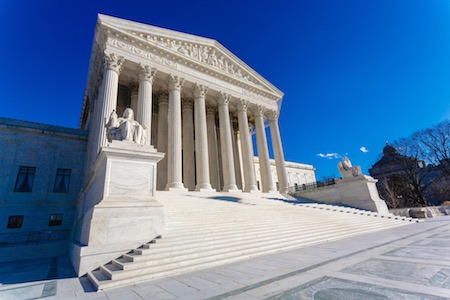 On Friday, a series of computer and automotive industry trade organizations representing most of the top filers of inter partes review (IPR) proceedings at the Patent Trial and Appeal Board (PTAB) filed a brief with the U.S. Supreme Court urging the Court to grant Google’s petition for writ of certiorari that ultimately challenges the PTAB’s “settled expectations” doctrine as developed under the current U.S. Patent and Trademark Office (USPTO) administration. The amici filing reiterates many of Google’s cert arguments on the USPTO’s statutory authority that would detract from improvements to patent title certainty wrought thus far during Director Squires’ tenure, as pointed out by independent inventors facing PTAB challenges similar to server migration solution developer VirtaMove.
Denials Based on Discretionary Factors Are “Dismantling” System of Patent Review
Google’s cert petition follows a two-page Federal Circuit ruling entered this January that denied Google’s petition for mandamus relief from the PTAB’s denial of Google’s IPR petitions filed to challenge VirtaMove’s U.S. Patent No. 7519814, System for Containerization of Application Sets. Google’s petition was denied based in part on VirtaMove’s settled expectations in patent rights that have been in force for 14 years. The Federal Circuit denied Google’s mandamus petition on the grounds that Google had not shown it was entitled to relief under Celgene Corp. v. Peter, a 2019 case holding that the establishment of IPR proceedings by the America Invents Act (AIA) did not pose an unconstitutional taking even though they invalidated patent rights that were issued prior to the AIA taking force. Although Celgene did not address the limits of denial-of-institution determinations, the Federal Circuit cited it while noting that it has similarly rejected other petitions for mandamus relief challenging the PTAB’s settled expectations doctrine.
This April, Google filed its cert petition presenting two questions for the Court’s review: whether the USPTO lacks statutory authority to deny validity challenges based on a patent’s settled expectations when relevant patent statutes allow for administrative review across the life of the patent; and whether the federal judiciary has authority to review IPR denials by the USPTO based on grounds contrary to statute.
The more recent amicus filing supporting Google’s petition, which lists former USPTO Acting Director Joseph Matal as counsel of record, argues that the USPTO’s settled expectations doctrine goes much further than violating the agency’s authorizing statute. Trying not to “overstate the violence that the USPTO’s leadership has done to [AIA] patent reviews during the past year,” amici note that as a practical matter, patent validity cannot be challenged at the PTAB through IPR proceedings if that patent has been in force for at least six years. According to amici, a total of 201 IPR denials based on settled expectations, and another 302 IPR and post-grant review (PGR) petitions denied based on agency discretion, is “dismantling the congressionally enacted system of patent validity review.”
Amici also points out that the USPTO has changed rules governing deadlines for a party to file an IPR petition after being named a defendant in patent infringement litigation in U.S. district court. Despite the one-year deadline for filing IPR petitions clearly codified in 35 U.S.C. § 315(b), amici note that the USPTO has implemented time-to-trial statistics in U.S. district courts handling parallel infringement litigation in analyzing conditions for discretionary denial of IPR petitions even when statutory deadlines are met. The industry organizations’ brief further notes 280 IPR and PGR petitions denied based on this new time limit since it was officially promulgated by the agency last March. These rules arguably benefit patent owners suing in Eastern Texas, which has an average time-to-trial of about 22 months, which leaves defendants with four months to file a validity challenge under the USPTO’s new timing rules. Other extra-statutory rules surrounding third-party and assignor estoppel have further contributed, leading to a total of 770 IPR or PGR petitions denied for discretionary reasons since the new timing rules were established.
Timing of Challenge to PTAB’s Precedential Decision-Making Raises Sharp Questions
As was highlighted by independent inventor Molly Metz and leading IP strategist Erich Spangenberg in an IPWatchdog post this May, these arguments about the settled expectations doctrine make a certain sense, but the timing of this challenge from Google and Google’s ilk raises sharp questions. PTAB decision-making has been shaped through doctrinal PTAB cases like Sotera or Fintiv designated precedential by the agency. Now that settled expectations, which is actually providing the kind of certainty in patent title that independent inventors like Metz claim would have saved her business prospects, is in the crosshairs of Google’s petition, Metz questioned whether the groups advocating for Google’s position are advocating for positive overall improvements to the U.S. patent system.
The trade organization’s brief lists as amici the Computer & Communications Industry Association (CCIA), the High Tech Inventors Alliance (HTIA), and US*MADE. Google is a member publicly listed both by the CCIA and the HTIA, and the membership for both include a veritable who’s-who of the top IPR petitioners at the PTAB: Samsung, Apple, Microsoft, Intel, Micron, Cisco, Comcast are each among those top 10 IPR petitioners and are a member of one or both of those groups. Other amici named on this brief include the Alliance for Automotive Innovation, which lists as a member Ford Motor Company, the largest filer of IPRs among U.S.-based carmakers. Ford and several CCIA and HTIA members are also members of US*MADE, which also claims as members other top IPR petitioners not mentioned here.
On the same day the CCIA/HTIA brief was filed, the PTAB Bar Association also filed an amicus brief urging the Court to grant Google’s petition. The Association, which represents counsel representing either side of IPR proceedings, largely reiterates the same arguments raised by the automotive and computer industries. The PTAB Bar Association adds that the USPTO’s supplantation of the federal legislature’s role in assuming authority to introduce discretionary considerations rises to the level of a constitutional issue as 35 U.S.C. § 314(a), cited in discretionary denials, is being interpreted as a grant of legislative authority when it is rather a limit on the Director’s authority to institute IPRs only when proper grounds for a validity challenge do not exist in the IPR petition.
This article was updated on June 1 to reflect that the settled expectations doctrine, which was first introduced by then-Acting Director Coke Morgan Stewart, was developed under the current USPTO administration and not solely Director Squires.
![[Advertisement]](https://ipwatchdog.com/wp-content/uploads/2026/10/BlackBox-IP-Oct-20-2026-sidebar-700x500-1.jpg)
![[Advertisement]](https://ipwatchdog.com/wp-content/uploads/2026/10/Questel-Oct-22-2026-sidebar-700x500-1.jpg)
![[Advertisement]](https://ipwatchdog.com/wp-content/uploads/2026/09/Life-Sciences-2026-sidebar-early-bird-ends-Oct-25-700x500-1.jpg)
![[Advertisement]](https://ipwatchdog.com/wp-content/uploads/2026/09/WE-BUY-PATENTS-SIM-IP-Ad-1-revised-on-Sep-28-2026-700x500-1.jpg)
![[Advertisement]](https://ipwatchdog.com/wp-content/uploads/2024/09/Patent-Prosecution-Training-sidebar-700x500-2025-03-27.jpg)






![[Advertisement]](https://ipwatchdog.com/wp-content/uploads/2021/12/WEBINAR-336-x-280-px.png)
![[Advertisement]](https://ipwatchdog.com/wp-content/uploads/2021/12/Ad-4-The-Invent-Patent-System™.png)







Join the Discussion
No comments yet.