
![[IPWatchdog Logo]](https://ipwatchdog.com/wp-content/themes/IPWatchdog%20-%202023/assets/images/temp/logo-small@2x.png)

 0
0 Bites (noun): more meaty news to sink your teeth into.
Barks (noun): peripheral noise worth your attention.
Want to have your doggie(s) featured in one of our future Barks & Bites Columns? Send your dogs photo(s) along with their name, breed (if you know it) and their age to dogwall@ipwatchdog.com. All photos will be added to the IPWatchdog Dog Wall at IPWatchdog Studios and will be added to the queue of images we select from each week.
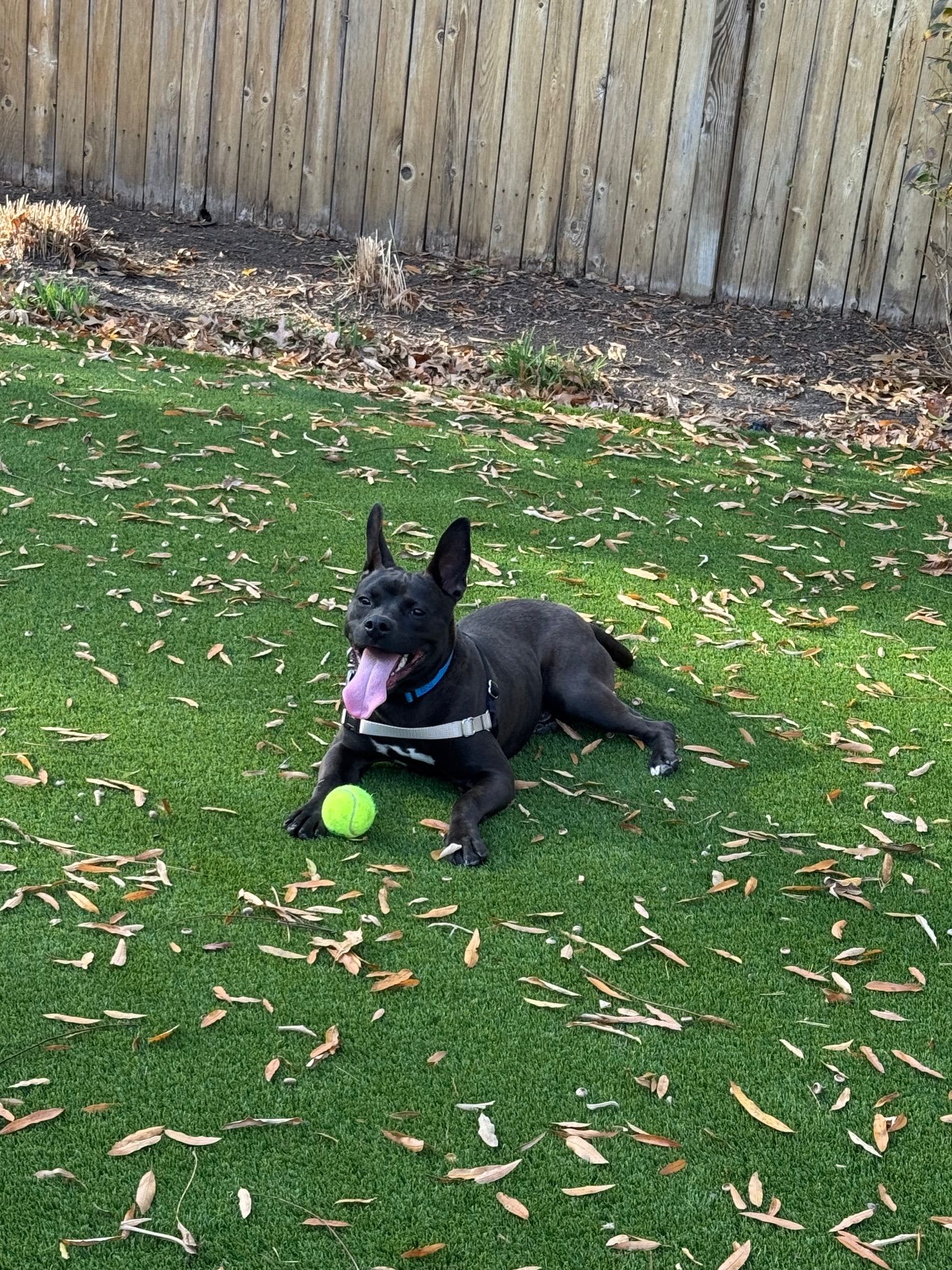
Matthew Rizzolo‘s 1 yo pitbull boxer mix – Rufus
This week in Other Barks & Bites: public interest groups voice their opposition to the PRO CODES Act for allowing private ownership of code standards incorporated by reference into public law; the Eleventh Circuit reverses the Middle District of Florida for failing to consider evidence of non-generic use in a cheerleading competition trademark case; the Federal Trade Commission files an amicus brief arguing that no specific intent is required to show that Johnson & Johnson’s patent acquisitions were anticompetitive; the European Patent Office publishes a study analyzing dozens of landmark cases on licensing rate determinations for standards-essential patents; Micron posts blockbuster earnings during its recent fiscal third quarter due to high memory chip demand by AI hyperscalers; the U.S. Patent and Trademark Office will begin requiring parties filing petitions to excuse unintentional delays to explain the circumstances of such delays lasting more than one year; and the European Union Intellectual Property Office announces that a joint working group has officially endorsed a framework designed to help businesses secure financing for intellectual property and other intangible assets.
Bites
EPO SEP Licensing Study Shows Courts Moving From Defining to Applying FRAND – On Wednesday, June 24, the European Patent Office (EPO) Observatory published a study into the determination of fair, reasonable and non-discriminatory (FRAND) licensing rates for standards-essential patents (SEPs), analyzing 65 major court decisions issued from 2013 to 2025 and addressing key SEP licensing issues across seven jurisdictions, including 33 reasoned decisions in which courts set licensing rates for parties in SEP infringement cases. Among the study’s key findings include that courts across jurisdictions have converged on a shared conceptual framework for FRAND obligations with the focus for most jurists shifting from defining FRAND obligations to applying the FRAND framework, with comparable licenses and the top-down approach emerging as the two dominant methodologies for determining FRAND rates.
Public Interest Groups Signal Opposition to Contentious PRO CODES Act – On Wednesday, June 24, a coalition of public interest and industry groups including the Electronic Frontier Foundation, Association of Research Libraries, Center for Building in North America, R Street and the Center for Investigative Reporting sent a letter addressed to U.S. Representatives Jim Jordan (R-OH) and Jamie Raskin (D-MD), respectively the Chair and Ranking Member of the U.S. House of Representatives’ Committee on the Judiciary, urging opposition to the Protecting and Enhancing Public Access to Codes (PRO CODES) Act for giving private companies ownership over technical standards vested with the force of law by state legislatures. This bill has also raised opposition from organizations developing building standards like ASME, which has noted that the bill would force the online publication of otherwise copyright-protected standards incorporated by reference into municipal code across the country, eliminating revenues that support the standards-setting process and potentially shifting control over standards-setting to foreign adversaries.
Eleventh Circuit Finds Error in District Court’s Discounting Evidence of Non-Generic Use – On Wednesday, June 24, the U.S. Court of Appeals for the Eleventh Circuit issued a ruling in U.S. All Star Federation, Inc. v. Open Cheer & Dance Championship Series, LLC reversing a summary judgment ruling entered by the Middle District of Florida dismissing U.S. All Star Federation’s (USASF) trademark infringement claims after finding that USASF’s supplemental registration for “THE CHEERLEADING WORLDS” and its unregistered mark “WORLDS” were generic. The Eleventh Circuit found that the district court erred in failing to consider evidence of non-generic use proffered by USASF, finding that cases relied on by the district court to find evidence of non-generic use to be non-probative if only one relevant product exists on the market did not establish any such per se rule, remanding the case to Middle Florida district court for proper consideration of whether USASF’s marks are descriptive with acquired secondary meaning.
FTC Amicus Filing Argues No Specific Intent Required to Show Anticompetitive Stelara Conduct – On Tuesday, June 23, the Federal Trade Commission (FTC) filed an amicus brief in CareFirst of Maryland v. Johnson & Johnson, an appeal currently ongoing at the U.S. Court of Appeal for the Fourth Circuit involving antitrust claims filed under the Sherman Act and targeting Johnson & Johnson’s (J&J) allegedly anticompetitive conduct in acquiring patent portfolios owned by Momenta Pharmaceuticals and others to willfully maintain monopoly power over its blockbuster chronic inflammatory drug Stelara. The FTC’s brief argues that monopolization only requires a general intent to perform the acts that result in maintaining monopoly power, arguing that the district court erred in granting summary judgment to J&J after requiring proof of specific anticompetitive intent to exclude rivals on some basis other than efficiency, which the FTC argues is not required by U.S. Supreme Court precedent in antitrust cases.
Light & Wonder PTAB Precedential Ruling Creates 30-Day Deadline for All Director Review Requests – On Monday, June 22, U.S. Patent and Trademark Office (USPTO) Director John Squires issued an order marked precedential for the Patent Trial and Appeal Board (PTAB) in Light & Wonder, Inc. v. Evolution Malta Ltd., sua sponte initiating Director review and vacating institution of inter partes review (IPR) proceedings after finding that, though the PTAB correctly denied patent owner Evolution Malta’s motion to terminate IPRs in light of the district court’s invalidation of all patent claims challenged in IPR, it was inefficient to maintain Light & Wonder’s IPR petition as Evolution Malta’s claims have now been invalidated with prejudice at district court. In so ruling, Director Squires’ waived the deadline for requesting Director review of decisions to institute IPR so that such requests now have the full 30-day deadline of other requests for Director review, and held that the filing deadline may be further extended in exceptional circumstances where parallel district court proceedings have not progressed meaningfully.
EUIPO Working Group Endorse IP-Backed Finance Roadmap – On Monday, June 22, the European Union Intellectual Property Office (EUIPO) announced that the IP-Backed Finance Steering Group and Technical Working Group, organized jointly with the European Commission, had officially endorsed the European IP-Backed Finance Roadmap, an initiative to develop a practical pathway toward financing backed by intellectual property assets by improving how businesses report information about intangible assets. The Roadmap builds upon the work of the EUIPO’s study on IP-backed financing published this April, which recommended a series of policy initiatives to unlock critical financing for small- and medium-sized enterprises (SMEs) by addressing structural barriers preventing commercial lending institutions from using IP assets as financing collateral.
Barks
Hundreds of Regional Newspapers Sue Microsoft, OpenAI for Copyright Infringing AI Training – On Wednesday, June 24, a coalition of publishers representing nearly 400 local and regional newspapers filed a lawsuit in the Southern District of New York alleging claims of copyright infringement against Microsoft and OpenAI over those companies’ unauthorized scraping of copyrighted articles published online for use in training their generative artificial intelligence (AI) models.
USPTO Issues Non-Final Refusal of Caleb Williams’ “ICEMAN” Trademark – On Wednesday, June 24, the USPTO issued an office action including a non-final rejection for a trademark application filed by a holding company owned by Chicago Bears quarterback Caleb Williams for the standard character mark “ICEMAN,” finding a likelihood of confusion for a previously registered “ICEMAN” mark used in commerce on goods including insulated boots and shirts.
USPTO to Begin Requiring Explanation of Circumstances for Unintentional Delays of One Year – On Tuesday, June 23, the USPTO announced that it would be revising its practice surrounding petitions to revive applications or excuse other missed deadlines for unintentional delays, moving up the requirement to explain circumstances around those delays for petitions to excuse unintentional delays of one year from the previous two-year threshold for this requirement, with the new requirement set to take effect for any petitions filed on or after August 13 of this year.
Copyright Office Announces Copyright Essentials Webinar for July 15 – On Tuesday, June 23, the U.S. Copyright Office announced that registration had opened for its upcoming webinar, “Copyright Essentials: Copyright 101,” which will take place at 1 PM Eastern on Wednesday, July 15, as part of the Office’s educational series teaching copyright basics and key concepts to creators within various disciplines.
Tenth Circuit Reverses, Remands Charter School Trademark Case Over Ambiguous Contract – On Monday, June 22, the U.S. Court of Appeals for the Tenth Circuit issued a ruling in Ascent Classical Academies v. Lands’ End, Inc. reversing and remanding a ruling by the District of Colorado finding that defendant Ascent Classical Academy Charter Schools (ACACS) was permitted to continue using educational business trademarks owned by plaintiff Ascent, the appellate court finding that either parties’ interpretation of the disputed contract provision was reasonable and thus Ascent’s claim was unfit to be resolved at the motion to dismiss stage.
Music Licensing Group Sues Nvidia, Suno for Unauthorized Catalog Use in Training AI – On Monday, June 22, Luxembourg-based music licensing group Jamendo filed a copyright infringement lawsuit in the Northern District of California against chipmaker Nvidia and generative artificial intelligence (AI) company Suno, alleging that those companies made unauthorized use of music within Jamendo’s licensing catalog to train Nvidia’s Fugatto and Audio Flamingo music generating AI models.
This Week on Wall Street
Memory Boom Driven by AI Demand Leads to Blockbuster Third Quarter for Micron – On Thursday, June 25, American memory chipmaker Micron announced that the company earned $41.46 billion in third quarter revenues, nearly quadruple the $9.3 billion earned by the company during the same period last year and much higher than analyst expectations of almost $36 billion, with the company citing surging demand for memory chips created by AI infrastructure buildout by major hyperscalers.
Quarterly Earnings – The following firms identified among the IPO’s Top 300 Patent Recipients for 2025 are announcing quarterly earnings next week (2023 rank in parentheses):
- Monday: None
- Tuesday: Nike, Inc. (122nd)
- Wednesday: None
- Thursday: None
- Friday: None
![[Advertisement]](https://ipwatchdog.com/wp-content/uploads/2026/09/Patently-Sep-22-2026-sidebar-700x500-1.jpg)
![[Advertisement]](https://ipwatchdog.com/wp-content/uploads/2026/06/Womens-IP-Forum-2026-sidebar-regular-price-700x500-rev1.jpg)
![[Advertisement]](https://ipwatchdog.com/wp-content/uploads/2026/08/OneTransform_700x500_v1-REVISED.jpg)
![[Advertisement]](https://ipwatchdog.com/wp-content/uploads/2024/09/Patent-Prosecution-Training-sidebar-700x500-2025-03-27.jpg)





![[Advertisement]](https://ipwatchdog.com/wp-content/uploads/2021/12/WEBINAR-336-x-280-px.png)
![[Advertisement]](https://ipwatchdog.com/wp-content/uploads/2021/12/Ad-4-The-Invent-Patent-System™.png)




Join the Discussion
No comments yet. Add my comment.
Add Comment