
![[IPWatchdog Logo]](https://ipwatchdog.com/wp-content/themes/IPWatchdog%20-%202023/assets/images/temp/logo-small@2x.png)

 1
1 “Patentable subject matter is increasingly becoming a front-end strategic consideration rather than one left for prosecution.”
 The Canadian Intellectual Property Office (CIPO) has materially changed how examiners are instructed to apply the law on patentable subject matter. In March 2026, CIPO replaced its November 2020 practice notice on computer-implemented inventions, medical diagnostic methods, and medical uses. The 2026 notice represents an important development for current Canadian prosecution practice.
The 2026 notice incorporates a framework shift and catches up with several court decisions that have recently interpreted the underlying law. CIPO has folded the “actual invention” inquiry into purposive construction, rather than treating it as a separate analytical step, and continues to organize Canadian subject-matter analysis around a physicality requirement anchored in subsection 27(8) of the Patent Act. Dusome, which concerned a method for playing a card game either physically or on a computer, was a major driver of this recent practice notice. Consistent with Dusome, the notice moves the “actual invention” inquiry back into purposive construction, expressly disapplies MOPOP’s guidance relating to games, and formalizes the Schlumberger question for computer-implemented claims that lack physicality beyond the computer system itself.
Overall, Canada continues to maintain a relatively restrictive approach for software, artificial intelligence (AI), and medical-use claims, though Canadian diagnostics practice is generally more permissive than U.S. practice. The approach to medical uses may evolve, as the Supreme Court of Canada is considering the appeal in Pharmascience. This highly awaited decision is expected to provide further guidance on what constitutes a method of medical treatment.
For patentable subject matter, the USPTO continues to apply the Alice/Mayo framework set out in MPEP § 2106 (Alice Corp v. CLS Bank International, 573 U.S. 208 (2014); Mayo Collaborative Services v Prometheus Labs., 566 U.S. 66 (2012)). Separate memoranda addressing AI and recent examination practice supplement the framework rather than replace it. These updates instruct examiners to resolve close eligibility calls in favor of the applicant (August 4, 2025), encourage the use of subject matter eligibility declarations to overcome rejections under 35 U.S.C. § 101 through objective evidence of eligibility (December 4, 2025), and expand the concept of qualifying improvements beyond computer functionality to include improvements to a technology or technical field (December 5, 2025).
CIPO’s developments are of particular interest to practitioners managing global patent portfolios, including parallel U.S. and Canadian applications, as they highlight both the similarities and differences in the subject matter eligibility frameworks applied in each jurisdiction for computer implemented inventions. Understanding these distinctions can be important when coordinating cross-border drafting, filing, and prosecution strategies.
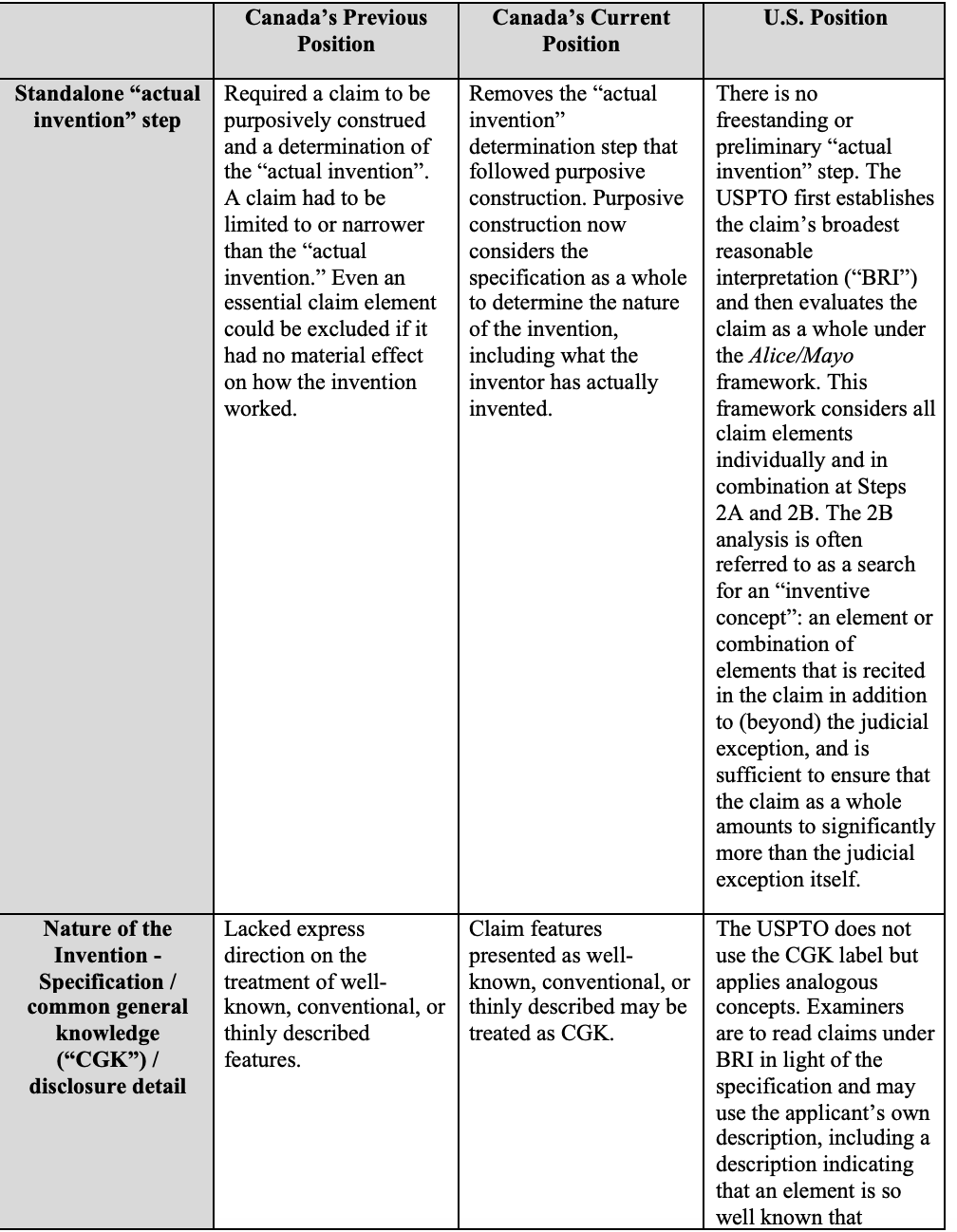
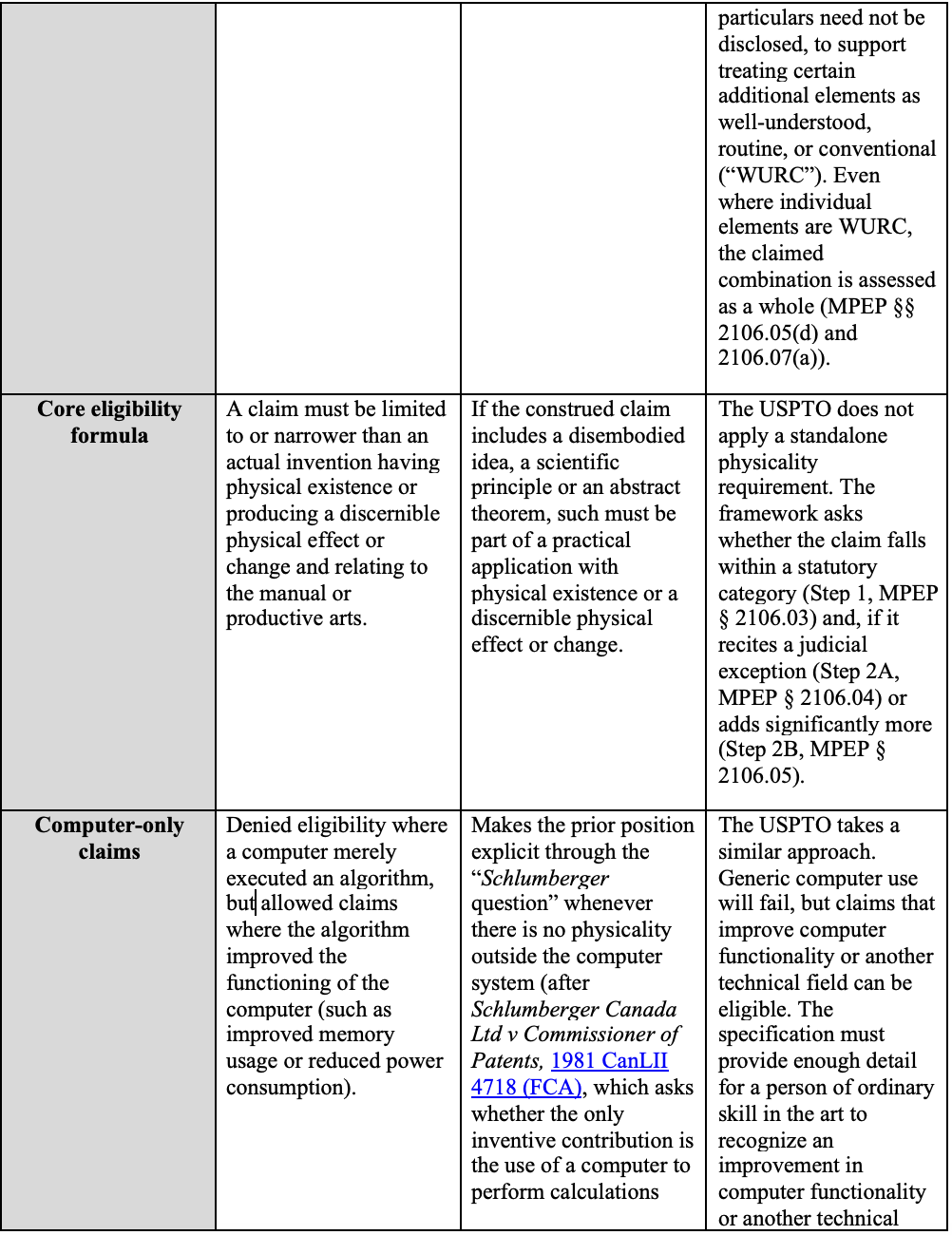
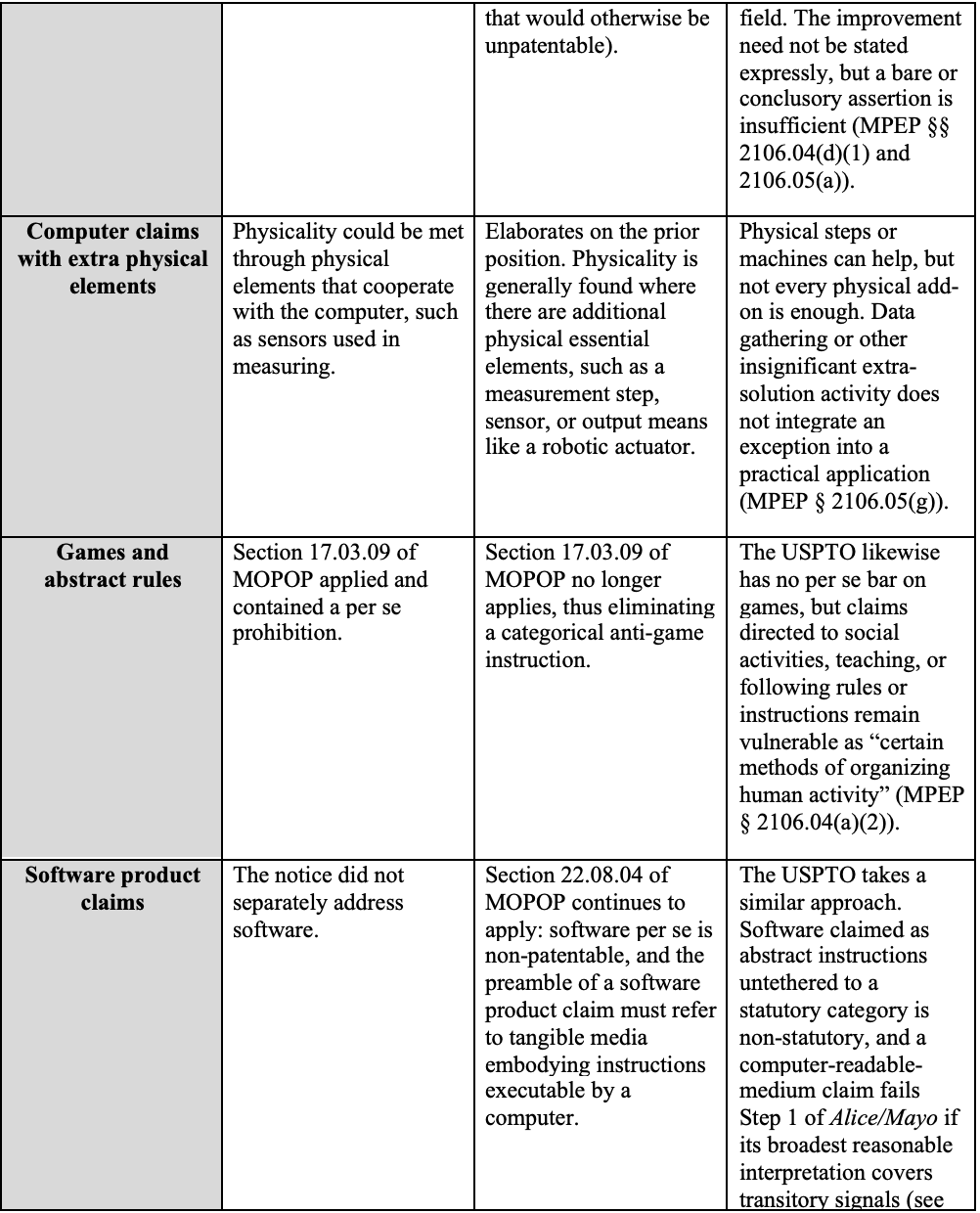
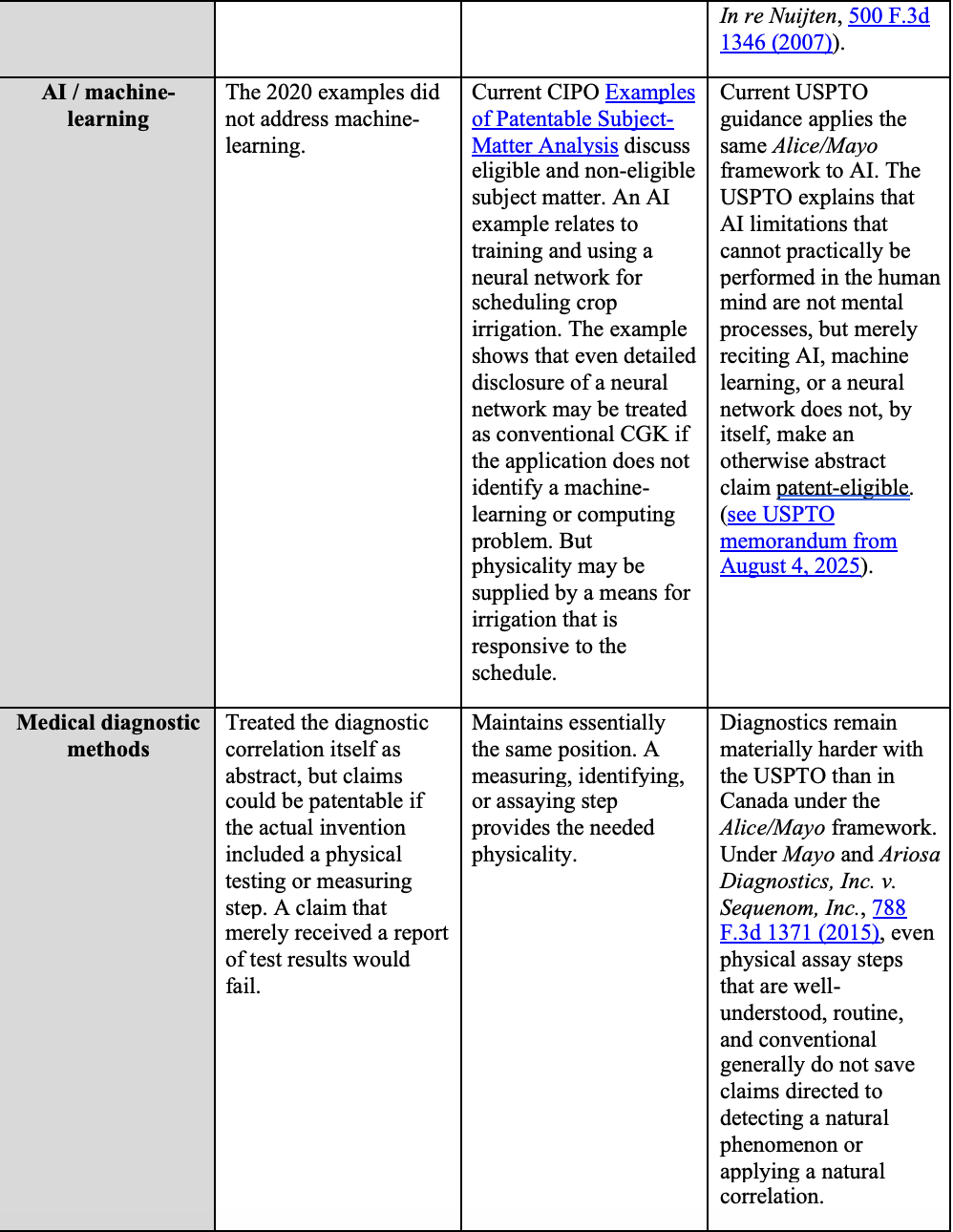
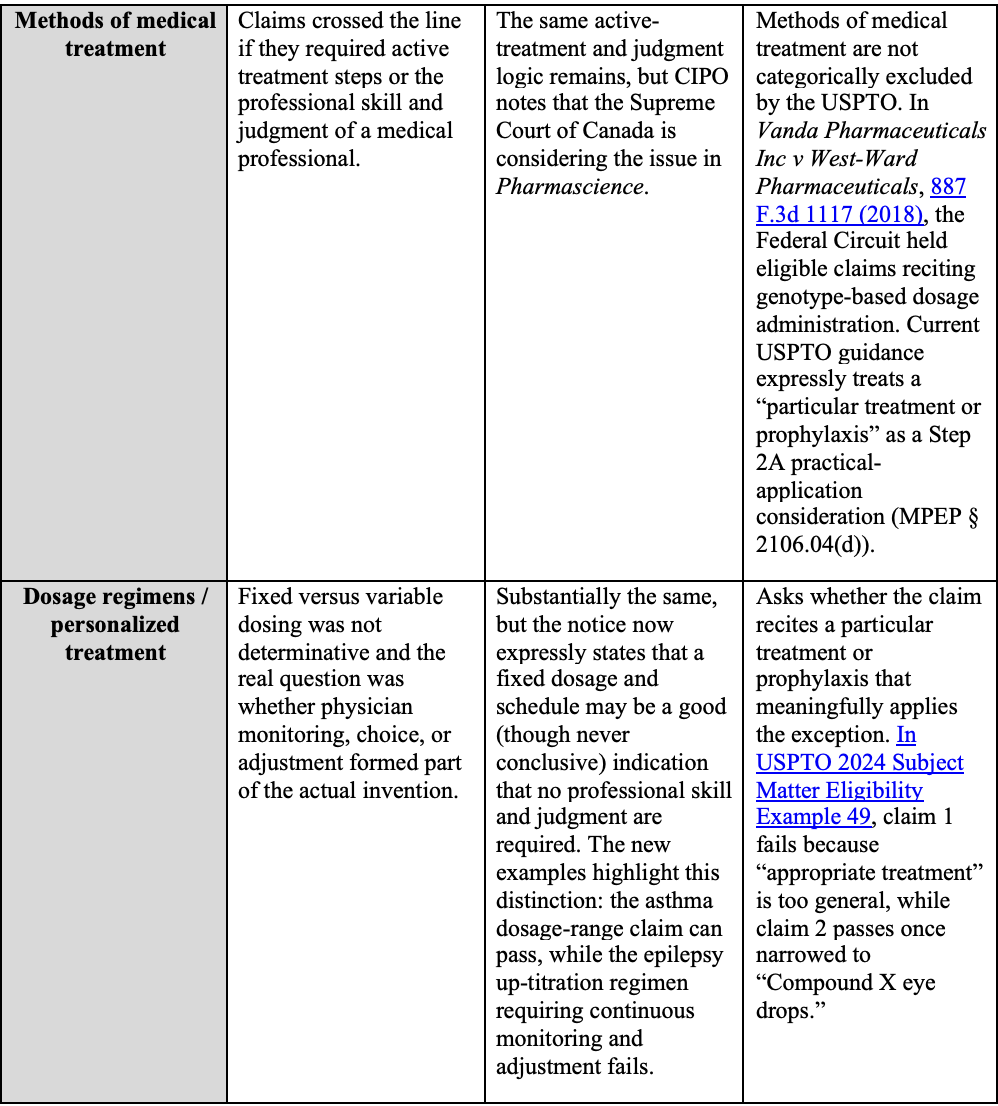
A detailed comparison table at the end of this article summarizes Canada’s prior framework, Canada’s updated approach, and U.S. practice across key subject matter categories.
In short, while both jurisdictions share similar concerns about abstract claims and generic computer use, Canada’s physicality-based framework and the U.S. Alice/Mayo framework can lead to different outcomes—making early attention to cross-border drafting considerations increasingly important.
Key Takeaways
While CIPO’s 2026 Practice Notice refines, rather than replaces, Canada’s existing approach to patentable subject matter, it does provide important insight into how patentable subject matter should be assessed by Canadian Examiners. Key changes include:
- No standalone “actual invention” analysis: This analysis has been folded into purposive construction.
- Physicality remains central: Physical existence or a discernible physical effect continues to underpin patent eligibility analysis.
- The Schlumberger question is now explicit: Where a computer is the only physical element, examiners are directed to assess whether the claimed contribution extends beyond the mere use of a computer.
- Common general knowledge matters more: Conventional or sparsely described features may receive less weight in the analysis.
- The practical impact remains to be seen: As examination guidance rather than binding law, its significance will ultimately depend on examination practice and future judicial consideration.
Patent Eligibility Starts at Drafting
If Canada is on your filing horizon, now is the time to rethink your drafting playbook. Under the 2026 guidance, patentable subject matter may increasingly need to be addressed at the drafting stage—not only during prosecution. Here’s how to mitigate eligibility risk from the outset:
- Ground the invention in tangible terms. Explain how the claimed method engages with hardware, what physical effects flow from it, and why the implementation goes beyond routine steps on a generic computer.
- Highlight physicality. Emphasize hardware interactions, measurements, sensors, or improvements to computer functionality wherever supported by the disclosure.
- Caution conventionality. Features characterized as “well-known” or “routine” may carry less weight in the eligibility analysis—describe them with care.
- Layer your claims. Include fallback positions anchored in non-computer physical elements and demonstrable computational improvements.
- Draft with Canada in mind. A specification optimized solely for U.S. practice may not provide the strongest foundation for Canadian eligibility.
A Growing Need for Cross-Border Alignment
As the table below illustrates, a claim set that feels comfortable under U.S. practice may need a slightly different drafting style in Canada. Canadian and U.S. approaches still align in many respects, with Examiners appearing to review counterpart prosecution when examining cases, but they diverge in others, such as medical diagnostic methods. Coordinated drafting and prosecution planning across jurisdictions may become increasingly important for global portfolio management.
Looking Ahead
The full impact of the 2026 guidance will emerge through examination practice and future judicial decisions, but one point is becoming clear: patentable subject matter is increasingly becoming a front-end strategic consideration rather than one left for prosecution. For applicants seeking Canadian patent protection for software, AI, fintech, and other computer-implemented technologies, early drafting decisions may significantly affect claim scope, prosecution flexibility, and long-term portfolio value.
See chart with hyperlinks here.


![[Advertisement]](https://ipwatchdog.com/wp-content/uploads/2026/10/IP-Copilot-Oct-13-2026-sidebar-700x500-1.jpg)
![[Advertisement]](https://ipwatchdog.com/wp-content/uploads/2026/10/Junior-Oct-15-2026-sidebar-700x500-1.jpg)
![[Advertisement]](https://ipwatchdog.com/wp-content/uploads/2026/10/BlackBox-IP-Oct-20-2026-sidebar-700x500-1.jpg)
![[Advertisement]](https://ipwatchdog.com/wp-content/uploads/2026/09/WE-BUY-PATENTS-SIM-IP-Ad-1-revised-on-Sep-28-2026-700x500-1.jpg)
![[Advertisement]](https://ipwatchdog.com/wp-content/uploads/2026/09/Life-Sciences-2026-sidebar-early-bird-date-corrected-700x500-1.jpg)
![[Advertisement]](https://ipwatchdog.com/wp-content/uploads/2024/09/Patent-Prosecution-Training-sidebar-700x500-2025-03-27.jpg)






![[Advertisement]](https://ipwatchdog.com/wp-content/uploads/2021/12/WEBINAR-336-x-280-px.png)
![[Advertisement]](https://ipwatchdog.com/wp-content/uploads/2021/12/Ad-4-The-Invent-Patent-System™.png)







Join the Discussion
One comment so far.
Anon
June 26, 2026 10:57 amFor the USPTO angle…
Alas, this: “Separate memoranda addressing AI and recent examination practice supplement the framework rather than replace it” is simply meaningless at the enforcement stage in front of the judicial branch (as opposed to obtaining a patent in the executive branch).