
![[IPWatchdog Logo]](https://ipwatchdog.com/wp-content/themes/IPWatchdog%20-%202023/assets/images/temp/logo-small@2x.png)
IPWatchdog and Industry Events
Promote your IP event on our Industry Events calendar for $129 Per Event

CLE Webinar: AI Prompts and Agentic Tools – In-House Workflows for Evaluating Patent Assertions
August 20 @ 12:00 pm - 1:00 pm EDT
Free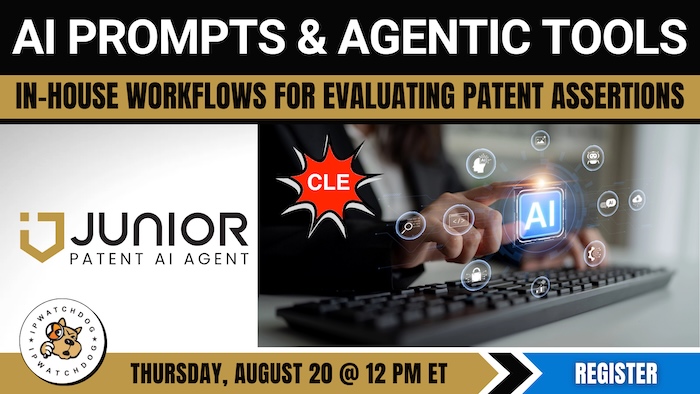
When a patent is asserted against a company, counsel is rarely given the luxury of time. A claim chart arrives from the other side, the patent is one no one on the team has lived with, and a preliminary read on exposure is needed quickly. Generative AI and purpose-built agentic tools can compress that first assessment substantially, but the compression comes from directing the analysis to the one part of the patent that actually decides the question, and from independently verifying everything the model returns.
Join us on Thursday, August 20, at 12 PM ET, for a skills-based program featuring live demonstrations of AI prompts and custom agentic tools being used to evaluate incoming patent assertions. Panelists will show attendees how to:
- Prompt a model for a fast and reliable orientation on an unfamiliar asserted patent;
- Direct AI analysis of an opposing claim chart so that it concentrates on the element carrying the mapping rather than spreading evenly across every limitation;
- Build a narrowly tailored AI tool for a recurring patent task without an engineering team; and
- Determine where AI output can be used reliably and where experienced legal judgment must remain decisive.
The discussion will also address the ethical and professional-responsibility issues implicated when assertion material is routed through third-party AI tools, including confidentiality, the preservation of attorney work product prepared in anticipation of litigation, vendor oversight, and the duty to independently verify any reference or position before it is advanced in a response letter, a petition, or a negotiation. Panelists will explain practical techniques for keeping sensitive correspondence and licensing posture appropriately siloed while still capturing the efficiency advantages of AI-assisted analysis.
Moderated by Yuri Eliezer, CEO of Junior, the panel will feature Leonard Hope, U.S. patent attorney and founder of Hope IP, and Shankar Krithivasan, Senior Patent Counsel at Qualcomm. Attendees will leave with a repeatable first-cut framework for reducing a broad assertion into a small number of specific, testable challenges – and for recognizing when that first cut has failed and a fuller analysis is warranted.
