
![[IPWatchdog Logo]](https://ipwatchdog.com/wp-content/themes/IPWatchdog%20-%202023/assets/images/temp/logo-small@2x.png)

 0
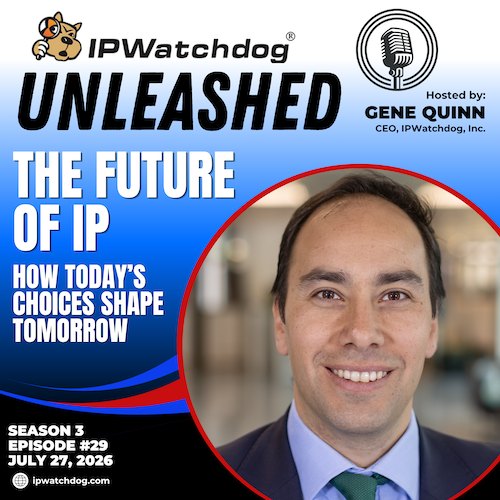
0 This week on IPWatchdog Unleashed, I speak with Martin Correa, who leads foresight work at the World Intellectual Property Organization (WIPO). Correa’s job is not to predict the future of IP, but to consider what futures are possible so WIPO and Member States can be better prepared for whatever eventuality does materialize. And since there is no data about the future—as he puts it—his work uses signals of change, horizon scanning and competing scenarios to expose assumptions and identify the decisions that could push the IP system in one direction or another.
Our conversation examines the danger of viewing IP solely as a legal instrument or barrier, rather than as infrastructure supporting investment, innovation, economic development, and public welfare. We discuss how IP leaders can identify high-impact uncertainties, test strategy against multiple plausible futures, and remain prepared as technology, economics, law, and public attitudes evolve.
Correa then puts me through WIPO’s seven-question foresight exercise, shifting the discussion to the future of the IP system. He asked me to place myself in 2040 and identify what I would want to know about the international IP system. My first question was blunt: “do we still have a patent system in the U.S.?”
I was not suggesting that Congress will formally abolish the Patent Act. A system can remain on the books while becoming commercially irrelevant. It can issue patents that are too expensive to obtain, too uncertain to license, too easy to challenge and too difficult to enforce. It can call those instruments property while treating their owners as presumptive wrongdoers whenever they attempt to exercise the rights the government granted. In short, just because you call something a patent doesn’t make it so.
Correa’s response was not to offer a prediction. The foresight exercise is not intended to result in pushback or even debate, it is intended to elicit information that can then be used to identify what thought leaders think might happen, and why. In that regard his follow-up question was: What decisions, assumptions and institutional relationships would lead to that future, and what must be done now to avoid it? That is where foresight becomes valuable. The question is not whether the United States will technically retain patents in 2040. The question is whether those patents will still induce anyone to invest money that would otherwise go somewhere safer, and what do I envision happening to make that vision a reality, or to avoid it entirely.
As I explained in our conversation, “if you can’t own it, you can’t invest in it.” That principle is not complicated, but the IP community has done a remarkably poor job of communicating it in a way that is truly understood. We often speak to policymakers as if a familiarity with patent doctrine is a prerequisite to understanding the economic bargain struck nearly 250 years ago and embedded into the fabric of the U.S. Constitution. It is not. The message should be simple: ownership supports investment; investment supports development; development turns ideas into products, companies and jobs. But that virtuous cycle is not possible without secure ownership that is investable.
Correa ultimately arrived at the same communications problem. He said, “the message of IP needs to go beyond the IP community.” He is right. If our explanation never leaves conferences, law firms, patent offices and specialist publications, we should not be surprised when the broader public accepts the caricature offered by those who benefit from weaker right.
The future of the patent system is being built—or dismantled—right now, through decisions about what intellectual property is, whom it serves, and whether it deserves to be treated as property at all. If the public and policymakers increasingly understand patents as little more than legal barriers wielded against innovators, then weak rights, limited enforcement and chronic underinvestment will follow. And that future will exists because the IP community failed to defend the connection between exclusive rights, investment and innovation.
More IPWatchdog Unleashed
You can listen to the entire podcast episode by downloading it wherever you normally access podcasts or by visiting IPWatchdog Unleashed on Buzzsprout. You can also listen to IPWatchdog Unleashed conversations on the IPWatchdog YouTube channel. For more IPWatchdog Unleashed, see below for our growing archive of previous episodes.
![[Advertisement]](https://ipwatchdog.com/wp-content/uploads/2026/08/LexisNexis-Aug-18-2026-sidebar-700x500-1.jpg)
![[Advertisement]](https://ipwatchdog.com/wp-content/uploads/2026/08/Junior-Aug-20-2026-sidebar-700x500-1.jpg)
![[Advertisement]](https://ipwatchdog.com/wp-content/uploads/2026/07/Womens-IP-Forum-2026-sidebar-register-early-bird-now-700x500-1.jpg)
![[Advertisement]](https://ipwatchdog.com/wp-content/uploads/2026/07/Juristat-Varsity-Ad-2026-IPW-ad-FreeTrial_2-UPDATED-on-Jul-15-2026.png)
![[Advertisement]](https://ipwatchdog.com/wp-content/uploads/2026/07/ClearstoneIP-Varsity-Ad-2026-Ad-2.jpg)
![[Advertisement]](https://ipwatchdog.com/wp-content/uploads/2024/09/Patent-Prosecution-Training-sidebar-700x500-2025-03-27.jpg)



![[Advertisement]](https://ipwatchdog.com/wp-content/uploads/2021/12/WEBINAR-336-x-280-px.png)
![[Advertisement]](https://ipwatchdog.com/wp-content/uploads/2021/12/Ad-4-The-Invent-Patent-System™.png)







Join the Discussion
No comments yet. Add my comment.
Add Comment