


 1
1 Bites (noun): more meaty news to sink your teeth into.
Barks (noun): peripheral noise worth your attention.
Want to have your doggie(s) featured in one of our future Barks & Bites Columns? Send your dogs photo(s) along with their name, breed (if you know it) and their age to dogwall@ipwatchdog.com. All photos will be added to the IPWatchdog Dog Wall at IPWatchdog Studios and will be added to the queue of images we select from each week.
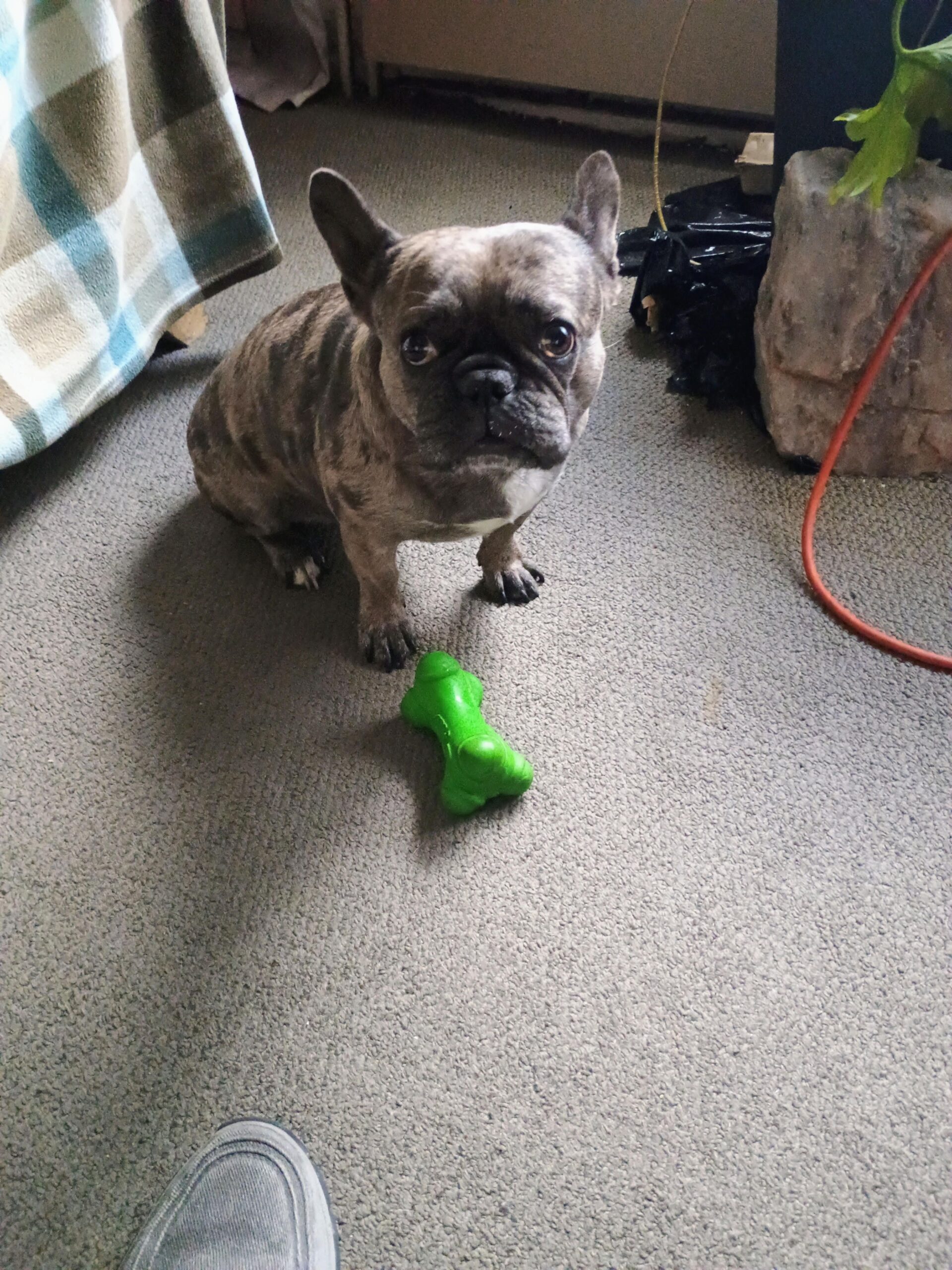
JOHN PAUL ARCHULETA’s (Independent inventor) three- year old, FRENCHIE BULLDOG RESCUE – MULA
This week in Other Barks & Bites: the Second Circuit issues a summary order affirming that copyright infringement claims filed by Xinuos against IBM are time-barred; Nvidia announces an AI infrastructure plan in partnership with several global investment firms to turn its AI products into an investable class raising up to $500 billion; the nation of Pakistan hails the Federal Court of Australia’s ruling nixing an appeal from India’s agricultural authority appealing the rejection of that nation’s “Basmati” trademark; a bill co-sponsored by Senators Chuck Grassley and Maggie Hassan that increases information sharing surrounding allegedly infringing imports unanimously passes the U.S. Senate; the UK High Court affirms the validity of patent and supplementary protection certificate rights held by Novartis in its heart treatment Entresto; two MLB franchises oppose the WNBA’s trademark application for “THE W”; and BMG and Suno announce a landmark agreement enabling BMG artists to be compensated for voluntary participation in generative AI music platforms.
Bites
Pakistan Applauds Australian Court’s Dismissal of India Basmati Mark Appeal – On Wednesday, August 12, Pakistan’s Ministry of Commerce issued a press release formally applauding the Federal Court of Australia for dismissing an appeal filed by India’s Agricultural and Processed Food Products Export Development Authority (APEDA) following its unsuccessful trademark application with IP Australia to claim the word “Basmati” as a certification trade mark. According to Pakistani government officials, the ruling vindicates that nation’s position that neither India nor Pakistan can claim exclusive rights in the word mark Basmati, which refers to a historic growing region that spans areas of both nations, and marks an important achievement for Pakistan’s agricultural heritage and export identity.
Chief Judge Moore Dissents from En Banc Rehearing Denial in Design Patent Case – On Tuesday, August 11, the U.S. Court of Appeals for the Federal Circuit issued an order denying a petition for en banc rehearing in Range of Motion Products, LLC v. Armaid Co., leaving in place an earlier panel decision affirming a grant of summary judgment to Armaid after finding that certain structural elements in Range of Motion’s design patent for a body massaging apparatus were functional. Circuit Judge Tiffany Cunningham authored a concurrence arguing that the panel majority’s holding was correct under U.S. Supreme Court precedent from Egyptian Goddess v. Swisa (2008) but Chief Judge Kimberley Moore, who dissented from the original panel decision in the case, dissented from the en banc denial, arguing that the court has improperly removed the factfinder from the design patent infringement inquiry, which should return to the ordinary observer test as laid out by the Supreme Court in Gorham Co. v. White (1871).
USPTO Adds Biomedical Degree to Category A, Denies Applied AI For Now – On Tuesday, August 11, the U.S. Patent and Trademark Office (USPTO) issued a notice in the Federal Register announcing that the agency was updating the scientific and technical qualifications for admission to the patent bar as outlined by the General Requirements Bulletin so that the Biomedical Science degree would be moving from Category B to Category A in order to increase the pool of degrees that automatically qualifies an applicant to sit for the patent bar exam. The USPTO declined to add the Applied AI degree to Category A, explaining that only one person with an Applied AI degree and no one with a standalone AI degree has applied for the exam within the past three calendar years.
Grassley-Hassan Bill on Combating Counterfeits Unanimously Passes Senate – On Monday, August 10, U.S. Senators Chuck Grassley (R-IA), Chairman of the Senate Judiciary Committee, and Maggie Hassan (D-NH) announced that their recent bill, S. 2677, introduced to expand the sharing of information with respect to suspected violations of intellectual property rights in trade had passed the U.S. Senate by a unanimous vote. The bill, which now moves on toward a vote at the U.S. House of Representatives, would expand the definition of “person” from whom U.S. Customs and Border Protection officials can request information to determine if imported merchandise violates copyright or trademark laws, lowers the standard under which CBP can request such assistance to reasonable suspicion, and expands the scope of information that CBP can share to include images of packing materials and shipping containers.
CAFC Says Prior Art Reference Must Satisfy Section 112 to Claim Earlier Priority – On Monday, August 10, the U.S. Court of Appeals for the Federal Circuit issued a precedential ruling in Dental Monitoring SAS v. Align Technology, Inc. vacating a final written decision by the Patent Trial and Appeal Board (PTAB) invalidating Dental Monitoring’s patent claims to methods of dental arch imaging for obviousness after determining that one of the prior art references used for this determination was not entitled to the earlier priority date of its provisional patent application filing. The Federal Circuit, analyzing statutes under the Patent Act governing the benefit of earlier priority dates, found that the written description requirement of 35 U.S.C. § 112 was incorporated into the substantive requirements of claiming earlier priority dates under the statute, rejecting Align’s argument that the non-provisional application merely had to comply with procedural “ministerial requirements” to claim an earlier priority date as a prior art reference.
Second Circuit Affirms Dismissal of Xinuos Source Code Case Against IBM – On Monday, August 10, the U.S. Court of Appeals for the Second Circuit issued a summary order in Xinuos, Inc. v. International Business Machines Corp. affirming the Southern District of New York’s grant of summary judgment to IBM on copyright infringement claims filed by Xinuos related to IBM’s use of source code developed during a joint venture for UNIX-based operating systems briefly operated in the late 1990s with a company that had sold its software assets to Xinuos during bankruptcy proceedings in 2011. The Second Circuit agreed with the district court that Xinuos’ claim went to IBM’s alleged ownership of the accused source code, which Xinuos had notice of by the 2011 bankruptcy sale as the selling company had already alleged that IBM misappropriated the accused source code, and as such was time-barred under the Copyright Act’s three-year statute of limitations.
Barks
UK High Court Upholds Patent, SPC Validity for Novartis’ Entresto – On Thursday, August 13, the UK High Court issued a ruling rejecting Intas Pharmaceuticals’ challenge to patent and supplementary protection certificate (SPC) rights held by drugmaker Novartis Pharmaceuticals to its blockbuster heart failure treatment Entresto, reserving market exclusivity for Novartis within the UK and likely preventing the introduction of a generic version of Entresto from Intas subsidiary Accord Healthcare.
Copyright Office Amends Group Registration for Frequently Updated News Websites – On Thursday, August 13, the U.S. Copyright Office issued a final rule in the Federal Register amending the group registration of updates to a news website, which enables registration of frequently updated news websites as collective works without requiring the entire contents of the website as deposit material, clarifying the definition of news website and establishing that the news website need only report on a variety of subjects and that its primary function must be to comment on current events.
BMG, Suno Establish Landmark Partnership for Licensed Generative AI Music – On Wednesday, August 12, generative artificial intelligence (AI) developer Suno and music rights collective BMG announced that the two organizations have entered into an agreement establishing a framework enabling BMG artists to choose to participate in generative AI models while receiving fair compensation for their works used in Suno’s music platform.
USITC Institutes Section 337 Investigation into Samsung Mobile Devices – On Wednesday, August 12, the U.S. International Trade Commission (USITC) issued a notice announcing that the agency had instituted an investigation following a Section 337 complaint filed by Japanese consumer electronics company Maxell alleging patent infringement claims against certain mobile electronic devices imported into the U.S. for sale by South Korean electronics conglomerate Samsung.
EPO Launches Inventions for Impact STEM Training Modules for Young Learners – On Wednesday, August 12, the European Patent Office (EPO) announced that it was establishing an Inventions for Impact educational program for learners as young as 9 years of age providing several training modules with interactive multimedia content designed to introduce students to science, technology, engineering and math (STEM) topics.
MLB’s Cubs, Nationals Oppose WNBA’s “THE W” Trademark Application – On Monday, August 10, as first reported by Josh Gerben of Gerben IP, Major League Baseball (MLB) franchises the Chicago Cubs and the Washington Nationals filed a notice of opposition with the U.S. Patent and Trademark Office challenging a trademark application filed by the Women’s National Basketball Association to register the standard character mark “THE W,” the baseball teams claiming that the mark is confusingly similar to “W” marks already in use by both franchises.
This Week on Wall Street
Nvidia Announces AI Infrastructure Plan Unlocking $500B of Third-Party Capital – On Monday, August 10, American chipmaker Nvidia announced that it was entering into a series of strategic partnerships with several leading global investment firms including BlackRock and Goldman Sachs to create financing platforms turning Nvidia’s compute and full-stack AI infrastructure into an investable class that could unlock up to $500 billion in third-party capital.
Quarterly Earnings – The following firms identified among the IPO’s Top 300 Patent Recipients for 2025 are announcing quarterly earnings next week (2025 rank in parentheses):
- Monday: None
- Tuesday: Baidu, Inc. (174th)
- Wednesday: Analog Devices, Inc. (t-223rd)
- Thursday: Alibaba Group Holding Ltd. (t-255th); Deere & Co. (92nd)
- Friday: None
![[Advertisement]](https://ipwatchdog.com/wp-content/uploads/2026/10/Junior-Oct-15-2026-sidebar-700x500-1.jpg)
![[Advertisement]](https://ipwatchdog.com/wp-content/uploads/2026/10/BlackBox-IP-Oct-20-2026-sidebar-700x500-1.jpg)
![[Advertisement]](https://ipwatchdog.com/wp-content/uploads/2026/10/Questel-Oct-22-2026-sidebar-700x500-1.jpg)
![[Advertisement]](https://ipwatchdog.com/wp-content/uploads/2026/09/WE-BUY-PATENTS-SIM-IP-Ad-1-revised-on-Sep-28-2026-700x500-1.jpg)
![[Advertisement]](https://ipwatchdog.com/wp-content/uploads/2026/09/Life-Sciences-2026-sidebar-early-bird-date-corrected-700x500-1.jpg)
![[Advertisement]](https://ipwatchdog.com/wp-content/uploads/2024/09/Patent-Prosecution-Training-sidebar-700x500-2025-03-27.jpg)




![[Advertisement]](https://ipwatchdog.com/wp-content/uploads/2021/12/WEBINAR-336-x-280-px.png)
![[Advertisement]](https://ipwatchdog.com/wp-content/uploads/2021/12/Ad-4-The-Invent-Patent-System™.png)






Join the Discussion
One comment so far. Add my comment.
Pro Say
August 14, 2026 03:25 pm“Grassley-Hassan Bill on Combating Counterfeits Unanimously Passes Senate”
. . . and yet the Senate can’t just as quickly and easily pass a simple, less-than-25-words-needed, bill overruling the unconstitutional Alice & Mayo decisions and restoring patent eligibility to all categories of innovation.
How can the U.S. continue to offer less patent protection than the majority of the rest of the world?
Happy 250th Birthday America.
Add Comment