


 8
“Despite demand for IP Knowledge amidst AI challenges, not one of the top programs surveyed requires an IP course or elective be taken to complete requirements for a degree.”
 A new report that examines education at the leading U.S. business schools has found that more and better courses are being offered to students at graduate business programs about how intellectual property (IP) rights function in business, but not a single program requires an IP-related course be completed to obtain a degree.
It has been well established that the primary value of most companies today is comprised not of real estate or factories but of intangible assets like trademarks, patents, copyrights and trade secrets. Accordingly, the IP valuation firm Ocean Tomo, determines that Intangible Asset Market Value (IAMV) comprises 92% of S&P 500.
The historic emphasis on managing tangibles like real estate and equipment is significantly less relevant in today’s knowledge-based, AI-driven economy.
Business students having completed MBAs, many of whom will be leading major corporations or engaged in finance and transactions, need to be conversant in IP to work with technology, legal and market specialists. A knowledge-based, AI-driven landscape demands it. But are they being properly prepared?
The latest summary report conducted by the Center for Intellectual Property Understanding (CIPU), an independent nonprofit, Intellectual Property Education at Leading Business Schools – 2026 Update, Identifying Tools for Today’s Educators and Tomorrow’s Leaders, found that over the past five years there has been progress at some leading MBA programs regarding course offerings but there is still room for significant improvement.
Nurturing Future Executives and Funders
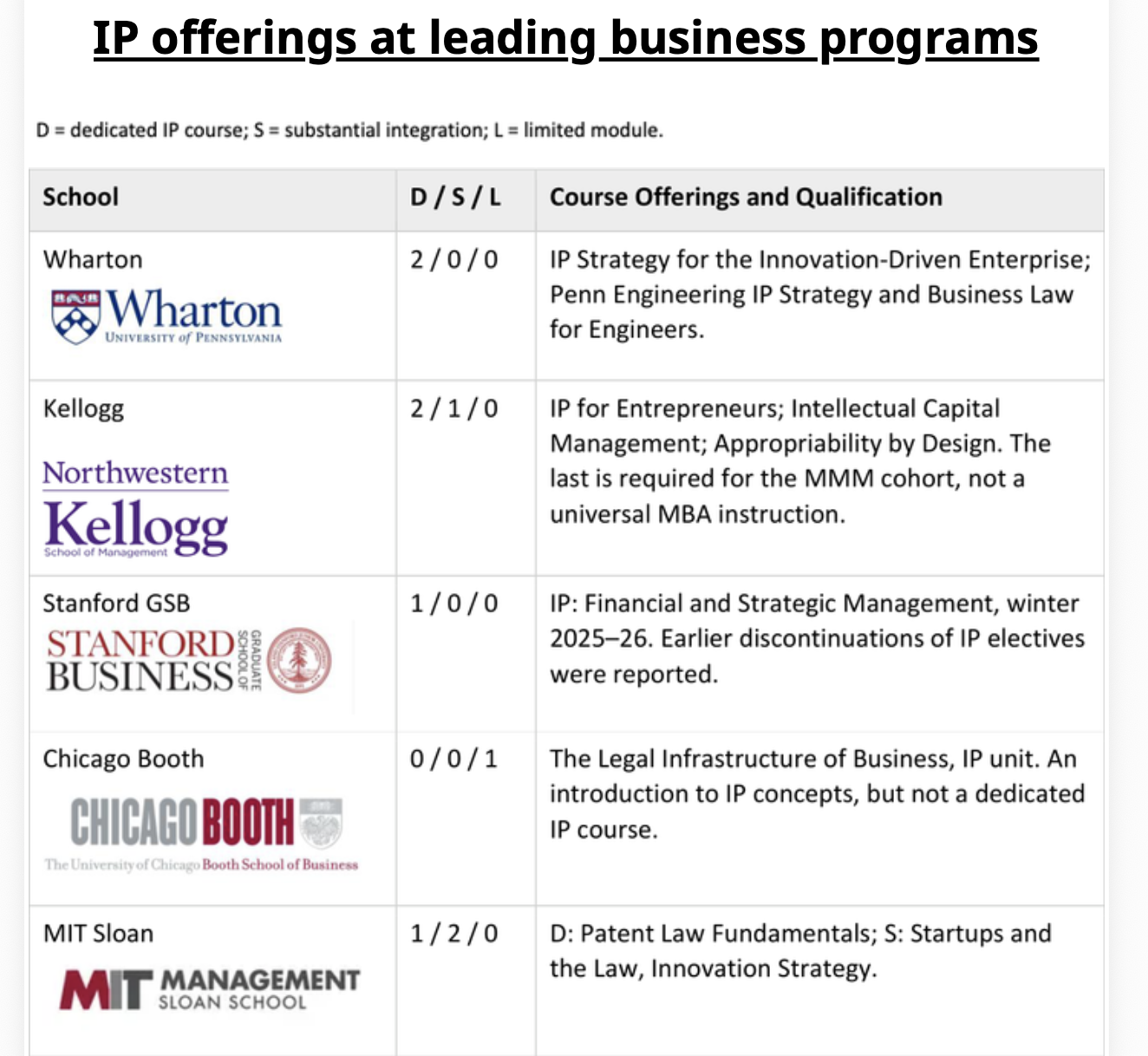 “Dedicated strategy courses, instruction embedded in growth and innovation electives, and interdisciplinary commercialization programs connect IP with the decisions business students are preparing to make,” the CIPU report found. “As AI and data become increasingly embedded in business, that capability deserves greater curricular attention.”
Despite demand for IP Knowledge amidst AI challenges, not one of the top programs surveyed requires an IP course or elective be taken to complete requirements for a degree.
Five years after a similar report described an evolving scenario for IP education (Intellectual Property Education at Business Schools: An Evolving Landscape—Courses, Content and Instructors at Leading Management Programs), the strongest courses continue to be encouraging. Dedicated strategy courses, instruction embedded in growth and innovation electives, and interdisciplinary commercialization programs connect IP with the decisions business students are preparing to make.
“The [2026] report, which I thought was well conducted, does not identify one other glaring shortcoming: the lack of faculty with real, practical operational experience,” said Brian Hinman former IBM licensing executive, Chief IP Officer at Philips and an MBA holder. “Much of the theoretical research on patent valuation, IP strategy, etc., is built on just that, how things are ‘supposed’ to be versus reality in a business setting.”
Expanding to Include New Audiences
Discussions in the report with seven esteemed IP academicians, some with hands-on IP licensing experience, conveyed the importance of sustained student interest, expansion to new audiences, and active adaptation to AI. “The opportunity now is to extend those strengths into a more consistent foundation for MBA graduates,” explained the report. Five of the 20 programs on which data was based offer no IP courses or integration with other courses—about the same percentage as 2021.
The 2026 report dataset identifies 30 qualifying offerings across 15 of the top 20 business schools surveyed: nine dedicated IP courses, 14 substantial integrations, and seven limited modules. Seven schools have a dedicated offering, including some hosted within departments besides the business school; five have no qualifying MBA course listed. This update uses different criteria and a partly different sample from 2021. Its totals describe the present state of IP education, rather than a direct numerical trend. The report noted:
“The response to these findings suggests a layered approach is needed, introducing IP to MBA students through repeated application in established business subjects [not just stand-alone courses] and accessible opportunities for specialist and experiential learning… The goal is a generation of managers better equipped to recognize opportunity with intangible assets, protect valuable knowledge, negotiate access, and connect innovation with commercial success.”
See the 2026 report on IP education at leading U.S. business programs on CIPU’s website.
Ultimately, the 2025–26 dataset indicates that, for 15 of the top 20 graduate business programs surveyed:
- 9 have dedicated IP courses
- 14 have substantial integrations
- 7 have limited modules
- 7 schools have a dedicated offering, including some hosted within other departments
- 5 of the 15 have no qualifying MBA course listed
- None of these programs surveyed require an IP course for graduation



















Join the Discussion
8 comments so far. Add my comment.
Bruce Berman
October 26, 2026 05:10 pmIs it patent law that disavows treating IP as assets or SEC regulations? Businesses need to do a better job at recognizing and conveying what gives their companyb meaning.
Anon
October 26, 2026 04:43 pmNow turn around and do FASB and other accounting protocols that treat innovation (end product being the same) as to HOW an innovation occurs….
(Patent law itself expressly disavows this)
Manny Schecter
October 16, 2026 12:22 pmOur business schools need to do better…
Bruce Berman
October 14, 2026 02:58 pmMany students believe that the primary job of graduate business programs is to award degrees that lead to the best jobs or a faster track in their career. I wonder how much emphasis is placed on what they are studying and for what purpose? It appears, at least, they focused primarily on managing the estimated 8% of tangible asset market value that is readily seen.
Don Baker
October 14, 2026 12:21 pmOnly a few U.S. Engineering Schools teach how to apply for a U.S. Patent. I had not seen any such programs in the undergraduate and graduate schools that I had attended between 1964 and 1994.
The USPTO did not typically make it easy for engineers to understand its procedures, and is only lately offering online seminars.
But China began this in 2008, with the release of the National Intellectual Property Strategy Outline,
And it shows. I do some woodworking now. Most of my tools, both woodworking and test electronics, are made in China.
Pro Say
October 14, 2026 11:24 amStunning MBA deficiency. Simply stunning.
Indeed, because one cannot be a master in business without IP knowledge, this deficiency renders “MBA” a misnomer.
Don Baker
October 14, 2026 10:59 amNor do Engineering Schools teach how to apply for Patents. Nor does the USPTO make it easy for Engineers to understand the process.
But according to Google AI, the Chinese do.
Brian Hinman
October 14, 2026 09:28 amSince the primary value of companies is embodied in its intangible assets, it should follow that our nation’s best MBA schools should mandate IP course offerings as part of their curriculum!
Add Comment