


 1
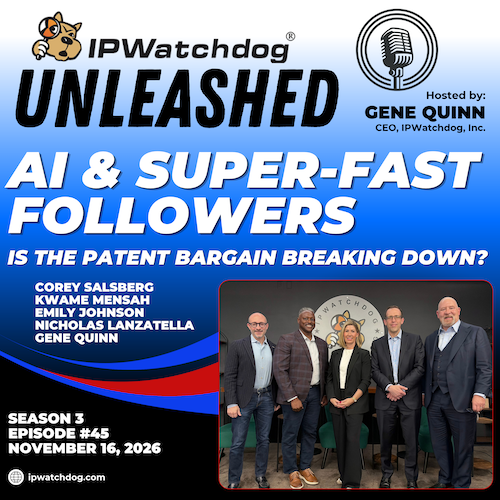
This week on IPWatchdog Unleashed, I spoke with Emily Johnson, Nicholas Lanzatella, Kwame Mensah, and Corey Salsberg. This conversation (see transcript) took place on November 9, 2026, at IPWatchdog Studios at the fifth annual Life Sciences Masters™ conference. We examine how artificial intelligence is changing life sciences research and patent strategy. Our focus was on the emergence of super-fast followers, who are competitors positioned to quickly analyze published inventions and rapidly pursue related candidates and patent filings. For an industry built on expensive, uncertain research, the implications reach well beyond faster drafting or more efficient discovery. At stake is the balance between accelerating the development of new medicines and preserving the economic incentives that make pioneering discoveries possible in the first place.
At the center of the conversation is a tension inherent in the patent bargain: disclosure enables others to learn from an invention, which makes sense as long as meaningful protection exists to preserve the incentive to undertake the original work. The problem is AI could dramatically accelerate what competitors can do with that disclosure. My concern is whether super-fast followers will block the full commercial advantage that has historically inured to the benefit of the innovator, which would then undermine investment in pioneering research. For biopharmaceutical innovator companies, that question affects which discoveries receive funding and which development risks are worth taking.
The panel did not agree that every example of rapid follow-on development establishes an AI problem, much less an abuse of the patent system. Salsberg challenged assumptions about patent scraping and cautioned against conflating legitimate improvements with unsupported filings. Mensah likewise emphasized the scientific and clinical hurdles that remain between identifying a candidate and delivering a successful medicine, and the reality that the U.S. Patent and Trademark Office requires comprehensive data to obtain patent protection for these types of innovations. Those distinctions do matter, and a competitor developing a better product absolutely presents a different challenge from one generating speculative applications without meaningful supporting work.
As our debate unfolds, we lead directly into a conversation about claim scope and Section 112. Johnson emphasized the gap between what a pioneering patent discloses and what its claims ultimately protect, particularly in the wake of Amgen v. Sanofi. Ultimately, the discussion explored whether today’s enablement standards adequately reward foundational discoveries and how innovators can develop disclosures that support broader protection. For in-house counsel and prosecution teams, the strategic question is how to secure an early filing position while building the scientific support needed to protect commercially important territory around the lead invention.
One practical theme drew substantial agreement: innovators should become their own fast followers. Lanzatella urged companies to use the same AI capabilities available to competitors to explore variants and anticipate opportunities around their inventions. That means treating patent strategy as part of continuing research, with attention to what additional data and disclosures could strengthen the portfolio before an application publishes. The objective is defensible coverage supported by the science, including evidence of unexpected results that may become increasingly valuable as AI changes expectations about what skilled researchers can accomplish.
Human inventorship adds another layer of complexity. Lanzatella recommended documenting human conception when AI plays a substantial role in discovery, while Salsberg warned that expansive inventorship attacks could threaten innovators’ own AI-assisted patents. The broader lesson for IP leaders is to assess proposed solutions against their consequences for the entire research enterprise. Restrictions aimed at speculative filings could also constrain legitimate computational work or established patent drafting practices. Protecting pioneering innovation requires care in defining both the perceived harm and the remedy.
For life sciences executives, patent practitioners, and research leaders, this conversation connects immediate portfolio decisions with the longer-term economics of drug development. AI offers opportunities to reduce costs and improve medicines, alongside competitive pressures that deserve serious attention. The episode explores where a more robust patent strategy can help now, where the law may need reconsideration, and why preserving incentives for original discovery must remain central as the tools of innovation change.
More IPWatchdog Unleashed
You can listen to the entire podcast episode by downloading it wherever you normally access podcasts or by visiting IPWatchdog Unleashed on Buzzsprout. You can also listen to IPWatchdog Unleashed conversations on the IPWatchdog YouTube channel. For more IPWatchdog Unleashed, see below for our growing archive of previous episodes.











Join the Discussion
One comment so far. Add my comment.
Julie Burke
November 18, 2026 03:27 pmbut how can innovators become their own fast followers when the wait time for a first Office action in Tech Center 1600, which examines biotech and pharma applications, averages nearly 30 months?
Add Comment