


 0
“One of the greatest misconceptions about AI is viewing it merely as a patent drafting tool. Its real strength lies in serving as a continuous quality assurance layer throughout the entire SEP lifecycle.”
 Standard-essential patents (SEPs) are among the most valuable assets in today’s technology economy. They form the foundation of licensing programs, determine competitive positioning, and increasingly become the center of high-stakes litigation across multiple jurisdictions.
Yet one reality remains unchanged: many SEPs that initially appear to be strong eventually fail when scrutinized in court.
A patent may look technically impressive, map well to a standard, and even become part of a licensing campaign. However, years later, when challenged in Germany, the United States, China, the United Kingdom, or the Unified Patent Court (UPC), weaknesses often emerge. Prior art that was overlooked during drafting is discovered. Claim amendments made during prosecution create inconsistencies. Foreign filings introduce translation errors. Claim construction differs across jurisdictions. Support for amended claims becomes questionable. In some cases, the patent ultimately survives neither validity nor infringement challenges.
The cost of these mistakes is enormous. This raises an important question:
“Can modern large language models (LLMs) help draft stronger, more defensible SEPs that remain valuable throughout their entire lifecycle?”
The answer is increasingly yes, but only when AI is integrated across the entire patent workflow. Doing this well requires a deep understanding of those workflows, a clear sense of where AI can add the most value, and access to clean, curated, fully indexed data.
The Goal Is Not Faster Drafting, It Is Better Patents
Most discussions around AI in patent drafting focus on productivity.
- Can AI generate invention disclosures?
- Can AI draft patent specifications?
- Can AI prepare claims?
While these capabilities are certainly useful, they are not where the greatest value lies:
The real opportunity is improving patent quality.
Every step of the patent lifecycle presents an opportunity to strengthen, or weaken, a future SEP portfolio. AI can support inventors, patent attorneys, and portfolio managers by continuously identifying risks, inconsistencies, and opportunities before they become expensive problems years later.
Better Invention Disclosures
The quality of a patent is largely determined long before the first claim is written. Many invention disclosures suffer from vague problem statements, inconsistent terminology, incomplete technical descriptions, or insufficient explanations of the inventive contribution.
LLMs can assist inventors by:
- Refining invention disclosures for clarity and consistency,
- Helping formulate stronger technical problem statements,
- Identifying the key inventive concepts,
- Performing initial prior-art searches,
- Comparing the invention against known technologies,
- Providing portfolio managers with better information for filing decisions.
Finding Prior Art
Perhaps most importantly, AI enables prior-art searching early in the patenting process. Identifying relevant publications before filing helps applicants refine their claims and reduce the risk of later invalidation based on previously unknown references.
For patents relating to standardized technologies, standards contributions are a valuable source of non-patent literature (NPL) for prior-art searches. These documents include technical proposals submitted by participants in the standards development process and can disclose emerging technologies well before a final standard is adopted.
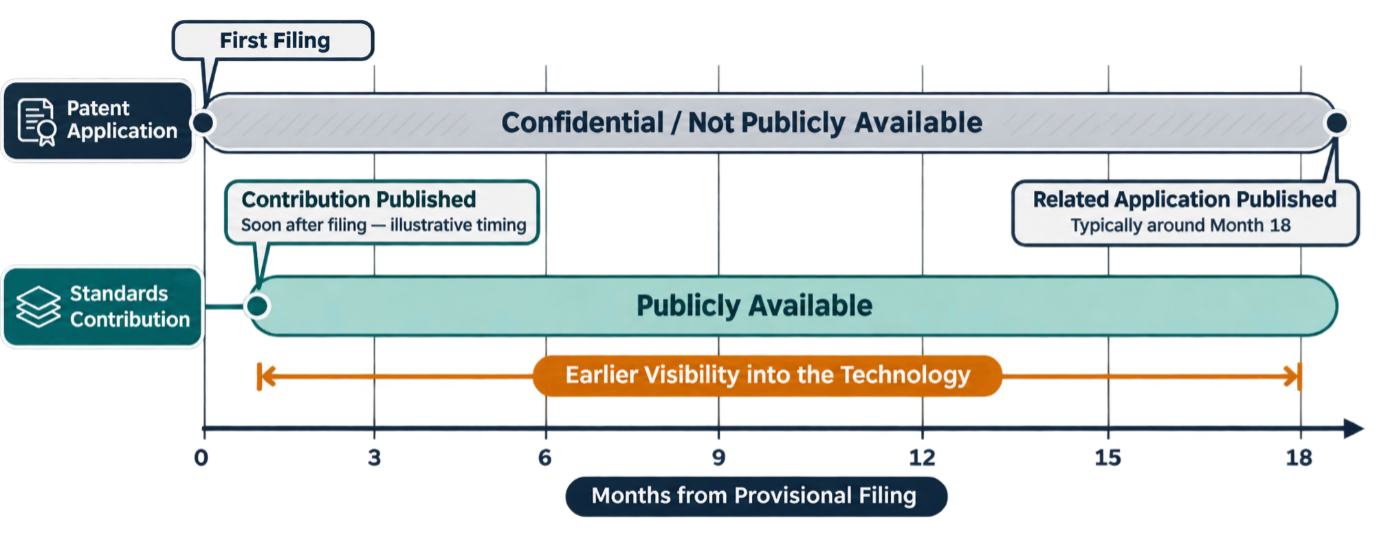
Companies may file patent applications before disclosing the corresponding inventions in standards contributions. But patent applications generally remain unpublished until approximately 18 months after the earliest claimed priority date, subject to applicable publication rules and exceptions.
Standards contributions, by contrast, may become publicly accessible much sooner through meeting documents and online repositories, providing earlier visibility into the disclosed technology (figure 1). Searching standards contributions, draft standards specifications and meeting minutes can therefore uncover relevant technical disclosures that searches limited to published patent documents may miss. Whether a particular document qualifies as prior art depends on its content, when it became publicly available, any confidentiality restrictions and the applicable legal framework.
Figure 1: Early Visibility of Standards Contributions Before Patent Publication
Supporting Patent Drafting
AI can play a powerful role in the initial drafting of patent applications. Rather than replacing patent attorneys, it serves as an intelligent drafting and review assistant, capable of analyzing extensive technical documentation, identifying inconsistencies, and helping attorneys develop stronger, more comprehensive patent applications.
Professional LLMs can support patent drafting by:
- Analyzing technical disclosures: Summarizing complex invention disclosures, technical specifications, and supporting documentation.
- Supporting inventor interviews: Generating targeted questions to clarify inventive concepts, identify technical distinctions, and uncover additional implementation details.
- Reviewing patent specifications: Checking drawings, descriptions, and claims for consistency, completeness, and potential gaps in technical support.
- Analyzing standardization activities: Reviewing relevant standards contributions, technical proposals, meeting documents, and draft specifications to identify emerging technical directions and anticipate potential developments in the final standard.
For SEP drafting, AI offers an additional strategic advantage: the ability to connect patent drafting with the ongoing development of technical standards. Standards contributions and draft specifications can serve as early technical reference points for evaluating how an invention may relate to emerging standardized technologies. By analyzing these documents alongside invention disclosures and proposed patent claims, AI can generate preliminary claim charts that map claim elements to relevant technical features discussed during standardization.
AI During Patent Prosecution
Patent prosecution is often where SEP quality either improves or deteriorates. Office actions frequently require claim amendments, and each amendment can potentially affect:
- Claim scope,
- Coverage of the relevant technical standard,
- Infringement positions,
- Validity,
- Claim construction.
Historically, evaluating these implications required substantial manual effort.
Modern LLMs can now assist by:
- Analyzing office actions,
- Reviewing cited prior art,
- Evaluating examiner interpretations and objections,
- Comparing and analyzing prior art references cited by the examiner more efficiently,
- Verifying whether proposed claim amendments are supported by the original patent disclosure,
- Checking consistency between amended claims and the patent specification,
- Updating draft claim charts following each amendment.
For SEP portfolios, these capabilities are particularly valuable. Every proposed claim amendment can be evaluated against the relevant technical standard to assess whether potential standard essentiality is preserved and whether the amended claims remain supported by the patent specification. Rather than discovering years later that prosecution amendments have unintentionally weakened a patent’s licensing position, attorneys can receive immediate feedback during prosecution.
This is especially important because amendments made to overcome prior art or examiner objections may introduce claim limitations that no longer map to the relevant standard. Conversely, attempts to align amended claims more closely with the standard may introduce technical features that lack sufficient support in the original patent specification. While standards may not yet be finalized, mapping patent claims against standards contributions is a well-established practice before the final standard is defined. AI-assisted analysis can help attorneys identify these risks early, enabling more informed prosecution decisions while preserving both claim validity and potential standard essentiality.
Managing International Filings
International patent protection introduces additional complexity, including:
- Translations of patent applications and claims,
- National filing requirements,
- Local prosecution strategies,
- Jurisdiction-specific claim formats and requirements for demonstrating claim support.
Errors or inconsistencies introduced during international filings may remain undetected for years and only become apparent during litigation or licensing negotiations.
Modern LLMs can support this process by:
- Reviewing translations for accuracy and consistency,
- Supporting document conversion and adaptation to local filing requirements,
- Identifying inconsistencies across applications within the same patent family,
- Assisting with the adaptation of claims to jurisdiction-specific requirements and prosecution practices,
- Reviewing work performed by foreign patent associates,
- Verifying that claim amendments remain supported by the relevant patent specifications across jurisdictions.
For SEP portfolios, these capabilities are particularly valuable. Even subtle differences in claim language across jurisdictions can affect claim interpretation, scope, and potential standard essentiality. AI-assisted analysis can help patent attorneys identify such differences early, maintain greater consistency across international patent families, and ensure that jurisdiction-specific amendments do not unintentionally weaken patent protection or potential standard coverage.
Continuations and Divisionals
SEP portfolio management does not end with the initial patent filing. Continuation and divisional applications can become important strategic tools as technical standards evolve.
Modern LLMs can assist patent attorneys and portfolio managers by:
- Reviewing related patent family members and their prosecution histories,
- Identifying additional inventions and technical aspects disclosed in the original application that have not yet been claimed,
- Suggesting alternative claim strategies and claim structures,
- Generating proposed claims that better align with evolving technical standards while remaining supported by the original disclosure,
- Evaluating whether maintaining pending applications could preserve opportunities for future claim amendments.
For SEP portfolios, these capabilities are particularly valuable. As technical standards evolve, continuation and divisional applications can provide opportunities to pursue additional claims that better align with the final adopted standard, provided those claims are supported by the original patent disclosure. Rather than treating each application independently, AI enables a more comprehensive, portfolio-wide approach to prosecution strategy, helping patent attorneys identify opportunities to strengthen patent protection and potential standard essentiality across related patent families.
Patent Grant Is Not the End
Grant does not eliminate risk. In reality, the most difficult questions often arise afterward:
- Will the patent survive invalidity attacks?
- Does it actually read onto deployed products?
- Which companies practice the standard?
- How should claim charts differ for individual licensees?
- Can prior-art searches still identify weaknesses?
Modern AI systems can assist with:
- Deployment analysis,
- Infringement analysis,
- Claim chart generation,
- Portfolio quality evaluation,
- Licensing target identification,
- Patent stress testing,
- Invalidation risk assessments.
This creates a continuous quality assurance process extending well beyond patent issuance.
Human Expertise Remains Essential
None of this suggests that AI can replace experienced patent attorneys or technical experts. Quite the opposite. SEP drafting requires legal judgment, technical expertise, strategic thinking, and commercial awareness that current AI systems cannot independently replicate. The inventor remains the most important source of technical knowledge, particularly when identifying how an invention relates to specific standards contributions or technical specifications. Inventors therefore need to remain closely involved in the process, helping identify relevant technical features and potential opportunities for claim mapping.
AI can significantly accelerate this process by identifying potential connections between patent claims and technical standards. However, human experts are still needed to validate these connections, structure the analysis consistently, and assess the resulting claim charts.
The real value of AI lies in dramatically expanding the amount of information experts can analyze. Instead of manually reviewing hundreds of pages of technical documentation, experts can focus on validating AI-generated analyses. Rather than creating every claim chart from scratch, they can review, refine, and approve AI-generated drafts.
The result is higher-quality analysis delivered more efficiently and consistently. AI does not diminish the value of human expertise; it amplifies it.
From Drafting Assistant to Portfolio Intelligence
One of the greatest misconceptions about AI is viewing it merely as a patent drafting tool. Its real strength lies in serving as a continuous quality assurance layer throughout the entire SEP lifecycle, from initial invention disclosure and patent drafting to prosecution, portfolio management, essentiality assessment, and licensing.
At every stage, AI can help patent attorneys and technical experts address critical questions:
- Prior art: Has relevant prior art been overlooked that could affect patentability or validity?
- Claim support: Are the claims fully supported by the patent specification, including potential future amendments?
- Standard coverage: Do the claims cover the relevant technical features of the standard, and are important implementations or alternative embodiments missing?
- Claim construction: Is the claim language sufficiently clear and consistent to support the intended interpretation?
- International filings: Do translations and jurisdiction-specific amendments preserve the intended technical and legal meaning?
- Prosecution: Have claim amendments unintentionally narrowed the scope or weakened potential standard essentiality?
- Essentiality: Do the claims still map to the relevant technical standard as both the claims and the standard evolve?
- Enforcement: Could the patent withstand validity and infringement challenges across different jurisdictions?
Historically, many of these questions were addressed only at specific stages of the patent lifecycle, often years later when patents were evaluated for licensing or litigation. By then, opportunities to strengthen the original disclosure, adjust claim language, or preserve standard coverage may have been lost. AI enables a shift from retrospective patent quality assessment to continuous, proactive quality assurance. Rather than discovering weaknesses during licensing negotiations or enforcement, patent owners can identify potential issues earlier, when there may still be opportunities to address them. For SEP portfolios, this is particularly valuable because patent quality depends not only on validity and claim scope, but also on how consistently patent claims align with evolving technical standards.
The result is a more systematic approach to SEP portfolio management, where patent quality, potential essentiality, and licensing relevance are continuously evaluated throughout the patent lifecycle rather than assessed only after patents have been granted.
What IP Professionals Need to Consider
1. Improving Decisions Across the SEP Lifecycle
LLMs are already capable of making a meaningful contribution to drafting stronger, more defensible SEPs. Their greatest value does not lie in automatically generating patent applications, but in improving decision-making throughout the entire patent lifecycle. AI enables earlier identification of risks, more comprehensive prior-art analysis, stronger claim support, greater consistency across patent families, and better alignment between patent claims and evolving technical standards.
For SEP portfolios, this creates a particularly important opportunity. By continuously mapping patent claims against standards contributions, draft specifications, and final standards, AI can help identify potential essentiality early, guide claim drafting and prosecution strategies, and reduce the risk that amendments unintentionally weaken standard coverage. It can also support more systematic essentiality assessments and help portfolio managers identify which patents have the strongest potential relevance for licensing and enforcement.
2. Keeping Professional Judgment at the Center
For organizations building global SEP portfolios, the future is unlikely to involve AI replacing patent professionals. Instead, it will be experienced inventors, patent attorneys, technical experts, and portfolio managers working alongside AI systems that continuously review, challenge, and strengthen important decisions. Human expertise remains essential for interpreting technical inventions, evaluating claim scope, validating standard mappings, and making strategic prosecution decisions.
3. Building Stronger, More Commercially Valuable Portfolios
The companies that adopt this approach early will be better positioned to build SEP portfolios that are not only larger, but demonstrably stronger and more commercially valuable. Such portfolios can benefit from stronger validity positions, more consistent claim coverage across jurisdictions, better-supported essentiality assessments, and greater transparency in licensing negotiations.
Ultimately, AI has the potential to shift SEP portfolio management from a process in which patent quality and essentiality are often assessed retrospectively to one in which validity, claim quality, standard alignment, and licensing relevance are continuously evaluated and improved throughout the patent lifecycle.












Join the Discussion
No comments yet. Add my comment.
Add Comment