


 0
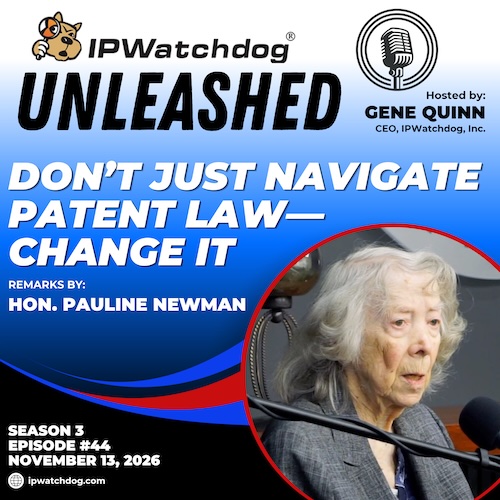
Patent practitioners spend much of their professional lives helping clients navigate uncertainty. But when uncertainty undermines the commercial purpose of patent protection, adapting to the law is insufficient. In this episode of IPWatchdog Unleashed, Judge Pauline Newman delivers a timely challenge to the IP community: consider what the law should be and participate in changing it. Her message, which was delivered on November 10, 2026, at our annual Life Sciences program, carries particular weight for companies whose research depends on the prospect of reliable protection. A transcript of Judge Newman’s remarks is available here.
Speaking to our live studio audience, Newman recognized a familiar pattern in the concerns raised by the preceding panel. Questions about the reliability of patent rights, commercial incentives, and investment in innovation recalled the conditions she encountered decades ago in industry. Her historical perspective offers something valuable to a profession accustomed to working within precedent: a reminder that the legal structures shaping business decisions can themselves be reconsidered.
The commercial stakes are central to her remarks. Newman recalls research laboratories closing and projects being abandoned more than five decades ago amid uncertainty about protection and the opportunity to earn a return. For research-intensive businesses, successful products must support the costs of unsuccessful research as well as their own development. Unreliable patent rights therefore affect more than litigation strategy. They influence which scientific opportunities companies can justify pursuing and, therefore, which potential discoveries and products will never be made.
Newman brings firsthand experience to the question of how those concerns become a case for reform. She describes her participation in the Carter administration’s domestic policy review of technological innovation, where industry leaders and other stakeholders debated the obstacles to investment. The course of events that lead to a top-to-bottom review of U.S. innovation policy was the reality that research and commercial opportunities were being lost. These consequences ultimately gave the policy debate a practical foundation and urgency.
Her account connects that period of reassessment with the creation of the Federal Circuit and the broader reform era that included Bayh-Dole and Hatch-Waxman. The objective she emphasizes remains relevant: greater certainty and predictability in the treatment of patent rights.
For today’s IP leaders, the lesson is to examine whether the system delivers the reliability necessary to support investment, and to explain the business consequences when it does not. For in-house counsel, patent practitioners, and life sciences executives, that suggests a role beyond managing individual portfolios and disputes. Their experience can help identify where legal uncertainty changes investment decisions and inform proposals for improvement.
Newman acknowledges that meaningful change requires time and persuasion. She also rejects the assumption that shaping the law lies outside the province of those in the private sector who work with its consequences every day.
These brief remarks offer both historical perspective and a reason to engage. Newman’s challenge is especially relevant: navigating today’s patent system and improving the system for tomorrow are connected responsibilities. This episode invites listeners to consider what their own experience could contribute to that effort, and to take action.
More IPWatchdog Unleashed
You can listen to the entire podcast episode by downloading it wherever you normally access podcasts or by visiting IPWatchdog Unleashed on Buzzsprout. You can also listen to IPWatchdog Unleashed conversations on the IPWatchdog YouTube channel. For more IPWatchdog Unleashed, see below for our growing archive of previous episodes.












Join the Discussion
No comments yet. Add my comment.
Add Comment