


 0
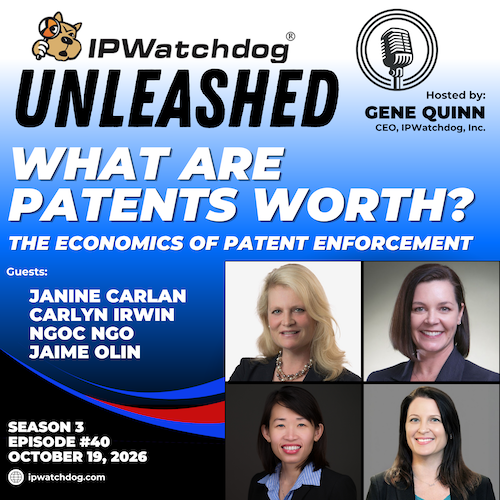
A patent’s economic value and the price it commands in a licensing negotiation can be very different things. The technology may deliver substantial commercial benefits, yet the amount a patent owner can capture depends on legal risk, enforcement costs, negotiating leverage, and each party’s business objectives.
This week on IPWatchdog Unleashed, we ask how much a patent is really worth, and how to prove it at a negotiating table or in court. This conversation, which occurred as part of IPWatchdog’s 2026 Women’s IP Forum, examines how sophisticated licensors, licensees, counsel, and valuation professionals assess patent value in real-world transactions and disputes. The conversation explored royalty structures, comparable licenses, portfolio strength, litigation and validity risk, damages principles, standard-essential patent (SEP) licensing, and the practical factors that drive parties toward—or away from—a deal.
The conversation brings together litigation and economic perspectives to explore what patents are really worth in transactions and disputes. Moderated by Janine Carlan, a patent litigator and partner with ArentFox Schiff, panelists include Carlyn Irwin, Senior Advisor at Cornerstone Research, Dr. Ngoc Ngo, an Economist at Competition Dynamics, and Jaime Olin, a patent litigator and partner with Stris & Maher.
For operating companies, licensing can protect customer relationships, provide access to technology, support cross-licensing, and create a competitive advantage. For patent owners seeking monetization, the priorities may involve generating sustainable revenue or recovering an investment in innovation. Identifying those objectives at the outset is essential because the same patent can support very different strategies depending on who owns it and who needs a license.
Valuation begins with the commercial contribution of the patented technology. Does the invention reduce production costs, increase profitability, or provide functionality that drives demand? Those questions help anchor expectations in economic evidence. But an economically valuable invention does not automatically produce an equivalent licensing payment. The panel explores how litigation expense, delay, financial pressure, and uncertainty about infringement or validity influence what parties are willing to accept or pay. For individual inventors and smaller patent owners, those constraints can be particularly consequential.
That distinction becomes especially important when assessing enforcement risk. Section 101 challenges, PTAB proceedings, and ex parte reexamination can alter the negotiating landscape even when the underlying technology remains unchanged. The panel discusses how uncertainty surrounding those mechanisms complicates advice to patent owners and affects settlement expectations. For software and other technologies exposed to eligibility challenges, as well as portfolios facing prior-art attacks, licensing strategy must account for the possibility that an asserted right will not survive enforcement.
The discussion also examines two recurring challenges in patent damages: comparable licenses and apportionment. A royalty rate drawn from another agreement is meaningful only when the relevant technological and economic differences are understood. Products, markets, timing, portfolio scope, and contractual provisions all affect comparability. Similarly, valuing a patented feature requires attention to its contribution to the broader product. For companies selling complex, multicomponent products, these issues directly affect whether a damages position is defensible and persuasive.
Patent licensing becomes more complicated when agreements also convey trade secrets and know-how. Bundled rights and intercompany licenses can create evidence that later influences valuation or damages arguments. The panel considers why counsel should understand those implications before an agreement is signed. For SEP licensing, the conversation further emphasizes the importance of documenting the economic rationale behind terms and maintaining a coherent approach to fair, reasonable, and non-discriminatory (FRAND) commitments.
The practical takeaway is to coordinate legal strategy, economic analysis, and commercial objectives early. Damages experts can help identify valuable discovery, test assumptions, and inform negotiations before an expert report becomes necessary. Counsel can also consider contingent payments and other contractual provisions that allocate risk rather than treating the royalty figure as the entire negotiation. Throughout the process, revisiting the client’s goals helps ensure that the chosen path still serves the business.
For in-house counsel, patent owners, and licensing professionals, this conversation offers a useful framework for connecting patent rights to achievable commercial outcomes. Of course, understanding what an invention contributes is only the beginning. The harder, often more consequential question is how to translate that contribution into an agreement that reflects the evidence, accounts for uncertainty, and advances the owner’s objectives.
More IPWatchdog Unleashed
You can listen to the entire podcast episode by downloading it wherever you normally access podcasts or by visiting IPWatchdog Unleashed on Buzzsprout. You can also listen to IPWatchdog Unleashed conversations on the IPWatchdog YouTube channel. For more IPWatchdog Unleashed, see below for our growing archive of previous episodes.














Join the Discussion
No comments yet. Add my comment.
Add Comment