


 0
“[After Desjardins], the 101 reversal rate for AI inventions jumped about two and a half times and rose in every major tech center, and reversals for improving how a model trains or operates went from six to 44.”
 U.S. Patent and Trademark Office (USPTO) Directors often make moves that are over-celebrated or over-criticized. Patent nerds hail them as breakthroughs or trash them as catastrophes. Their significant others endure hearing about them, the rest of the world ignores them, and they rarely have a long-term impact even in the patent dork-o-sphere.
It has been a little over a year since one of these moves, and I am here to provide dinner table convo for those of you who want to get back at your spouse for leaving dirty dishes in the sink. What follows is a data-driven look at all things Ex parte Desjardins at the Patent Trial and Appeal Board (PTAB). Buckle up, it’s about to get nerdy.
Squires’ Power Play
In September 2025, USPTO Director John Squires made a savvy move by issuing a PTAB ex parte appeal decision finding artificial intelligence claims patent eligible in Desjardins. Even savvier, he updated the Manual of Patent Examining Procedure (MPEP) to include excerpts from the decision IN FAVOR OF PATENT ELIGIBILITY. I have been screaming for years that MPEP case law is tilted toward rejecting claims and omits too much case law that is favorable to patentability. Director Squires nudged the MPEP in the right direction. The USPTO draws more criticism than praise, and I am guilty of my share (put examiners who think everything is obvious in detention…cough, cough), but this decision and the matching update to the examiner’s bible deserve praise.
In Desjardins, Director Squires found that the claimed step of adjusting model parameters to learn a second task while protecting performance on the first improved how the machine learning model itself operates, not merely the underlying math. He relied on the specification, which said the technique let the system learn tasks in succession, use less storage capacity and reduce system complexity. On December 5, 2025, the Office wrote Desjardins into MPEP 2106.04(d)(1) as an example of an improvement to computer functionality.
Unlike the AI claims the U.S. Court of Appeals for the Federal Circuit reviewed a few months earlier in Recentive v. Fox, the Desjardins claims did not simply recite “the application of generic machine learning to new data environments, without disclosing improvements to the machine learning models to be applied.” The Desjardins invention was directed to a technical machine learning problem: “catastrophic forgetting.” The Recentive invention was directed to a business problem: scheduling live events.
The Federal Circuit decides more cases on computer inventions that solve business problems than technical ones, because infringement of business-problem inventions is generally easier to detect and there is broader infringement. As the cliché goes: bad facts make bad law. The Supreme Court has made clear that business methods fare poorly in the patent eligibility analysis. Unfortunately, examiners and courts have since extended Federal Circuit language trashing business method inventions to technical inventions. AI applicants have narrowed claims through unnecessary rounds of prosecution, with no helpful precedent to turn to. Desjardins supplies that precedent. Every Section 101 appeal involving AI now sits between Desjardins and Recentive, not on Recentive alone.
The Impact on 101 Appeals of AI Inventions
Using the USPTO’s Open Data Portal, this article looks at how the PTAB treated 101 rejections of AI inventions in the year after Desjardins, from 10/18/2025 to 10/18/2026. In that year, the PTAB reversed 98 of the 309 patent eligibility rejections of AI inventions it reviewed (91 in full, 7 in part), about 31.7%. Two of every three AI appeals still lose on 101, but that is a big improvement over the year before, when the PTAB reversed 29 of 240, or 12.1%. For non-AI inventions, the reversal rate for 101 rejections moved only from 13.3% to 16.5%.
By “AI inventions,” I mean applications whose claims recite machine learning, neural networks, language models or other AI, or that the USPTO classifies in its AI-specific CPC groups. A follow-up companion article will cover specific decision from the PTAB for AI inventions.
Finding 1: Unsurprisingly, Business Method Decisions Skew Results
The tech center (still) matters more than almost anything else, but reversals of 101 rejections for AI-inventions increased across the board – even in business method art units. In TC 2100 (computer architecture and software), the PTAB reversed about 46% of 101 rejections of AI inventions, up from 30% the year before. In TC 3600, which includes the business method art units (3620, 3680 and 3690), the reversals tripled from 5% to about 18%, and TC 3600 supplied nearly half of all AI 101 appeals. Reversal rates rose in every tech center with more than a handful of AI appeals, but the order among them barely moved.
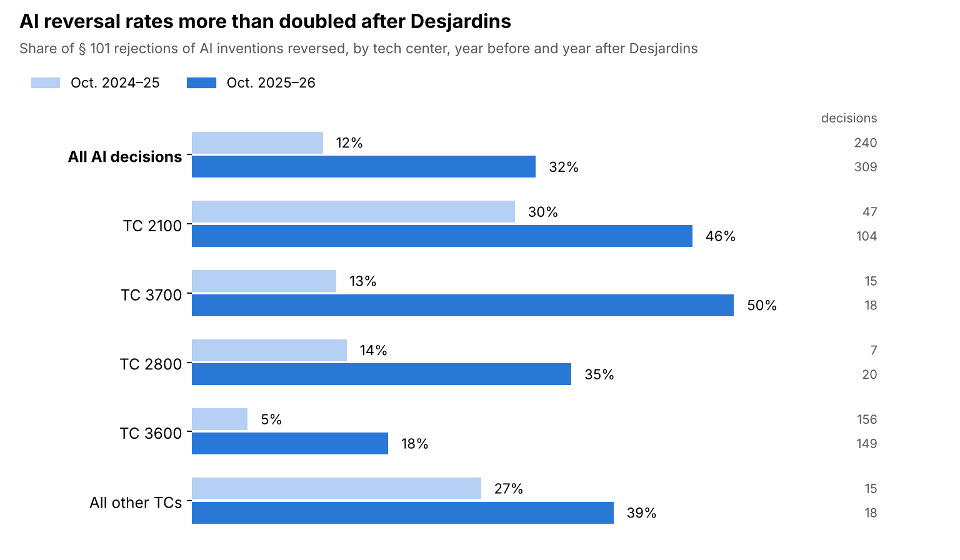
Exhibit 1 · USPTO Open Data Portal, PTAB decisions on 101 rejections of AI inventions, 10/18/2024–10/18/2026; reversed in full or in part
Examiners in the business method art units examine inventions for commercial or financial processes, where the asserted improvement tends to be an improvement to the business practice itself, and the PTAB rarely calls that a technological improvement. TC 2100 claims more often recite how a computer or model operates, which is exactly what Desjardins protects. Still, the tripling of TC 3600 reversals shows how broadly Desjardins has helped patent applicants.
Practice tip: as the usual advice goes, draft applications to stay out of the business method art units, for example by describing inventions in terms of computer operations and data structure retrievals. But if you end up in front of an examiner with a very low allowance rate, appeal might be reasonable option in the business method art units.
Finding 2: Step 2A, Prong Two, Decides Most Reversals
Most AI reversals turned on Step 2A, Prong Two, and the PTAB usually got there by assuming the Examiner was right at Prong One. Panels routinely write some version of “even if claim 1 recites an abstract idea” and then reverse on integration. See Ex parte Asif, Appeal 2025-002672, at 6; Ex parte Schulz, Appeal 2025-003096, at 4. Prong Two decided 69% of AI reversals in the year after Desjardins, up from 41%. Claims that improve how a machine learning model trains or operates drove almost all of the growth, going from six reversals to 44.
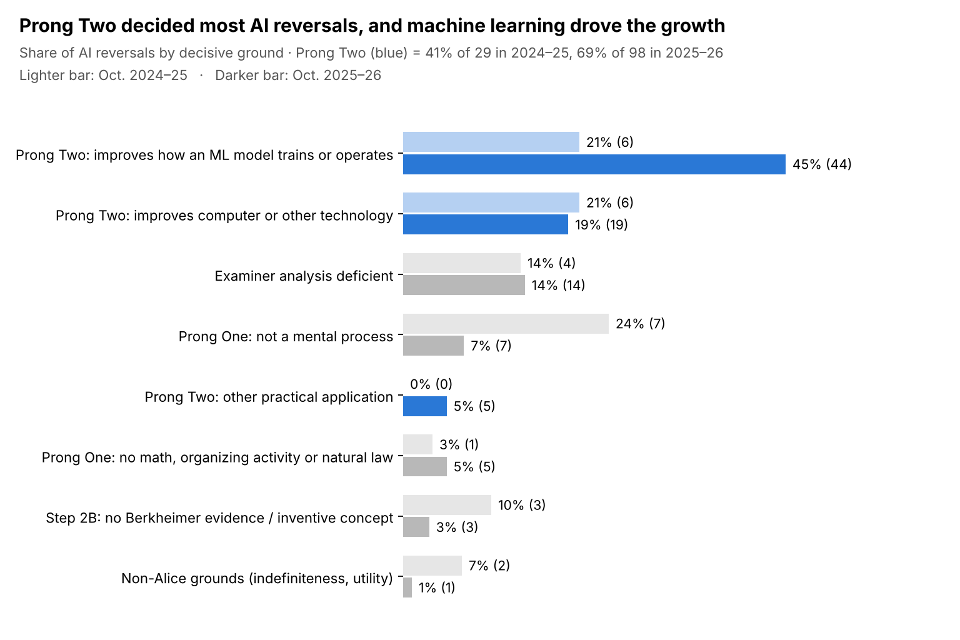
Exhibit 2 · 29 AI reversals in 2024–25 and 98 in 2025–26, coded by the PTAB’s decisive ground
The PTAB cited Desjardins in 52 of the 98 AI reversals and distinguished Recentive in 24, up from three. The winning machine learning claims looked alike: they recited a specific training or operating step, and the specification explained the technical problem that step solved.
- Feature selection that improves training. In Ex parte Stephens, Appeal 2026-001132, the claims trained intermediate models, ranked features by importance and trained the final model on the selected features. The PTAB held that “like Desjardins, the claimed invention is directed to an improvement in the way that a machine learning model is trained.” at 12.
- Training steps belong at Prong Two. In Ex parte Favre, Appeal 2026-001749, the PTAB held that iterative retraining steps “should have been analyzed under step 2A, prong 2, and step 2B, and should not be part of the abstract idea under 2A, prong 1.” at 4.
- Steps that go to the model itself. The recited steps “are not merely generic machine learning steps. Instead, they go to the heart of how the machine learning model itself operates.” Schulz, at 6.
- Distinguishing Recentive. Claims that “go beyond generically applying iterative machine learning model training,” Ex parte Verma, Appeal 2025-000739, at 15, or that do “not perform a task previously undertaken by humans,” Ex parte Chen, Appeal 2026-001932, at 7, are not Recentive
Practice tip: describe the technical improvement in the specification and tie it to the claim language, including in the dependent claims. Write the improvement as the model or computer improving, not the math, and answer Recentive before the examiner raises it by showing that the claim recites how you train or structure the model.
Finding 3: The Examiner’s Analysis is Often the Weak Point
About one AI reversal in seven (14 decisions) turned on a gap in the Examiner’s analysis, often while the PTAB agreed the claims recited an abstract idea. These reversals are underrated. They do not require the PTAB to accept a theory of technological improvement, only to see that the Examiner did not do the work. The year before, the share was about the same (4 of 29).
- Calling everything an improvement to the abstract idea. In Favre, the PTAB rejected a conclusion that “at best, the claimed combination amounts to an improvement to the abstract idea” because the Examiner never explained why the recited limitations were not a practical application. Favre, at 5.
- Unsupported extra-solution findings. Labeling a limitation “insignificant extra-solution activity” requires evidence or reasoning, not just the label. Ex parte Yi, Appeal 2025-003340, at 12–13.
- Oversimplifying the claim and ignoring the specification. An oversimplified characterization may show the claim involves an abstract idea, but it does not show the claim as a whole is directed to one. Ex parte Williams, Appeal 2025-001079, at 7.
Practice tip: build your Appeal Brief around what the Examiner actually wrote. Set the Examiner’s characterization beside the claim language and attack the limitations the Examiner never addressed. Even a skeptical panel will reverse a rejection built on skipped steps. Cite PTAB reversals from the same art unit, especially of the same examiner.
Finding 4: What did not carry appeals
Prong One alone rarely wins. Arguments that the claim does not recite a mental process decided only about 7% of AI reversals, down from 24% the year before. Where one did win, it rested on specific operations the human mind is not equipped to perform, not on volume or speed alone.
The August 4 memo and Berkheimer did little work. The USPTO’s pro-patent eligibilty memo “Reminders on evaluating subject matter eligibility of claims under 35 U.S.C. 101” from August 4, 2025 appears in only four AI reversals, and Berkheimer arguments drove only three. Step 2B as a whole fell from 10% of AI reversals to 3%, and those wins were mostly procedural: the PTAB sent the case back for lack of evidence of conventionality without deciding patent eligibility on the merits.
“The Examiner found no prior art” is not a Step 2B argument. Novelty and patent eligibility are separate inquiries, a point a dissent in Ex parte Rahmes, Appeal 2026-001993, made directly.
What to Watch
The Desjardins bump is fading. In the year before Desjardins, the quarterly reversal rate for AI inventions averaged 12% and never topped 22%. It jumped to 42.0% in the fourth quarter of 2025, then fell to 36.0% and 21.5%, and held at 21.8% in the third quarter of 2026. That is well off the peak, but still nearly double the old average. Patent examiners may have learned to write Examiner’s Answers that engage with Desjardins, or panels may be reading Desjardins more narrowly. Either way, the claim language has to carry more of the load.
These are PTAB decisions. Only Desjardins is precedential, and none of this binds a district court. But for an applicant facing a 101 rejection today, appeal is a realistic path when the specification identifies a technical problem and the claim recites the solution.
So, Did It Have Any Impact?
Unlike most Director moves, this one did, at least at the PTAB. The 101 reversal rate for AI inventions jumped about two and a half times and rose in every major tech center, and reversals for improving how a model trains or operates went from six to 44. But just because Desjardins had an impact does not mean you should mention it to your significant other. Save that conversation for other patent nerds.
In future articles, I will examine the substantive effects of Desjardins on PTAB case law and examiner decision-making.
The charts in this article were created by Claude using publicly available USPTO data.
Image Source: Deposit Photos
Author: Wavebreakmedia
Image ID: 1996574














Join the Discussion
No comments yet. Add my comment.
Add Comment