


 0
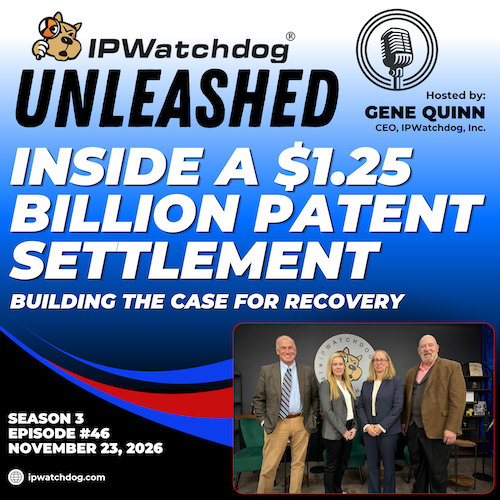
This week on IPWatchdog Unleashed, I spoke with Jon Putnam, Lindsey Miller, and Jane Love. Our conversation took place during our annual Life Sciences Program and examined a fundamental challenge in patent enforcement: translating a strong infringement case into a meaningful economic recovery.
The conversation begins with the ViiV Healthcare–Gilead litigation, which resulted in a $1.25 billion upfront settlement payment and a 3% ongoing royalty that, according to estimates discussed during the panel, could add approximately $3.7 billion to the recovery. Perhaps most strikingly, the infringement theory rested on the doctrine of equivalents. Miller explained how the assertion of chemical compound claims drew support from multiple forms of scientific evidence, including clinical data. The case illustrates how technical proof can reinforce the economic case, while underscoring the importance of the particular claims, competitive market, and commercial interests involved.
A central theme of our conversation is the importance of involving economists early enough so litigators can still obtain the documents and testimony needed to build a supportable damages theory based on admissible testimony, which in the era of heightened evidentiary requirements under Rule 702 of the Federal Rules of Evidence is not as easy as it once was. Waiting until expert reports are due often leaves critical questions unanswered and key evidence missing. A company’s development records may explain why it invested in one drug candidate over another, what clinical advantages it expected, and how those advantages were projected to translate into sales. Those contemporaneous business judgments can help demonstrate the patented invention’s economic value. Early involvement from and coordination with an economist helps litigators identify and pursue that evidence before discovery closes.
The discussion also distinguishes settlement value from damages recoverable at trial. A negotiated resolution reflects litigation risk, future business considerations, and the structure of the payment obligation. An upfront payment and a running royalty serve different commercial purposes and allocate uncertainty differently. Understanding why a resolution could make economic sense to both parties requires looking beyond the headline number. For patent owners, that perspective helps align enforcement strategy with business objectives rather than treating the largest conceivable upfront payment or verdict as the only measure of success.
Competitive alternatives are equally important, even in life sciences patent damages analysis. As is the case in all types of patent litigation, every sale by an accused infringer does not necessarily represent a lost sale for the patent owner. The panel considers how prescription data and market analysis can test substitutability, particularly as treatments become more complex and differentiated. Safety, efficacy, dosing, and patient compliance may all contribute to the commercial story and should be told but will require evidence gathered during discovery.
Telling the story and building the record also requires anticipating appellate scrutiny. Love emphasized developing facts for issues that may appear secondary early in litigation but ultimately become decisive. Miller stressed selecting trial counsel who begin developing themes and plan for contingencies from the outset. Putnam’s discussion of Rule 702 reinforced the need for rigorous economic analysis of the market that would have existed without infringement. Together, their observations carry a practical message for those controlling litigation budgets: postponing essential investigation will almost certainly leave gaps that neither a persuasive expert nor an experienced trial lawyer can repair later, specifically when the case ultimately reaches the Federal Circuit and there is little or nothing in the record relevant to what otherwise could be a winning argument on appeal.
The broader lesson is that the decisions that shape the outcome from a patent owner’s perspective occur long before trial. Thorough preparation for trial and appeal from the earliest stages strengthens the opportunity for settlement; and when the case doesn’t settle that preparation will dramatically enhance the likelihood of a favorable verdict. Selecting counsel with trial experience, involving an economist during fact discovery, and coordinating technical proof with damages analysis establish the foundation for a credible recovery strategy. Those early choices determine whether the record demonstrates the invention’s commercial significance, addresses noninfringing alternatives, and supports a valuation that can withstand scrutiny at trial and on appeal.
More IPWatchdog Unleashed
You can listen to the entire podcast episode by downloading it wherever you normally access podcasts or by visiting IPWatchdog Unleashed on Buzzsprout. You can also listen to IPWatchdog Unleashed conversations on the IPWatchdog YouTube channel. For more IPWatchdog Unleashed, see below for our growing archive of previous episodes.









Join the Discussion
No comments yet. Add my comment.
Add Comment