


 0
“Terms such as ‘basis for customer demand’ or ‘driver of demand,’ while central to the EMVR inquiry, are not inherently legal constructs; rather, they implicate economic questions about consumer choice, product differentiation, and value attribution in multi-component products.”
 In a previous article, we examined the legal foundations of the entire market value rule (EMVR) and its relationship to apportionment, highlighting the U.S. Court of Appeals for the Federal Circuit’s repeated emphasis on tying damages to the value of the patented invention. Yet, as that discussion suggests, the doctrine’s most challenging aspects arise not from its articulation, but from its application. Terms such as “basis for customer demand” or “driver of demand,” while central to the EMVR inquiry, are not inherently legal constructs; rather, they implicate economic questions about consumer choice, product differentiation, and value attribution in multi-component products.
This article approaches EMVR through that economic lens. It examines how the “driver of demand” concept can be interpreted using established economic principles.
Economics 101
What is “customer demand”?
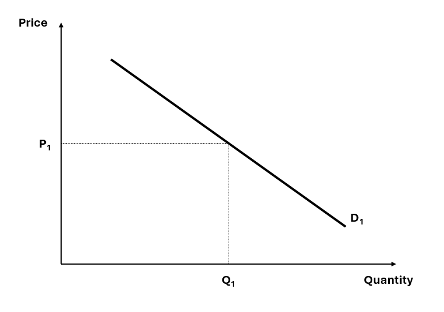
Customer demand (also referred to as consumer demand, or simply demand), reflects consumers’ willingness and ability to purchase a product or service, given their preferences and the product’s features. A demand curve depicts the relationship between the price and the quantity demanded at each price, holding other factors (like substitutes, or income) constant.
The law of demand provides that, all else being equal, quantity demanded moves inversely with price—the higher (lower) the price, the lower (higher) the quantity demanded. As the court observed in Crystal Semiconductor: “All markets must respect the law of demand.”
The graph below illustrates a demand curve D1 that represents the law of demand. At price P1, consumers demand quantity Q1.
What is a “driver of demand”?
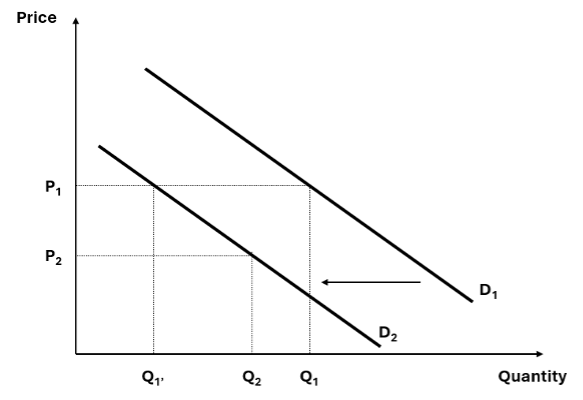
From an economic perspective, a “driver of demand” is any non-price factor that shifts the demand curve. These factors may include product features, consumer income, consumer expectations, economic shocks, policy changes, or prices of substitutes. In essence, if consumers value and are willing to pay for a particular feature, that feature influences the demand curve and thus can be considered as a “driver of demand.”
The graph below illustrates a downward shift in the demand curve resulting from the removal of a valued feature (e.g., the patented feature or a patented technology that enhances that feature) in a product. At the original price (P1), fewer units are demanded Q1’ < Q1. In response to this shift, a profit-maximizing firm would lower price (P2 < P1) to partially offset the decrease in demand Q1’ < Q2 < Q1.
Economic Interpretations of the EMVR
Recall that the EMVR exception has been articulated in several ways, including where the patented feature:
- “is the basis for customer demand.”—Rite-Hite Corp. v. Kelley Co.
- “drives demand for the entire product.”—LaserDynamics, Inc. v. Quanta Computer, Inc.
- “is the sole driver of customer demand”—Power Integrations, Inc. v. Fairchild Semiconductor International, Inc.
It is worth noting that a feature that “drives demand” is conceptually not the same as one that is “the basis for customer demand” or “the sole driver of customer demand.” As explained above, many product attributes can shift the demand curve and thus qualify, in an economic sense, as a “driver of demand.” On the other hand, describing a feature as the “basis” or the “sole driver” of demand implies a far more stringent condition. There are two ways to interpret this condition.
First, following the interpretation suggested in Power Integrations, a “sole driver” means that the feature is the only reason that consumers buy the product. Under this view, if consumers derive value from any additional feature, the asserted feature cannot be the “sole driver.” This interpretation would almost never be satisfied in practice, particularly for multi-feature products, as it effectively requires that the patented feature constitutes the product itself. Nonetheless, this appears to be the paradigm often contemplated in patent litigation.
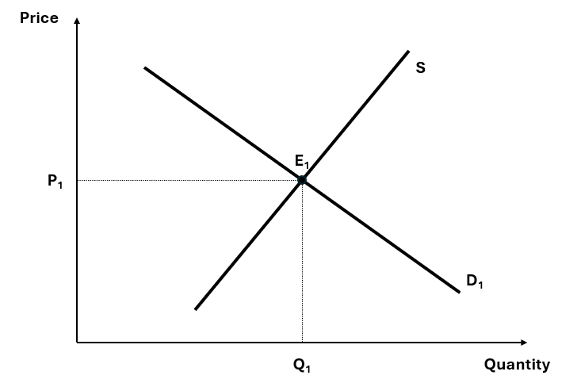
Second, the “sole driver” condition can be interpreted in economic terms as a scenario in which demand collapses to zero in the absence of the feature. To see this, it is useful to incorporate the supply side, specifically, the supply curve (“S”), into the analysis. Consider smartphones, for example, which are inherently multi-feature products, and suppose the patented feature is the ability to take photos. In the initial equilibrium (E1), where a firm’s supply and consumer’s demand for the firm’s smartphones intersect, Q1 units are sold at price P1.
If the photo-taking capability is removed, the demand curve shifts downward to D2.
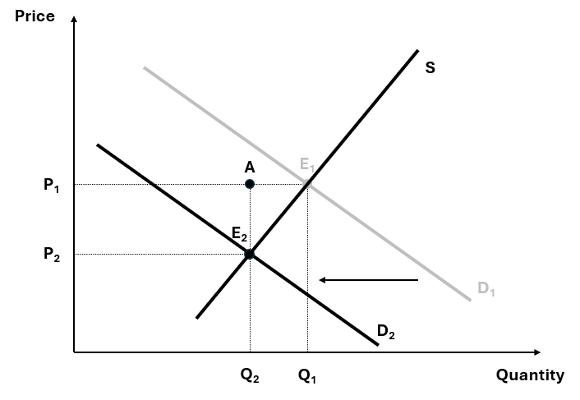
At the original price P1, demand (consumer’s willingness to pay) and supply (firm’s willingness to sell) no longer intersect. In other words, market equilibrium does not exist at price P1. While a new (hypothetical) equilibrium (E2) may exist at a lower price P2 and quantity Q2, this outcome is only relevant if production remains economically viable. If the price consumers are willing to pay falls below the firm’s cost of production, for example, a profit-maximizing firm would not continue selling this product.
Accordingly, even if some residual consumer demand exists in a technical sense, the product would no longer be offered in the market. In practical terms, quantity sold falls to zero. In this scenario, the patented feature can reasonably be characterized as the “basis for” or “sole driver” of demand.
This raises an important legal question: does this scenario qualify for the EMVR exception?
The “partial” scenario
Even if it remains profitable for the firm to sell at the lower price P2 and the new equilibrium E2 exists, the reduction in quantity from Q1 to Q2 reflects a segment of consumers who no longer purchase the product in the absence of the patented feature. For a subset of consumers, the feature was effectively the “basis for [their] demand” or “the sole driver of [their] demand.”
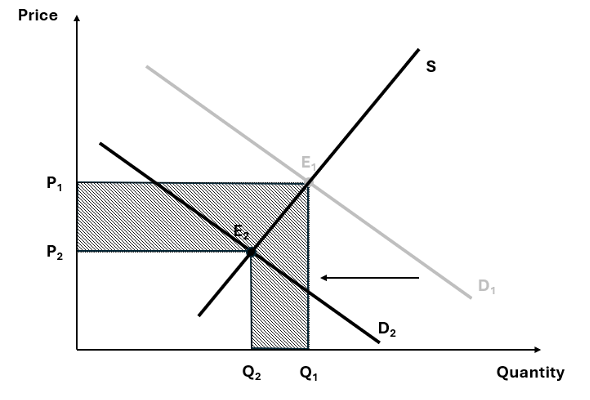
This raises another question: where a patented feature is dispositive for only a subset of consumers, should the EMVR exception be applied to this group of consumers? Put differently, and setting aside production costs, the patented feature caused a gain in the firm’s sales (the shaded area in the graph above). Can the patentee claim that gain as the incremental value of the invention?
From an economic perspective, the answer to both questions is yes. The extent to which courts will embrace this interpretation, and how it may shape the application of the EMVR in patent damages, remains an important question for future courts to address.
Image Source: Deposit Photos
Author: zimmytws
Image ID: 61513531














Join the Discussion
No comments yet. Add my comment.
Add Comment