
![[IPWatchdog Logo]](https://ipwatchdog.com/wp-content/themes/IPWatchdog%20-%202023/assets/images/temp/logo-small@2x.png)

 0
0 “A conventional application of case-based reasoning, even to a novel environment, is abstract.” – CAFC
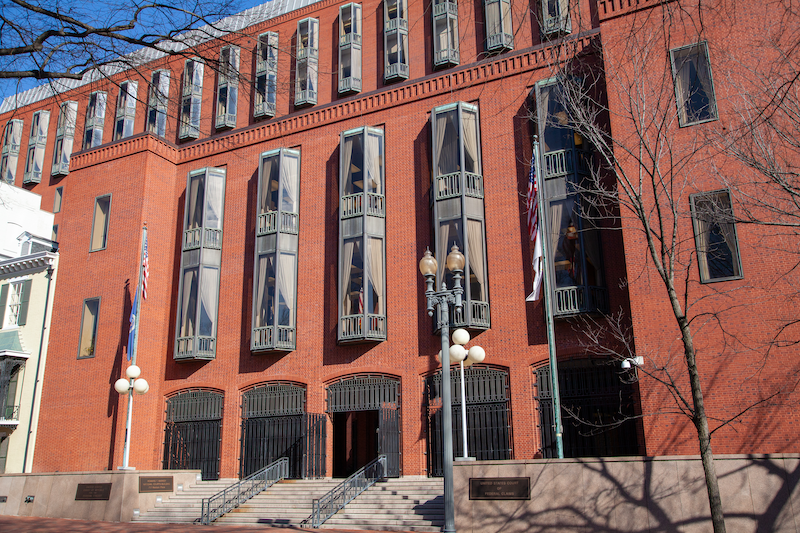 The U.S. Court of Appeals for the Federal Circuit (CAFC) today affirmed a summary judgment ruling from the United States District Court for the Northern District of New York finding the claims of a natural language processing patent asserted against Amazon.com, Inc. invalid for being directed to ineligible subject matter.
Rensselaer Polytechnic Institute and CF Dynamic Advances LLC originally brought the lawsuit against Amazon for infringement of United States Patent No. 7,177,798, which discloses a “method for processing a natural language input provided by a user.” Rensselaer argued that the patent was “directed to the novel application of case-based reasoning to a metadata database within [natural language processing].” The patent describes case-based reasoning as a form of machine learning or artificial intelligence that uses past information to resolve ambiguities in human language. Amazon filed a counterclaim by seeking a determination that the ‘798 patent was directed to patent-ineligible subject matter.
In the district court proceedings, Rensselaer and Amazon cross-moved for summary judgment. The district court concluded that the patent claims were ineligible under the Supreme Court’s framework established in Alice Corp. v. CLS Bank Int’l and granted Amazon’s motion. Then, Rensselaer appealed the decision to the Federal Circuit.
In its analysis, the Federal Circuit first addressed step one of the Alice test, which asks whether the claims are directed to a patent-ineligible concept such as an abstract idea. The appellate court agreed with the lower court that the claims were abstract. Judge Dyk writing for the court, noted that the claims recited the use of a “general purpose computer system” and is “not limited to a particular computer system platform, processor, operating system, or network.”
Rensselaer argued that the claimed improvement was the “novel application” of case-based reasoning to natural language processing. However, the Federal Circuit disagreed, relying on its 2025 decision in Recentive Analytics, Inc. v. Fox Corp. The court explained that the “generic use of AI without other parameters, such as ‘improving the mathematical algorithm or making machine learning better,’ is abstract.” It followed from this precedent that applying a well-established idea, such as AI, to a new environment and natural language processing, is abstract at step one of the Alice analysis. The opinion noted that Rensselaer conceded that under Recentive, claims requiring nothing more than the application of AI to a new environment are directed to an abstract idea.
The court also rejected Rensselaer’s argument that the claimed “metadata database” represented an unconventional technological improvement that rendered the claims non-abstract. The claims recited a database comprising information types such as case information, keywords, information models, and database values. The court found that the use of case information was simply the abstract application of AI in a new environment. For the other elements, the court determined they were conventional and that the patent’s specification described a metadata database as “well-known in the art” and the use of keywords as conventional. Furthermore, Amazon’s expert had testified that the metadata database was “well-understood, routine, and conventional.” The Federal Circuit found that Rensselaer had failed to produce evidence to create a genuine dispute of fact that the database was unconventional, stating that “Attorney argument is no substitute for evidence.”
In the second step of the Alice analysis, the court considered whether the claims contained an “inventive concept” sufficient to transform the abstract idea into a patent-eligible application. Rensselaer contended that case-based reasoning had not existed in the natural language processing field before its invention. The Federal Circuit found these arguments addressed novelty, not the inventive concept inquiry, and reiterated its holding in Recentive that the use of AI in a novel field is not an inventive concept at step two. “A conventional application of case-based reasoning, even to a novel environment, is abstract,” the court wrote. Therefore, the application of case-based reasoning to natural language processing did not provide an inventive concept sufficient to save the claims.
The Federal Circuit therefore affirmed the district court’s judgment, concluding that the claims of the ‘798 patent are directed to ineligible subject matter under 35 U.S.C. § 101, and awarded costs to Amazon.
![[Advertisement]](https://ipwatchdog.com/wp-content/uploads/2026/09/Life-Sciences-2026-sidebar-super-early-bird-ends-Sep-7-700x500-2.jpg)
![[Advertisement]](https://ipwatchdog.com/wp-content/uploads/2026/09/IP-Copilot-Sep-8-2026-sidebar-700x500-1.jpg)
![[Advertisement]](https://ipwatchdog.com/wp-content/uploads/2026/09/Ankar-AI-Sep-10-2026-sidebar-700x500-1.jpg)
![[Advertisement]](https://ipwatchdog.com/wp-content/uploads/2026/06/Womens-IP-Forum-2026-sidebar-regular-price-700x500-rev1.jpg)
![[Advertisement]](https://ipwatchdog.com/wp-content/uploads/2026/07/Juristat-Varsity-Ad-2026-IPW-ad-Solo_1.png)
![[Advertisement]](https://ipwatchdog.com/wp-content/uploads/2026/08/OneTransform_700x500_v1-REVISED.jpg)
![[Advertisement]](https://ipwatchdog.com/wp-content/uploads/2024/09/Patent-Prosecution-Training-sidebar-700x500-2025-03-27.jpg)




![[Advertisement]](https://ipwatchdog.com/wp-content/uploads/2021/12/WEBINAR-336-x-280-px.png)
![[Advertisement]](https://ipwatchdog.com/wp-content/uploads/2021/12/Ad-4-The-Invent-Patent-System™.png)





Join the Discussion
No comments yet.