


 0
“A proper determination on infringement… requires resolving—to at least some extent—the parties’ claim-construction dispute over ‘manifold.’” – CAFC
 The U.S. Court of Appeals for the Federal Circuit (CAFC) on Wednesday vacated a judgment of no infringement and affirmed a validity finding for patent owner Edge Systems LLC. The nonprecedential opinion was authored by Judge Prost and joined by Judges Hughes and Cunningham.
Edge had sued Cartessa Aesthetics, LLC in the U.S. District Court for the Eastern District of New York, alleging infringement of its U.S. Patent No. 9,550,052, titled “Console system for the treatment of skin.” Edge claimed Cartessa’s “Skinwave System” infringed the patent. The district court ultimately granted summary judgment of non-infringement to Cartessa and summary judgment of no invalidity to Edge, and Edge appealed the noninfringement finding.
On appeal, the CAFC first found that the district court should have resolved the parties’ claim construction dispute over the meaning of the word “manifold.” While Edge construed the term as “a closed space with several inlet pipes and one outlet,” Cartessa argued the manifold must be able to “combin[e] multiple sources into a single outlet,” which would mean the Skinwave system would not satisfy the elements of claim 1.
Under Edge’s construction, the CAFC said “we believe that a reasonable jury could find the relevant claim element(s) satisfied, at least with reference to the below image from the district court’s order”:
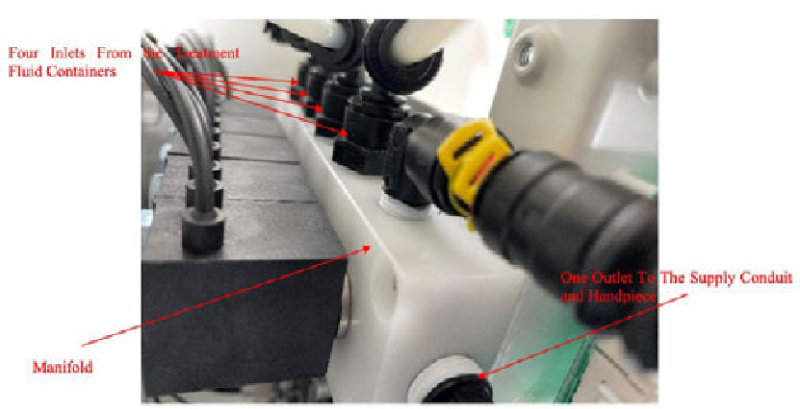
And, since Edge conceded that under Cartessa’s construction the Skinwave system does not infringe, “[a] proper determination on infringement therefore requires resolving—to at least some extent—the parties’ claim-construction dispute over ‘manifold.’”
The CAFC thus vacated and remanded for the district court to resolve in the first instance.
Although Cartessa argued Edge had waived its right to seek its preferred construction, the CAFC disagreed, and further rejected Cartessa’s proposed alternative grounds for affirming the summary judgment of noninfringement.
With respect to validity, the CAFC found that the prior art relied on by Cartessa, U.S. Patent No. 6,162,232 (“Shadduck”), to prove anticipation did not disclose “a system configured to let a user ‘select the treatment material [comprising a liquid] from the first fluid container or the at least second fluid container,’ as claim 1 of the ’052 patent requires.” While it was unclear whether the district court relied on this ground, and the CAFC said the order was confusing as to its reasoning, “even if the district court’s summary-judgment order did not rely on this ground, we may affirm a summary judgment ‘on a ground supported in the record but not addressed by the district court” if we conclude that there is no genuine issue as to a material fact.” The opinion dismissed Cartessa’s arguments with respect to Shadduck and affirmed the district court’s no invalidity finding, and vacated and remanded for further proceedings on infringement.















Join the Discussion
No comments yet. Add my comment.
Add Comment