


 1
1 “An en banc revision of the test as explained in Egyptian Goddess would have no impact on the ultimate outcome of Range of Motion.” – Judge Cunnigham’s Concurrence
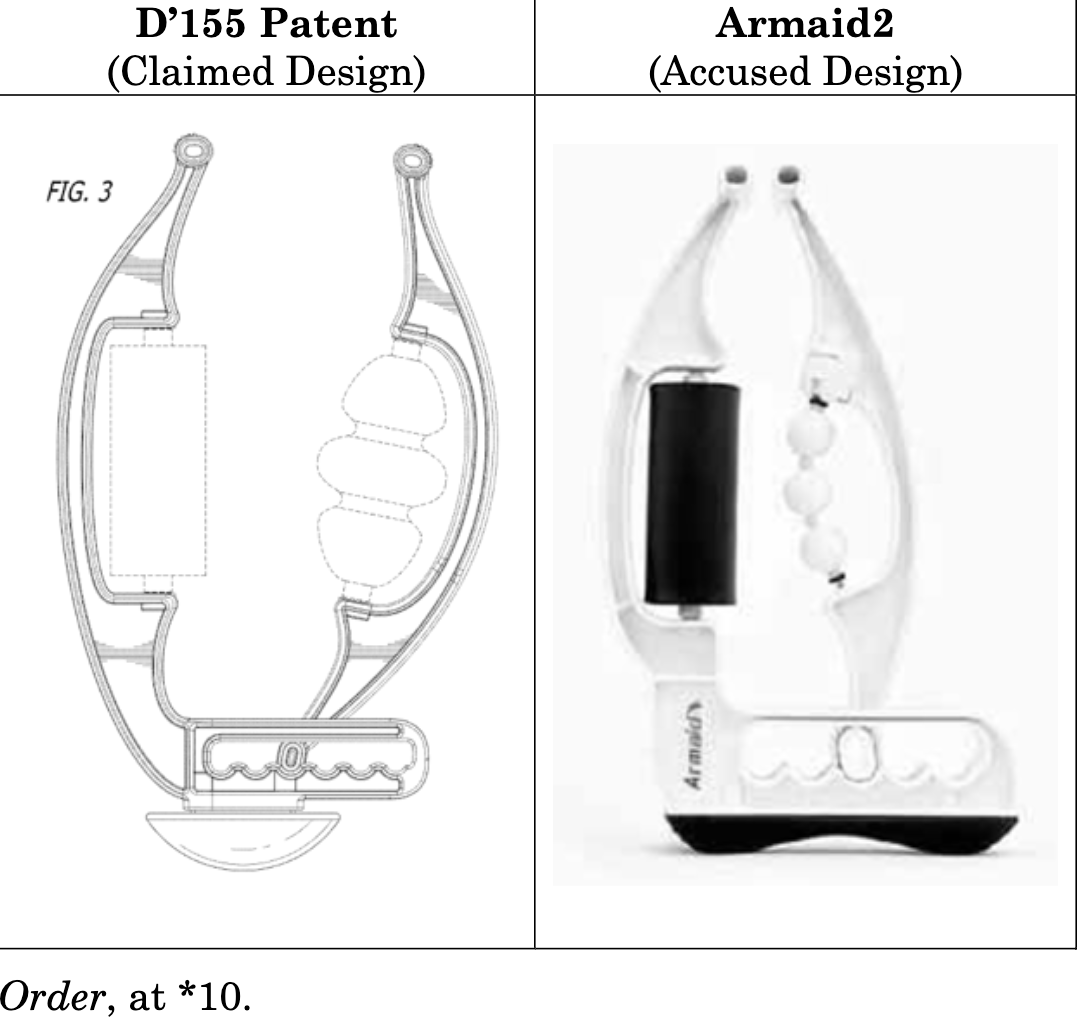 A split U.S. Court of Appeals for the Federal Circuit (CAFC) today denied a request for rehearing or rehearing en banc of a decision issued in February of this year relating to the proper test for determining design patent infringement. Six active judges voted to deny the petition, while two dissented with opinion and two dissented without opinion.
Judge Pauline Newman did not participate as she has been barred from hearing any cases at the panel or en banc level since 2023.
In the February precedential decision, the court affirmed a district court’s grant of summary judgment of non-infringement to Armaid Company, Inc. that its massage product did not infringe Range of Motion Products LLC’s (RoM’s) design patent claims. The opinion was authored by Judge Cunningham and Chief Judge Moore delivered a dissent in which she claimed her court has caused “the legal frame of reference” in design patent law cases to become “askew.”
In today’s denial of rehearing, Moore dissented again, joined by Judge Reyna, adding that the court has “messed up design patent infringement and essentially eliminated any role for the jury over what are quintessential jury-type fact questions.”
Panel Decision
RoM owns U.S. Design Patent No. D802,155, titled “Body Massaging Apparatus,” and sued Armaid in the U.S. District Court for the District of Maine, alleging that Armaid’s Armaid2 device infringed the claims of its patent, which are embodied in RoM’s Rolflex massage product. The district court determined that “many, but not all, of the design features in the D’155 patent—which the Rolflex embodied—are driven by function,” and that “the overall . . . scope of the claim is accordingly narrow,” and ultimately granted Armaid’s request for summary judgment of non-infringement.
On initial appeal to the CAFC, RoM argued that the district court erred in its claim construction “by eliminating entire structural elements from the claimed design.” But even if the claim construction was correct, RoM said the design of Armaid’s accused product is substantially similar to the Rolflex.
The CAFC agreed with the district court that the evidence in the record supported the finding that the shape of the arms claimed in the design patent is functional. The claims cover “limb-massaging apparatus[es]” with arms that “are shaped and dimensioned to adjustably clamp a limb between said first and second massaging members.”
As to whether the designs of the two products were substantially similar enough to withstand summary judgment of non-infringement, the majority said that “RoM and the dissent advocate for an approach that fails to respect the limits on a design patent’s scope.”
The CAFC said that RoM and Moore both argued that a mere side by side comparison of the two designs could determine that there is “substantial evidence of infringement” but that this approach does not take into account claim construction or separate out functional aspects. “By failing to ensure that functional aspects of a design do not play a role in the infringement analysis, the test endorsed by RoM and the dissent improperly seeks ‘to extend the scope of the patent far beyond the statutorily protected ‘new, original and ornamental design,’” wrote the CAFC.
Such reasoning would rule out summary judgment whenever functional aspects result in two designs sharing similarities, and would “render pointless our requirement to construe the claim.” The majority explained: “We reject the proposal to establish what amounts to an oversimplified version of the ordinary observer test that effectively eliminates the step of claim construction.” Detailing the district court’s analysis, the majority then concluded that the court did not reversibly err.
In her first dissent, Chief Judge Moore disagreed and said the district court erred by taking away the fact question of whether an ordinary observer would find the two designs to be substantially the same. Moore also identified a broader problem with the CAFC’s design patent jurisprudence:
“I confess that I considered ending the dissent here….
But alas, I have more to say. I believe there exists a small and easily solved problem in our design patent law that led the district court astray. A problem, which I confess, has infected several of our cases and which has been the subject of several amicus briefs to our court….
Without realizing it, in Egyptian Goddess, we meaningfully changed the substantial similarity test. We changed the frame of reference from whether two designs are substantially similar in overall appearance to whether two designs are ‘sufficiently distinct’ or ‘plainly dissimilar.’”
En Banc Denial
Today, Moore said that, in addition to “inadvertently” changing the substantial similarity test as described above, the court has also “messed up” by declaring “that claim construction includes determining which aspects of a design are functional versus ornamental.”
For Moore, the “error is obvious and the fix so easy,” namely, return to Gorham Mfg. Co. v. White, 81 U.S. 511, 528 (1871) and the “ordinary observer” test in which the determination is “whether an ordinary observer would find the two designs are substantially similar in overall appearance.”
But Judge Cunningham said in her concurrence in the denial, which was joined by Judge Hughes, that the panel’s decision is consistent with Supreme Court and Federal Circuit precedent and that, in any event, this case is not a good vehicle for review of the issues raised by the dissent:
“[T]he dissent urges that ‘[t]he factfinder should always compare the claimed and accused designs in light of the prior art.”… The district court in Range of Motion heeded that precise advice. It assessed the similarities and differences and conducted a three-way comparison to the prior art in its analysis, as described by Egyptian Goddess, determining under both analyses that no reasonable jury could find infringement. This court affirmed on both grounds…. An en banc revision of the test as explained in Egyptian Goddess would have no impact on the ultimate outcome of Range of Motion.”
The concurrence also criticized Moore’s dissent for voicing concerns over the assessment of functionality in design patent claim construction when she had failed to raise any such concerns in her original dissent. The concurrence argued that Moore’s and Range of Motion’s arguments that the functional-versus-ornamental inquiry in claim construction should go to the jury as a question of fact is counter to Supreme Court precedent in the utility patent context, which has held that “claim construction is a question of law for the court to decide.”
But Moore argued that design patents are unique and not suited to the same kind of judge advantage relevant to utility patents:
“Questions occurring within a design patent infringement trial, like the functional-ornamental fact finding, bear none of the hallmark indicia of judge advantage. For example, design patents are not ‘written instruments’ upon which a judge can bring his interpretative ‘training and discipline’ to bear…. Quite the opposite. Verbal descriptions frustrate, rather than aid, design patent claim construction.”
![[Advertisement]](https://ipwatchdog.com/wp-content/uploads/2026/10/BlackBox-IP-Oct-20-2026-sidebar-700x500-1.jpg)
![[Advertisement]](https://ipwatchdog.com/wp-content/uploads/2026/10/Questel-Oct-22-2026-sidebar-700x500-1.jpg)
![[Advertisement]](https://ipwatchdog.com/wp-content/uploads/2026/09/Life-Sciences-2026-sidebar-early-bird-ends-Oct-25-700x500-1.jpg)
![[Advertisement]](https://ipwatchdog.com/wp-content/uploads/2026/09/WE-BUY-PATENTS-SIM-IP-Ad-1-revised-on-Sep-28-2026-700x500-1.jpg)
![[Advertisement]](https://ipwatchdog.com/wp-content/uploads/2024/09/Patent-Prosecution-Training-sidebar-700x500-2025-03-27.jpg)








![[Advertisement]](https://ipwatchdog.com/wp-content/uploads/2021/12/WEBINAR-336-x-280-px.png)
![[Advertisement]](https://ipwatchdog.com/wp-content/uploads/2021/12/Ad-4-The-Invent-Patent-System™.png)







Join the Discussion
One comment so far. Add my comment.
Pro Say
August 13, 2026 12:24 am“in which she claimed her court has caused “the legal frame of reference” in design patent law cases to become “askew.”
Oh; you mean like what you and your anti-patent colleagues have done with utility patent claims eligibility?
You know. A body of decisions which are askew from the what SCOTUS (unconstitutionally) instructed with their Alice and Mayo decisions.
Add Comment