


 1
1 The mythology surrounding the act of invention tends to concentrate on the breakthrough moment. There is a flash of insight, a sketch is made on a cocktail napkin, the prototype is assembled in a garage to prove the brilliance of the concept. Unfortunately, commercial markets are considerably less romantic. They do not reward ideas merely because they are clever, patentable or even technically superior. They reward products that work, solve a problem customers recognize, can be manufactured at an economically sustainable price and generate an acceptable return for whoever assumes the risk of bringing them to market.
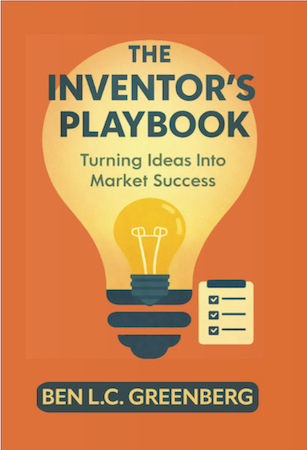
That distinction framed my recent conversation with Ben Greenberg of Inventions Unlimited, recorded before a live audience at IPWatchdog’s Patent Masters™ program. Greenberg is a mechanical and aerospace engineer who after working for NASA has spent years helping independent inventors, startups and smaller companies move from concept to prototype, manufacturing and commercialization. He is also the author of the recently published book titled The Inventor’s Playbook: Turning Ideas Into Market Success. His experience offers an important cautionary note to one of the most persistent misconceptions in intellectual property: that obtaining a patent is the culmination of the innovation process. In reality, a patent is only the beginning of what will often be a long journey.
A Patent Is the Beginning, Not the Business
Greenberg told me that the most common question he receives from inventors is simple: “can you sell my patent?” The question reveals how many inventors understand the commercialization process. They assume that the patent itself is the product—that once the government issues a certificate recognizing an exclusive right, a manufacturer or licensee will appear and pay for it. And while it is unfair to say that never happens, it is perfectly accurate to say that rarely happens.
Potential licensees generally want far more than a patent. They want evidence that the underlying product functions as intended, that it can be manufactured at an acceptable cost, that consumers will purchase it and that the market is large enough to justify the investment required to launch it. A patent may provide legal security, but it does not establish commercial demand.
Why Early Sales Matter, Even When They Lose Money
 As I explained during our conversation, if there is no demand, no one will make money trying to sell a product or service covered by a patent. And a prospective licensee confronts the same economic reality that an inventor would themselves. Before committing capital, it must determined whether the product can generate sufficient revenue to not only pay for manufacturing, marketing and distribution, but it also needs to return an acceptable profit to warrant the numerous risks being undertaken.
And that is why early sales matter, even when those sales are not profitable.
Inventors frequently resist this point. Many do not want to become manufacturers or retailers. They want to invent, obtain protection and license the technology to someone else. That is understandable, but it does not eliminate the need for market validation. It can often be extremely beneficial for an inventor to manufacture 100 units at a cost that cannot hope to be profitable because the goal of such a short run is to generate evidence and validate the market. By doing this the inventor removes one significant hurdle in the mind of a potential licensee—will anyone want to purchase the product?
Those initial transactions—even if they do not cover costs or even come close to covering costs—answer a series of critical questions. Will anyone buy the product? How difficult is the sale? How quickly does inventory move? What objections do customers raise? How do buyers actually use the product? How do buyers use the product once purchased? What features do they value, and what weaknesses become apparent only after the product reaches their hands?
Greenberg’s company addresses this problem by helping clients with small-batch manufacturing in plastics, metals, fabrics, electronics and other materials. The objective is not necessarily immediate profitability. It is to obtain enough real-world information to determine whether further investment is justified, and what improvements can and should be made.
Patent Strategy and Product Development Must Move Together
The same logic applies to crowdfunding and presales. Platforms such as Kickstarter can help demonstrate demand and provide capital, but public disclosure must be coordinated with patent strategy. Posting a product online before filing an appropriate patent application can create serious consequences, particularly for foreign rights. The sequencing of engineering, disclosure and patent filings therefore matters.
In some cases, filing a provisional patent application before extensive development may be prudent. In others, an inventor should first determine whether the concept works at all, provided the work is performed under appropriate confidentiality protections. Greenberg described a client who had already obtained an issued patent on a compact ratchet-related tool. When Greenberg’s team constructed the product substantially as disclosed, the underlying physics defeated the intended purpose. The tool produced torque, but the system rotated around the bolt instead of performing the expected function. So, the client owned a patent on an unworkable product.
That example illustrates a structural problem for independent inventors and small businesses. Large corporations typically bring legal, engineering, manufacturing, finance and marketing personnel into the development process at various stages. Each discipline tests the assumptions of the others. Independent inventors and small businesses must perform all of those functions themselves, usually with far less capital and experience, and often simultaneously.
Patent counsel may identify claims that can likely be obtained over the prior art, but those claims must also cover the product that will ultimately be manufactured and sold. Engineers may design an elegant solution, but that solution must be producible at a commercially viable cost. Manufacturers may simplify a design, but their changes must remain within the patent strategy. Marketing professionals may see demand, while finance personnel conclude that the opportunity is too small or risky to warrant investment. Simply stated, commercialization succeeds when those perspectives converge.
Technical Superiority Does Not Guarantee Adoption
Coordination is particularly important to commercial success because technical superiority does not guarantee adoption. During our discussion, I summarized the conventional product-development promise as “Better, stronger, faster, cheaper.” At first glance, a product possessing those attributes appears destined to succeed. Greenberg explained why the economics may still fail.
Consider an established company already earning millions of dollars from an existing product. A new invention may perform better and cost less but launching it could cannibalize the company’s current revenue. The company may need to invest heavily in tooling, manufacturing capacity, marketing and distribution. A lower-priced product may require substantially greater unit sales to produce the same return. Management must also account for the certainty of existing cash flow compared with the risk of an unproven alternative.
The engineering department may admire the invention, but the finance and marketing departments may still reject it.
Market Size Is Not the Same as Market Demand
Another problem we discussed was the unfortunate and predictable overestimation of market size by inventors. How often do inventors look at the population of the United States—roughly 350 million people—and say “if only half buy the product we will all be billionaires!” Obviously, that is unrealistic, and sadly that type of overestimation signals the inventor is not someone you can work with because they have unrealistic expectations.
But even where the inventor does not have objectively unreasonable expectations, they will often focus on the number of people who could theoretically use a product rather than the number likely to purchase it at a particular price. They underestimate competing products, regulatory barriers and substitutes—including imperfect substitutes consumers already consider good enough, although they may require a little more sweat to use.
The lesson is important: a product does not compete only with an identical item. A flat head shovel can substitute for a spade. A wrench can drive a nail, albeit inefficiently. Consumers regularly tolerate inconvenience rather than purchase a specialized product. Any credible market analysis must therefore examine not only direct competitors, but also the workarounds customers presently use.
Inventors must also distinguish between products people need and products they actively want. Necessities are not always easier to sell. Consumers often postpone purchasing tools that would improve efficiency while readily spending on hobbies, pets and recreation. Greenberg has seen strong results with golf, fishing and pet products because customers in those categories frequently spend to pursue enjoyment or because of an emotional attachment.
By contrast, medical devices and children’s products may address genuine needs but carry significant regulatory, testing and liability burdens. Automotive accessories operate in an intensely crowded market that is often dominated by the largest companies in the world. The lesson is that a product may be useful and technically sound but still occupy an unattractive commercial category.
Industry knowledge is therefore indispensable. Inventors who understand the customers, pricing, distribution channels, regulations and purchasing behavior within a market are disproportionately more likely to identify genuine opportunities. Those operating from the periphery often solve problems that customers do not regard as important—or build solutions incompatible with how the industry actually operates.
Validate Before You Escalate
Greenberg repeatedly returned to one imperative: “validate, validate, validate.” Validate the physics. Validate the prototype. Validate manufacturability. Validate the market. Validate pricing. Validate consumer interest. Validate the economics from the perspective of the company expected to manufacture or license the invention.
Validation should also be staged. A looks-like prototype may establish dimensions and appearance. A works-like prototype may demonstrate functionality. A minimum viable product can support user testing, small-batch production and early sales. Each stage produces new information and presents a decision point.
The objective is not to eliminate risk; that is unreasonable to expect. Innovation necessarily involves uncertainty. The objective is to avoid assuming all of the risk at once and moving forward in a judicious manner only so long as things check out and the risk level remains acceptable. Indeed, as I emphasized near the end of our conversation, inventors should “invest incrementally only to the point where it continues to make sense.”
Slow and Steady Wins the Race
Greenberg described the philosophy another way: “slow and steady is fast.” That does not mean moving timidly. It means advancing in a disciplined manner, with each step designed to reduce uncertainty before substantial capital is committed.
The patent system can protect an invention, but it cannot make the invention function. It cannot create a market, lower manufacturing costs, produce customer demand or persuade a company to abandon a profitable incumbent product. Those are business and engineering challenges, and they must be confronted with the same rigor applied to patentability.
For inventors, the central lesson is not that they should be pessimistic, but rather that they should be practical. A patent can be an extraordinarily valuable asset when it protects a workable product, addresses a meaningful market and supports a credible business model. But the value comes from the combination—not from the patent standing alone. Those who will succeed proceed one step at a time, in a responsible fashion.
More IPWatchdog Unleashed
You can listen to the entire podcast episode by downloading it wherever you normally access podcasts or by visiting IPWatchdog Unleashed on Buzzsprout. You can also listen to IPWatchdog Unleashed conversations on the IPWatchdog YouTube channel. For more IPWatchdog Unleashed, see below for our growing archive of previous episodes.
![[Advertisement]](https://ipwatchdog.com/wp-content/uploads/2026/10/ClaimHit-Oct-28-2026-sidebar-700x500-1.jpg)
![[Advertisement]](https://ipwatchdog.com/wp-content/uploads/2026/10/Patsnap-Oct-29-2026-sidebar-700x500-1.jpg)
![[Advertisement]](https://ipwatchdog.com/wp-content/uploads/2026/09/Life-Sciences-2026-sidebar-early-bird-ends-Oct-25-700x500-1.jpg)
![[Advertisement]](https://ipwatchdog.com/wp-content/uploads/2024/09/Patent-Prosecution-Training-sidebar-700x500-2025-03-27.jpg)



![[Advertisement]](https://ipwatchdog.com/wp-content/uploads/2021/12/WEBINAR-336-x-280-px.png)
![[Advertisement]](https://ipwatchdog.com/wp-content/uploads/2021/12/Ad-4-The-Invent-Patent-System™.png)




Join the Discussion
One comment so far.
IP Nerd
July 16, 2026 11:03 amHere is some open-source notebook content before being submitted for legal terms considerations for official research and promotional contracts, as they help decide best contract fits “indemnity” descriptor. This could affect the “terms and conditions” of mobile devices’ traditional arcade-style games that use game logic for points or scores for community adoption. Arcade gaming versions should not currently include attorney referral or convertible intellectual property rights-building game pieces.
Idea-Cube w/IPNUTs (Game Boy) and Bitcoin (Tetris)
Two great products bundled as one product called Digital IP Rights, brought to you by Idea Squared and powered by Idea Cube. If the step of two products in one is too much of a leap for you too soon, Idea Plus offers peer review to learn game theory and an index of communities that pitch (some are free and some have paywalls) to you what they have to offer—whether you decide to lease Bitcoin, buy IPNUTs (IP Nerd utility tokens), or bundle them together for maximum attention exposure. If your token or intellectual property rights garner a big number, an attorney referral is available to help you understand the legal rights of your IP tokens. Utilizing AI is free, but if you want superior privacy, “terms and conditions” representatives often suggest bundling AI + Peer Review + Attorney to maximize services per dollar.
This revolutionary approach takes the one-step, two-step methodology of inventor services and combines it with 1-2-3 methods of innovation services, allowing gameplay backwards, forwards, and remixed. Many have started at step two, garnering interest with a black box selling tokens to pay for an attorney, a peer-review community, and next-gen AI—all with the human-interest story of selling an empty box to a venture capitalist. You may have a token and a written admission only that I have a trade secret, not that I have divulged the trade secret to a VC agreement. I trusted you enough for a market participant to earn current and/or future access to my account by owning a promotion token that morphed into an access token. I paid for the right to knock on your door and sold you the right to call my attorney. This was a verified use case discovered through Berkshire Hathaway subsidiary shareholder value analysis by redacted Distributor 4-digit during scientific method testing in the East Coast regions.
Block Building
The following Tetris pieces can be fit together in various combinations to get the highest or lowest scores in the campaign.
* **Single Block:** The single block can fit anywhere, since a one-bit, one-space unit has an infinite number of attachments in the game. We call the single block piece the “attorney referral.”
* **Double Block:** The double block is a two-bit, two-space piece. This is peer review, since your content gets one subject-matter-relevant market participant. The double block can extend to numbers above two but not below two, as long as you convert your Idea Plus IMP (Interactive Metadata Data) to a monthly subscription upgrade. Double blocks can convert to an unknown, higher-numbered block depending on how gameplay develops.
* **Zero or One Blocks:** These are called IPNUTs and can be collected in single, double, triple, quadruple, or the recommended 5-card pack. Each token gets you campaign piece rights and can be played together or separately. This piece has special powers, since they may Pac-Man other blocks to become a longer centipede, giving you a snake-like length imported from black-and-white to modern-day color technology.
* **Empty Block:** This is your intellectual property rights that exist as a pointer on-chain with no proprietary data exposure without your permission. Some empty blocks have common, uncommon, or legendary properties. The labels are determined by third-party graders and may have variable values, since block grading services are an immature business method in the marketplace. Sometimes empty boxes are not empty, but a wallet address showing how much Bitcoin you are leasing, own, or have joint custody with other token holders, community members, or treasury accounts. IP in the boxes is a limitless exposure concept. Empty blocks are inputs.
* **Zero Block:** A specialized AI LLM is a zero block, since you start with no prompts received. This is your project library organizer. Some successful IP traders utilize zero-block technology (ZBT: Zillions Billions Trillions Secret Society) and others do not utilize ZBTs. A zero block could be empty library shelves, or the Brooks Hatlen Library with lots of books to flywheel content with communities. Zero blocks are outputs.
How you arrange your five block sizes with up to five token stacks determines the largest deck you can build at the start of gameplay. The smallest deck you can start the game with is a block and a token. Once the game starts, you acquire all the blocks and tokens introduced into the World Series of Technology. New tokens cannot be added once a campaign (game) starts, but there are no limitations to how many blocks can be added to the campaign. This is why every campaign has a unique rating in the mindshare of the audience. Once a campaign is completed, the finished block is added to an immutable ledger as a reference point to study for unfinished and future blocks not added to the redacted chain.
Public Domain Reporting
Beware of derivatives. Many tokens are not utilized in live campaigns. Tokens can be upgraded or swapped, but you cannot add tokens to the group size numeration from decks into gameplay. The only way to get more tokens once a game starts is by obtaining them from other players or winning them in challenges to earn a halving-round advancement. Sideline tokens are considered derivatives for future campaigns or upgrade potential for deck-swappers. Intellectual property rights, attorneys, and timed token commodity contracts are not subject to platform rules but are overseen by the CFTC, and communications are monitored by the FTC and FCC. All local and federal laws and regulations of your jurisdiction apply, meaning consequences for illegal activities could result in fines, penalties, and imprisonment. We report token and account identifiers so that future considerations could affect your present positions.
American Inventors Protection Act
Is this the best set of incentives of dollar-per-result-per-effort that has ever been implemented in the inventor promotion service industry in the history of humanity? This record-breaking formula requires key ingredients of blockchain tokens, passive inheritance recipients, and community oversight to funnel low-effort dollars into innovative minds’ treasuries. The US jurisdiction is the most susceptible to identifying low-effort passive market participants due to complex intellectual property laws and those who confuse inheritance dollars as being as fungible as income dollars. Accountants will claim the dollars are equal, but this is a lack of understanding of what dollars buy and what humans value.
There is no better use case than the high-end escort industry with Veblen good services, yet a participant only has relations with one identity for free or a negative number. When egos conflate how much money they hold with their worth, they commit multiple sins simultaneously against universal energy laws. Money is simply worth less when trapped in outdated trust schemes, since updated trust schemes fare so much better in communication methods employed by humans on a mind-boggling scale in modern economic societies. The law, trust, and taste trends cannot keep up with the most empowering art and the mind-altering states they create.
The beginner’s mind often ignores the old playbook market research to focus on the most innovative new playbooks authored by “hell has no fury like an artist scorned.” We simply see different things when the ink blots are shown to us. We convey what we want to reveal to the presenter when abstract art becomes a weapon to collect and not a tool to heal. The mental state of emotions is often chosen by the source and invalidated by not-well-researched shareholders. Shareholders whose bags become their identity are adopting the views of others, attempting to ride coattails. This is especially dangerous when founder-led shares are derivated by copy traders who want to win the marathon without completing the 26-mile race. We literally told you the answer not once, but twice:
>> When building for effectiveness, you disregard fiction for value. When building for adoption, you minimize friction for scale.<<
Many continue to build for scale before effectiveness. This is often the venture capitalist's fault, since they bastardize projects thinking they bring more than capital to the table. Some may prefer capital injections with no identity reveals. Many projects only need the incentive tokens' “units of account,” since decentralized feedback filters are better-suited suggestions to save a founder's time and energy with project manifestations.
In this open-source blockchain project game, the speed and efficiency of the rails is the project. The riders' identity safety should be valued by those who care about you most, regardless of the starting and end point. When utilizing mass transit, every passenger's life is valued equally at infinity. If you want to be above others in all circumstances, may I suggest another transit system where you may create hierarchy?
Hierarchy can be purchased before and after travel destinations; however, when on the high-speed bullet train, safety is treated as public infrastructure for the donation-grease portion that keeps the gears from grinding. The NPO is the soul nutrient of the project that allows specific shareholders to have privileges other shareholders do not have. The utility of a community employee remembering your order at your favorite coffee shop is a potential gift, not a prospectus offering. The utility of the barber texting his Calendly with special incentives not offered to other clients is beyond the scope of Idea Cube share valuations. These are just good reasons to be respectful to your Mother Nature non-profit overseer, with your Father Time shares as your third-eye rib helper and platform standards organizer. As the globe adopts, behind every great IPO is a sustainable community mission.
## How to Breed Socialist Voters
A nation where landowners and capital accumulators respect bootstrapping, knowledge accumulation with execution abilities, and coordination of the poor (the Jesus ethos) should be a capitalist nation. However, if the social contract is broken, only a socialist nation can restore resolve; a nation’s constitution is a right and not a bureaucratic nightmare where landowners and capital accumulators create processes to lower the effectiveness of bootstrapping—requiring by law that the man with nothing but work boots take 100 steps instead of one step to pick up a penny on the ground, or be in violation of State Code 46.48. This is why State Code 46.48 directly increases the demand for boot sales, since labor wears out soles faster, requiring more replenishment of supplies. Simultaneously, men who oversee and monitor how work is conducted will need more boots to march to the Proud Boys' grand master, further increasing boot sales.
By deeming knowledge accumulation and execution abilities to have higher barriers of entry—through more expensive filing and registering for those who wish to access Section 1, Article 1, Clause 8 of the Constitution—we can arbitrage student debt market participants' proof of work to the proof-of-stake landowners and capital holders. As intellectual property rights become a game played only by the wealthy, corporate monopolies, and those with proximity to the banking sector, only licking the right boot of the right plantation owner will result in nutrient supplementation with artificially high prices controlled by the state.
Those who coordinate the poor will be dragged to the town hall and prosecuted by those who take pictures with lobby-hobby buyers. Those who take pictures with elected representatives in the house of communism—where taxation will provide free housing for the supreme leader—will be given premium seating arrangements and invited to ballroom parties at the house of communism. They will whisper tales of children claiming false inheritances and parental claims to target identities that match future pathways to prosecution promotions.
All the people will know, but we will increase military budgets while limiting armed militias to reduce the resolve of those who read the writings of Lineage heretics. This will create dependence on the state for those who need subsidies, and those who do not need or receive subsidies will be taxed to such a degree that landowners need not solicit land brokers for deed transfers. Land transfers will be negotiated in the ballroom of the house of communism, though formally by invite only. This will keep our property rights clean with centralized swaps in the most trusted hands.
Our children shall marry each other to consolidate wealth from the low-subsidy receivers and the high-taxation-per-capita new boot owners. High-subsidy receivers will be renamed "government contracts," which is why expectations of profits based on the efforts of others will be predictable and safe. Risk will be seen as a gambling device of the poor, and we will identify who needs to be prosecuted when they apply for shares with the Secretary instead of going to the factory for one day's pay for one day's work.