


 3
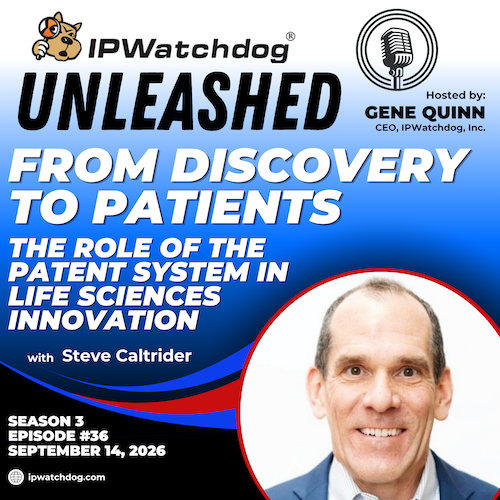
3 This week on IPWatchdog Unleashed, I spoke with Steve Caltrider. As Vice President and Chief Intellectual Property Officer at Dana-Farber Cancer Institute, and a former General Patent Counsel at Eli Lilly, Caltrider has worked at the highest levels of the pharmaceutical industry for more than four decades. Our wide-ranging conversation focused on how a reliable patent system supports the journey from scientific discovery to patient access—and on whether today’s system gives researchers, companies and investors enough confidence to take that journey.
At research institutions such as Dana-Farber, IP can be the bridge between an important discovery and the commercial partner needed to develop it. Caltrider described IP professionals as a critical part of that path: without the ability to protect and license an invention, promising work may never advance beyond the institution. He also pushed back on the idea that patient-focused research belongs only to the nonprofit world. In his experience, researchers and business teams in both nonprofit and for-profit settings are motivated by patient needs, even as each type of organization must find unique ways to attract sustainable funds to forward this important work.
Patent eligibility under Section 101 is especially consequential for diagnostics and emerging fields such as gene and cellular therapies. Caltrider warned that uncertainty about whether these inventions are patent eligible can chill investment, even when a court ultimately reaches a favorable result in a particular case. For life sciences innovators, the question is not only whether a discovery can be patented today, but whether the rules will remain predictable enough to support development over the years it takes to bring important life sciences innovations to patients.
The discussion also examined patent quality and the role of examination. Caltrider’s view is that the best time to establish confidence in a patent is when the USPTO examines it—not years later through PTAB review or district court litigation, after investment decisions have already been made. He recognized the need for an error-correction mechanism, while cautioning that review should not become so extensive or unpredictable that it undermines the value of issued patents. That balance matters to companies weighing commercialization, investors assessing risk, and smaller innovators with fewer resources to withstand prolonged disputes.
Patent prosecution practices are part of the same challenge. When applicants fear that candor with an examiner could later create inequitable conduct or prosecution history estoppel problems, they may have incentives to build a defensive record instead of focusing on the issues that determine patentability. Caltrider argued for a more productive examination dialogue and cautioned against letting hindsight drive obviousness analysis. For practitioners, that means considering not only how to secure claims, but how prosecution choices affect the reliability and enforceability of the patent that results.
AI could help improve that process by making prior-art searches more comprehensive and giving applicants earlier feedback on potential examination issues. Caltrider sees AI as a tool for finding the relevant “needle in the haystack,” allowing examiners to concentrate on applying the law and exercising judgment. He also raised the possibility of simplifying doctrines and practices that add complexity to examination. The goal, as he framed it, is not automation for its own sake, but stronger examination and greater confidence in patent rights.
The stakes extend beyond patent owners and the USPTO. In life sciences especially, uncertainty can affect which discoveries attract funding, which partnerships move forward, and ultimately which potential treatments reach patients. Caltrider’s message to the IP community is that system design matters: improve patent quality at the outset, preserve meaningful but proportionate review, and make it possible for applicants and examiners to engage candidly. The conversation offers a practical look at how those changes could support innovation while giving the public a more dependable patent system.
More IPWatchdog Unleashed
You can listen to the entire podcast episode by downloading it wherever you normally access podcasts or by visiting IPWatchdog Unleashed on Buzzsprout. You can also listen to IPWatchdog Unleashed conversations on the IPWatchdog YouTube channel. For more IPWatchdog Unleashed, see below for our growing archive of previous episodes.
![[Advertisement]](https://ipwatchdog.com/wp-content/uploads/2026/10/ClaimHit-Oct-28-2026-sidebar-700x500-1.jpg)
![[Advertisement]](https://ipwatchdog.com/wp-content/uploads/2026/10/Patsnap-Oct-29-2026-sidebar-700x500-1.jpg)
![[Advertisement]](https://ipwatchdog.com/wp-content/uploads/2024/09/Patent-Prosecution-Training-sidebar-700x500-2025-03-27.jpg)



![[Advertisement]](https://ipwatchdog.com/wp-content/uploads/2021/12/WEBINAR-336-x-280-px.png)
![[Advertisement]](https://ipwatchdog.com/wp-content/uploads/2021/12/Ad-4-The-Invent-Patent-System™.png)



Join the Discussion
3 comments so far. Add my comment.
John B
September 20, 2026 08:27 pmExcellent discussion from two of my favorites.
Jacek
September 16, 2026 08:34 amI think the statues are clear enough when comes to the “eligibility” No other nation in the world invented an “eligibility question” except, of course, the exceptionally wise Supreme Court bench legislating “Judicial exceptions” — ban on patents serving the interests of their “Vacations and RV donors. Now we are dealing with PERA. Muddying the eligibility question to the point of death of any future IP development in the US. PURE unadulterated CORRUPTION!!!
While the PERA claims to abrogate the abstract idea exception, it does not. In fact, it codifies it, enshrining this national security disaster in black letter law. What is the public policy justification for handicapping US innovation in ways no other country does?
Model 101
September 16, 2026 07:42 amNo!!!!!!!
Eligibility without reform will sink all patents.
Add Comment