
![[IPWatchdog Logo]](https://ipwatchdog.com/wp-content/themes/IPWatchdog%20-%202023/assets/images/temp/logo-small@2x.png)

 0
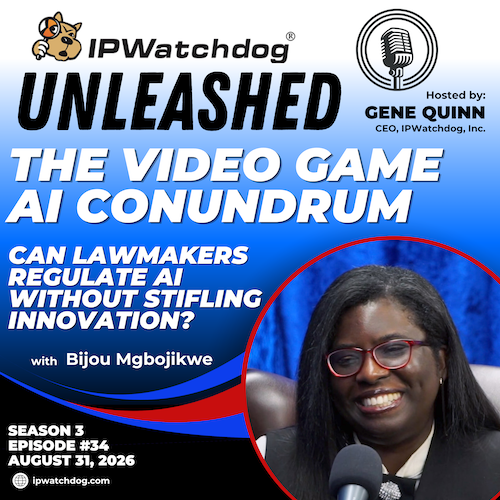
0 This week on IPWatchdog Unleashed, I spoke with Bijou Mgbojikwe, who serves as Senior Policy Counsel for the Entertainment Software Association. Our conversation examined the rapidly expanding intersection of artificial intelligence, intellectual property, and video game policy. Although generative AI has brought these questions into sharper public focus, the video game industry has used AI-enabled technologies for decades. That history makes the industry an important case study in how policymakers can address legitimate societal harms without restricting lawful creativity, technological development, or protected expression.
The central challenge is that legislation often treats very different technologies and use cases as though they present the same risks. Mgbojikwe discussed the distinction between harmful deepfakes and digital replicas used in legitimate creative works, including films and video games. Those concepts can implicate different legal frameworks, including right-of-publicity laws, copyright, consumer-protection statutes, and the First Amendment. When lawmakers combine them through broad definitions that are intended to prevent fraud, for example, legislation aimed at deception or abuse can inadvertently reach fictional characters, realistic game environments, and other expressive content.
That risk is particularly acute at the state level. Legislatures across the country are advancing AI legislation addressing transparency, disclosure, labeling, watermarking, content provenance, chatbot liability, discrimination, and online safety, with more than a thousand pieces of legislation seeking to regulate various aspects of AI across all 50 states. As I pointed out during our discussion, companies increasingly face this regulatory avalanche involving 50 states plus the federal government, with each jurisdiction often taking a different approach to similar issues. For businesses distributing digital content nationwide, the strictest state requirement inevitably will effectively become the national standard.
Mgbojikwe emphasized that this patchwork creates disproportionate burdens for smaller developers and emerging companies. A large enterprise may be able to absorb the cost of monitoring legislation, conducting compliance reviews, and retaining outside counsel in multiple jurisdictions. Small businesses and individual innovators almost certainly do not have those same resources. The result can be less competition, less experimentation, and fewer opportunities for newcomers to develop the next generation of creative and interactive experiences.
Our conversation also explored the problem of disclosure fatigue. A requirement that users be repeatedly told they are interacting with artificial intelligence may make sense in a high-risk setting involving employment, housing, finance, or health care. It makes considerably less sense in a video game, where players go into the interaction with the game in a fictitious universe understanding that non-player characters and fictional environments are computer-generated. Worse, excessive warnings would only interrupt game play without reducing the practically non-existent risk of deception. Regulation should be calibrated to actual harm, not simply to the presence of the word “AI.”
This same risk-based approach matters for content moderation and online safety. Video game companies have strong incentives to maintain safe and vibrant player communities, and they already use a combination of human review and AI tools to identify abusive conduct. A government-mandated, one-size-fits-all framework could interfere with those efforts by imposing rules designed for social media platforms on products that operate differently. Protecting children and consumers is a legitimate objective, but the language used to achieve that legitimate objective must account for the nature of the technology and the context in which it is used.
Ultimately, our discussion raised broader questions about whether existing law can address many of the problems now being presented as uniquely “AI” issues. Copyright, trademark, right-of-publicity, consumer-protection, and First Amendment doctrines already provide important tools. New legislation may be appropriate where genuine gaps exist, but lawmakers should first determine whether the problem is truly new and whether a proposed rule is narrowly tailored. For the video game industry—and for every technology sector built on software, creativity, and digital distribution—the stakes are substantial. The goal should be to prevent real harm while preserving the freedom to innovate.
More IPWatchdog Unleashed
You can listen to the entire podcast episode by downloading it wherever you normally access podcasts or by visiting IPWatchdog Unleashed on Buzzsprout. You can also listen to IPWatchdog Unleashed conversations on the IPWatchdog YouTube channel. For more IPWatchdog Unleashed, see below for our growing archive of previous episodes.
![[Advertisement]](https://ipwatchdog.com/wp-content/uploads/2026/06/Womens-IP-Forum-2026-sidebar-regular-price-700x500-rev1.jpg)
![[Advertisement]](https://ipwatchdog.com/wp-content/uploads/2026/09/WE-BUY-PATENTS-SIM-IP-Ad-1-700x500-1.jpeg)
![[Advertisement]](https://ipwatchdog.com/wp-content/uploads/2026/08/OneTransform_700x500_v1-REVISED.jpg)
![[Advertisement]](https://ipwatchdog.com/wp-content/uploads/2024/09/Patent-Prosecution-Training-sidebar-700x500-2025-03-27.jpg)





![[Advertisement]](https://ipwatchdog.com/wp-content/uploads/2021/12/WEBINAR-336-x-280-px.png)
![[Advertisement]](https://ipwatchdog.com/wp-content/uploads/2021/12/Ad-4-The-Invent-Patent-System™.png)




Join the Discussion
No comments yet. Add my comment.
Add Comment