
![[IPWatchdog Logo]](https://ipwatchdog.com/wp-content/themes/IPWatchdog%20-%202023/assets/images/temp/logo-small@2x.png)

 0
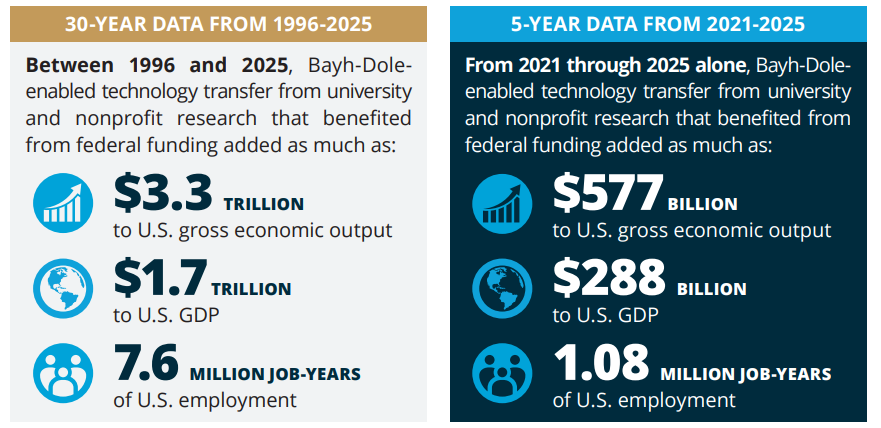
0 “From 2021 through 2025 alone, Bayh-Dole-enabled tech transfer generated up to $288 billion in U.S. GDP, $577 billion in gross economic output and supported 1.08 million job-years.” – Bayh-Dole Coalition Report
Source: Bayh-Dole Coalition Report
Today, the Bayh-Dole Coalition published a report detailing tremendous economic benefits driven by federal funding into American innovation made possible by the Bayh-Dole Act of 1980. Looking at the past three decades of available tech transfer licensing data, the Coalition’s report underscores the importance of the Bayh-Dole Act’s decentralization of patent ownership in federally-funded inventions, which has unlocked up to $3.3 trillion in gross economic output for the United States during the study period.
Economic Contributions Undermine Calls for March-In Rights, Patent Royalties
The report’s introduction notes that federal policymakers have increasingly called to re-centralize federal R&D funding to improve the effectiveness of commercializing inventions supported by that funding. Under former President Joe Biden, the federal government’s expanded use of march-in rights under the Bayh-Dole Act grew in popularity as a policy consideration. This February, the Government Accountability Office (GAO) issued a report based on tens of thousands of duplicative public comments while indicating that march-in rights could be used on more than pharmaceutical inventions. Under the Trump Administration, Commerce Secretary Howard Lutnick has proposed collecting royalties for the government on federally-funded inventions, though Lutnick publicly retreated from that stance earlier this year.
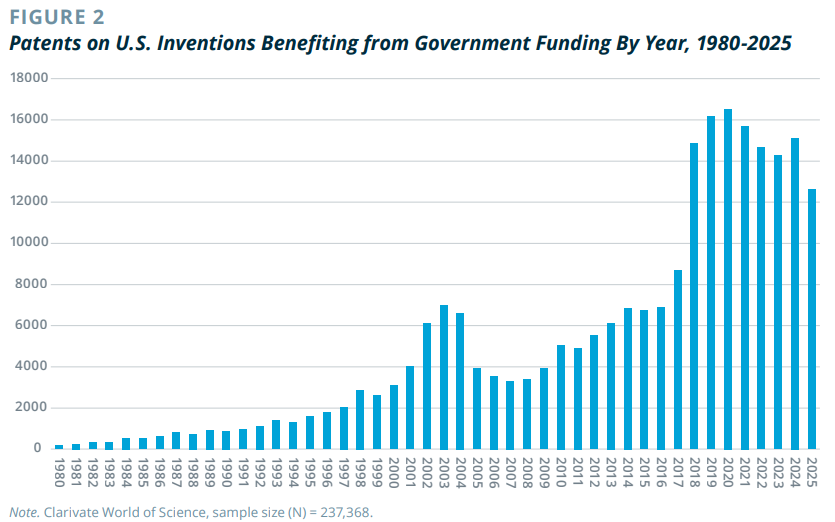
Prior to passage of the Bayh-Dole Act, only 5% of U.S. patents held by the federal government covering 28,000 inventions were licensed for commercialization. By contrast, allowing universities and other research institutions has supported an innovation explosion including the issue of more than 155,000 patents on federally-funded inventions from 2000 to 2024. According to the Coalition, the economic figures reflect that the Bayh-Dole Act is not simply good patent policy: “it is one of the nation’s most successful drivers of innovation, generating substantial returns for taxpayers while strengthening America’s long-term economic competitiveness.”
Tracing running royalty and other licensing data made available by the Association of University Technology Managers (AUTM), the Coalition reports that licensing of federally-funded inventions by nonprofit hospitals and research institutes (HRIs) and universities has generated at least $2.4 trillion in gross economic output. At the estimate’s higher end of $3.3 trillion, this translates into $1.7 trillion in contributions to U.S. gross domestic product (GDP) supporting the equivalent of 7.6 million job-years. From 2021 through 2025 alone, Bayh-Dole-enabled tech transfer generated up to $288 billion in U.S. GDP, $577 billion in gross economic output and supported 1.08 million job-years. The Coalition notes that these estimates are based on data self-reported by licensing managers, so these figures underestimate the actual economic impact of the Bayh-Dole Act.
Academia, Federal Government Flip Share of Patent Ownership Since Bayh-Dole Passed
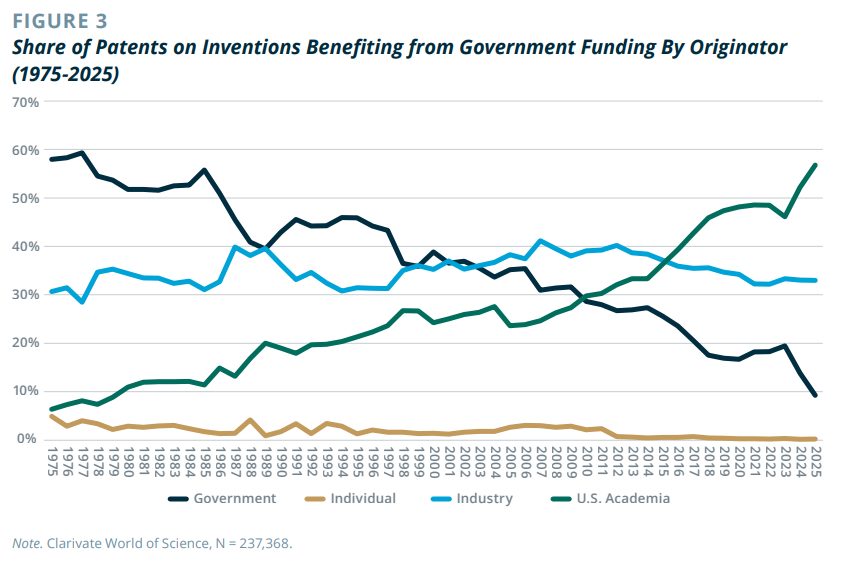
Since the Bayh-Dole Act was passed, the annual number of patents on inventions supported by federal funding has increased 70-fold, according to patent data from Clarivate and other sources. Those numbers hit a high-water mark in 2020, surpassing 16,000 patents issued on federally-funded inventions, although that number declined below 13,000 during 2025. While the share of patents issued to industry and individual inventors has stayed relatively stable since 1975, five years before the Bayh-Dole Act’s passage, the share of patents held by academia has essentially flipped with the number of patents held by government agencies, with academia now holding nearly 60% of patents issued on federally-funded inventions while government’s share has fallen below 10%.
 The number of revenue-generating licenses has also increased for American universities and HRI, with active licenses increasing from about 5,000 in 1992 up to more than 45,000 in 2025. However, less than 10,000 licenses were actively generating revenues in 2025, which demonstrates the gap between the early-stage nature of many of these patented inventions and the substantial additional research and development required to commercialize them.
Regionally, the Northeast held a leading position as a tech transfer hub with institutions across the region generating $8 billion in gross licensing income and an additional $4.2 billion in running royalties from 2021 to 2025. Tech transfer across the Northeast helped launch 4,823 startups and 2,331 new products during that same time period. Several notable pharmaceutical innovations stem from federal funding at research institutions across this region, with the Coalition noting in particular Yale University’s work on the HIV/AIDS therapy Zerit and the University of Pennsylvania’s development of CAR T-cell cancer immunotherapies. Following the Northeast was the South and Puerto Rico, generating $3.4 billion in licensing and $2.6 billion in running royalties during the five-year study period. Federally-funded and commercialized inventions from this region include the HIV/AIDS therapy Epivir (Emory University) and the multiple sclerosis therapy Toxavin (Baylor College of Medicine).
Even with the issuance of a patent, significant time and money is required for any federally-funded invention to be properly commercialized. As the Coalition’s report notes, patent rights are often granted while these inventions are still in early stages, attracting the venture capital necessary to turn a patented discovery into a useful product. The significant economic benefits stemming from the Bayh-Dole framework is strong support for the premise that federally-funded tech transfer fulfills a critical role in advancing American innovation leadership, the Coalition’s report concludes.
![[Advertisement]](https://ipwatchdog.com/wp-content/uploads/2026/09/Patently-Sep-22-2026-sidebar-DOW-700x500-1.jpg)
![[Advertisement]](https://ipwatchdog.com/wp-content/uploads/2026/06/Womens-IP-Forum-2026-sidebar-regular-price-700x500-rev1.jpg)
![[Advertisement]](https://ipwatchdog.com/wp-content/uploads/2026/09/WE-BUY-PATENTS-SIM-IP-Ad-1-700x500-1.jpeg)
![[Advertisement]](https://ipwatchdog.com/wp-content/uploads/2026/08/OneTransform_700x500_v1-REVISED.jpg)
![[Advertisement]](https://ipwatchdog.com/wp-content/uploads/2024/09/Patent-Prosecution-Training-sidebar-700x500-2025-03-27.jpg)








![[Advertisement]](https://ipwatchdog.com/wp-content/uploads/2021/12/WEBINAR-336-x-280-px.png)
![[Advertisement]](https://ipwatchdog.com/wp-content/uploads/2021/12/Ad-4-The-Invent-Patent-System™.png)






Join the Discussion
No comments yet. Add my comment.
Add Comment