
![[IPWatchdog Logo]](https://ipwatchdog.com/wp-content/themes/IPWatchdog%20-%202023/assets/images/temp/logo-small@2x.png)

 0
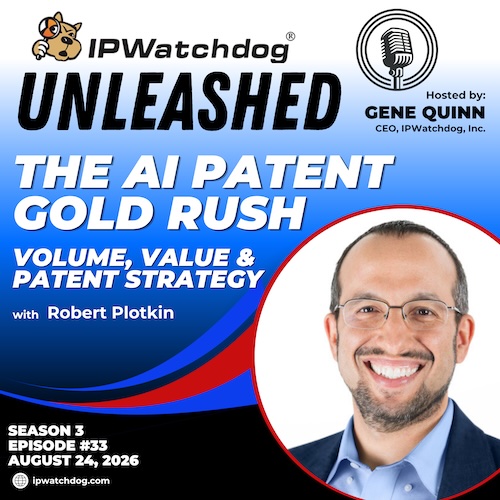
0 This week on IPWatchdog Unleashed, I spoke with Robert Plotkin, a patent attorney, computer scientist, and longtime software and AI practitioner. In what turned into a wide ranging conversation about artificial intelligence, Plotkin, who is the author of The Genie in the Machine and AI Armor: Securing the Future of Your AI Company with Strategic Intellectual Property, discusses the legal and strategic challenges confronting AI innovation. We cover why companies should be cautious about treating AI patent counts as evidence of innovation leadership and why the most valuable AI patent portfolios are built around technology that matters to the business for a specific, articulable reason.
A central theme of our conversation is the persistent failure to understand software as technology. The same inventive process may be implemented through hardware, software instructions, or a combination of the two. Treating software as inherently less technological—or assuming that a general-purpose platform cannot support patentable innovation—can obscure the actual technical contribution and lead to analysis untethered from how the system works.
We also examine the continuing problems surrounding patent eligibility. Section 101 is frequently used as a shortcut for issues that more appropriately belong under enablement, written description, novelty, or non-obviousness. We discuss the difficulty of determining whether a claim is abstract without construing it in light of the specification and prosecution history, which can produce conclusions detached from what the invention does, what was actually the core innovation, what experts in the industry would understand the description to fairly cover, and what the supposed abstract terms mean in the context of the innovation.
The conversation then turns to practical AI patent strategy. Plotkin argues that companies should begin by identifying the objective behind a patent: protecting a product, blocking competition, supporting financing or acquisition, or creating licensing and monetization leverage. Those objectives may require different decisions about what to file, how to prosecute, and how much of the portfolio to build. The practical implication is straightforward: companies should know what the actually own, why they own it, and what business outcome the patent is intended to support.
We also examine the risks of broad, AI-assisted patent drafting. For example, an omnibus patent application—particularly a provisional patent application—describing dozens of possible inventions may create the appearance of comprehensive protection while generating serious problems, not the least of which may be dedication to the public and loss of trade secrets that could have otherwise existed.
For startups and established companies alike, Plotkin explains the most important question to ask before rushing into a patent is what they had to develop because the needed capability was not available off the shelf. If they have addressed a core need like that, and that capability creates a meaningful competitive advantage, pursuing a patent can be worthwhile. Of course, this alone does not guarantee patentability or value, but it can help identify inventions worth evaluating with patent counsel and frame the choice among patent protection, trade secret protection, or some combination of both.
In a nutshell, this episode offers a practical reminder that effective AI patent strategy depends less on counting patents or patent applications and more on understanding the technology, the business objective, and the legal requirements that determine whether any protection obtained is likely to endure.
More IPWatchdog Unleashed
You can listen to the entire podcast episode by downloading it wherever you normally access podcasts or by visiting IPWatchdog Unleashed on Buzzsprout. You can also listen to IPWatchdog Unleashed conversations on the IPWatchdog YouTube channel. For more IPWatchdog Unleashed, see below for our growing archive of previous episodes.
![[Advertisement]](https://ipwatchdog.com/wp-content/uploads/2026/09/MarqVision-Oct-8-2026-sidebar-700x500-1.jpg)
![[Advertisement]](https://ipwatchdog.com/wp-content/uploads/2026/10/IP-Copilot-Oct-13-2026-sidebar-700x500-1.jpg)
![[Advertisement]](https://ipwatchdog.com/wp-content/uploads/2026/10/Junior-Oct-15-2026-sidebar-700x500-1.jpg)
![[Advertisement]](https://ipwatchdog.com/wp-content/uploads/2026/09/WE-BUY-PATENTS-SIM-IP-Ad-1-revised-on-Sep-28-2026-700x500-1.jpg)
![[Advertisement]](https://ipwatchdog.com/wp-content/uploads/2026/09/Life-Sciences-2026-sidebar-early-bird-date-corrected-700x500-1.jpg)
![[Advertisement]](https://ipwatchdog.com/wp-content/uploads/2024/09/Patent-Prosecution-Training-sidebar-700x500-2025-03-27.jpg)





![[Advertisement]](https://ipwatchdog.com/wp-content/uploads/2021/12/WEBINAR-336-x-280-px.png)
![[Advertisement]](https://ipwatchdog.com/wp-content/uploads/2021/12/Ad-4-The-Invent-Patent-System™.png)






Join the Discussion
No comments yet. Add my comment.
Add Comment