


 0
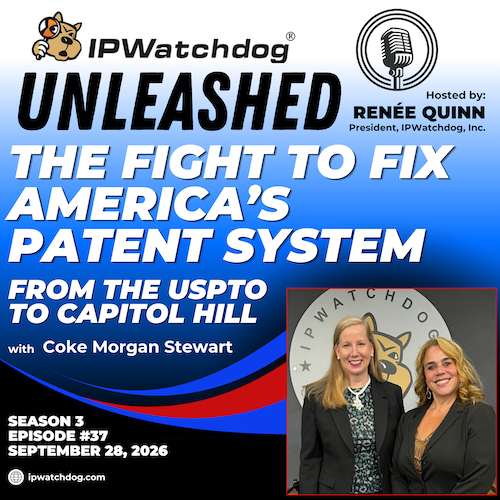
0 This week on IPWatchdog Unleashed, IPWatchdog President Renée C. Quinn spoke with Coke Morgan Stewart. Formerly Acting Director and Deputy Director of the U.S. Patent and Trademark Office (USPTO), Stewart is now president and CEO of the Council for Innovation Promotion (C4IP). Their conversation, recorded at IPWatchdog’s 2026 Women’s IP Forum, examines what she learned while leading the agency, why she believes the patent system needs legislative reform, and how her experience has shaped her approach to leadership and advocacy.
Stewart returned to the USPTO at a moment when its operational demands were difficult to separate from the policy debate. The backlog of unexamined patent applications was growing, a hiring freeze constrained the agency’s response, and federal return-to-office directives created uncertainty for a workforce that had become largely remote. For patent applicants, those pressures affect more than internal management: examination capacity and consistency influence how quickly innovators can obtain rights they can rely on.
Beyond the agency’s operations, Stewart sees a deeper problem with predictability across the life of a patent. Questions about patent eligibility arise before a patent issues. After issuance, patent owners must assess the prospect of validity challenges and the remedies available if infringement occurs. She discusses the strain that repeated proceedings can place on valuable patents, including challenges before the Patent Trial and Appeal Board (PTAB). The concern is consequential for inventors and innovative companies deciding whether a patent will provide a dependable basis for investment, licensing, and enforcement.
Stewart also addresses a divide within the patent community. Some stakeholders question whether examination produces sufficiently consistent, high-quality patents; others argue that issued rights have become too uncertain to enforce effectively. Those concerns cannot be resolved by treating patent quality and reliable patent rights as competing goals. Both matter to a system intended to encourage innovation, and both inform the difficult work of building support for reform, and that is why Stewart’s move from the USPTO to C4IP matters. She can now be an advocate for the system, and say what she believes without regard to whether it fits within the Trump or Lutnick agenda.
Speaking specifically about quality and reliability of patents, she believes the agency can improve both examination and the administration of PTAB proceedings. Of course, agency authority has limits. Stewart argues that Congress must address the statutory questions at the heart of patent eligibility, PTAB reform, and remedies. Her current work with C4IP is focused on making that case beyond the lawmakers who already follow patent policy closely and finding common ground among stakeholders who often disagree.
Reflecting on her path through government, private practice, and advocacy, she draws a distinction between mentorship and sponsorship: advice is valuable, but professionals also need people willing to put their names forward for opportunities. Her practical counsel is to build those relationships deliberately and make specific requests.
For patent professionals, the episode connects decisions made inside the USPTO with the broader legislative choices that determine the value of the rights it issues. It offers an inside account of managing the agency during a demanding period, working within the Trump Administration agenda to advocate for a remote workforce, and making the case for moving patent reform forward in Congress.
More IPWatchdog Unleashed
You can listen to the entire podcast episode by downloading it wherever you normally access podcasts or by visiting IPWatchdog Unleashed on Buzzsprout. You can also listen to IPWatchdog Unleashed conversations on the IPWatchdog YouTube channel. For more IPWatchdog Unleashed, see below for our growing archive of previous episodes.
![[Advertisement]](https://ipwatchdog.com/wp-content/uploads/2026/10/BlackBox-IP-Oct-20-2026-sidebar-700x500-1.jpg)
![[Advertisement]](https://ipwatchdog.com/wp-content/uploads/2026/10/Questel-Oct-22-2026-sidebar-700x500-1.jpg)
![[Advertisement]](https://ipwatchdog.com/wp-content/uploads/2026/09/Life-Sciences-2026-sidebar-early-bird-ends-Oct-25-700x500-1.jpg)
![[Advertisement]](https://ipwatchdog.com/wp-content/uploads/2026/09/WE-BUY-PATENTS-SIM-IP-Ad-1-revised-on-Sep-28-2026-700x500-1.jpg)
![[Advertisement]](https://ipwatchdog.com/wp-content/uploads/2024/09/Patent-Prosecution-Training-sidebar-700x500-2025-03-27.jpg)




![[Advertisement]](https://ipwatchdog.com/wp-content/uploads/2021/12/WEBINAR-336-x-280-px.png)
![[Advertisement]](https://ipwatchdog.com/wp-content/uploads/2021/12/Ad-4-The-Invent-Patent-System™.png)







Join the Discussion
No comments yet. Add my comment.
Add Comment