


 0
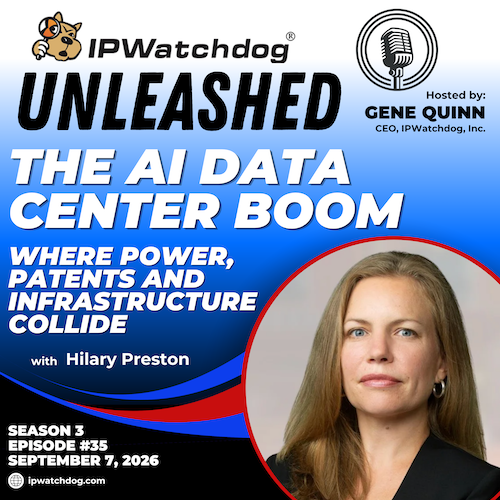
0 This week on IPWatchdog Unleashed, I spoke with Hilary Preston. Preston is a partner at Vinson & Elkins and co-head of the firm’s intellectual property and technology litigation practice. Our conversation focused on the rapidly expanding AI data center ecosystem and the technology, infrastructure, and intellectual property risks emerging as billions of dollars flow into the sector.
AI development depends on physical infrastructure, and that infrastructure is becoming increasingly difficult to build. Power availability, transmission capacity, equipment supply, cooling systems, and geographic location are all shaping where data centers can be developed and how quickly they can become operational. These are not merely engineering or public-policy questions. Each implicates technology rights, commercial relationships, project financing, and potentially significant patent exposure.
Preston explained that the data center market is developing across both hyperscaler facilities and smaller, purpose-built projects. Smaller facilities may be attractive where proximity, latency, security, or specialized computing requirements matter. But scaling technology up or down is rarely linear. Different architectures create different technical solutions—and potentially new patentable inventions, trade secrets, licensing requirements, and litigation risks.
That risk is already emerging. Preston noted that at least four patent cases filed over the summer involved power and energy technologies related to data centers. Cooling systems have also become the subject of consolidated patent litigation involving operators located across the country. The practical takeaway is important: a data center operator may face an infringement claim based on technology supplied by a third party, even when the operator did not develop or select every component itself. In large part that is due to the fact that data centers have money and funding, which makes them an ideal target for patent owners.
Preston also described the broader discipline as “innovation governance”—taking stock of the technology being used, tracking competitors, breaking down internal silos, planning for patent and trade secret protection, and understanding the enforcement landscape. For companies working with multiple vendors, developers, investors, and technology providers, ownership of jointly developed technology must be addressed before the project becomes valuable.
The same analysis applies to decisions about what should be patented and what should remain a trade secret. Patent protection requires disclosure but can provide exclusionary rights. Trade secret protection avoids disclosure and may be less expensive, but it depends on disciplined controls and does not protect against independent development or reverse engineering. As in other cases and industries reliant on trade secret protection, the choice between pursing a patent or keeping a trade secret is largely dependent upon the commercial value of exclusivity, the expected life of the technology, competitive conditions, and the organization’s ability to maintain secrecy.
The conversation also addressed the difficult patent-eligibility and disclosure questions surrounding AI itself. The Federal Circuit has continued to scrutinize generic machine-learning concepts under Section 101, all the while the Patent Office has allowed increasing numbers of AI-related patents to issue. This divergence in view on the patent eligibility and patentability of AI innovations creates real problems for innovators and patent owners alike. Just because you get a patent from the Patent Office does not mean the Federal Circuit will apply the same, or even similar, law when determining whether you get to keep it. And even where eligibility is satisfied, written description and enablement under Section 112 may present serious challenges when the claimed system depends on technologies that remain partly opaque, or “black box,” even to sophisticated engineers.
These issues matter greatly to data center developers, hyperscalers, energy companies, technology suppliers, investors, and the general counsel and boards overseeing these projects. Development speed is understandable given the strategic importance of AI, but speed can push ownership, indemnity, patent clearance, and disclosure questions into the future—where they become more expensive and less manageable. As Preston observed, the ability to build and control data center environments domestically will be a critical economic driver. Ensuring that AI data centers can be built safely, responsibly, and without avoidable IP disruption will require treating intellectual property as part of the infrastructure strategy from the outset.
More IPWatchdog Unleashed
You can listen to the entire podcast episode by downloading it wherever you normally access podcasts or by visiting IPWatchdog Unleashed on Buzzsprout. You can also listen to IPWatchdog Unleashed conversations on the IPWatchdog YouTube channel. For more IPWatchdog Unleashed, see below for our growing archive of previous episodes.
![[Advertisement]](https://ipwatchdog.com/wp-content/uploads/2026/10/BlackBox-IP-Oct-20-2026-sidebar-700x500-1.jpg)
![[Advertisement]](https://ipwatchdog.com/wp-content/uploads/2026/10/Questel-Oct-22-2026-sidebar-700x500-1.jpg)
![[Advertisement]](https://ipwatchdog.com/wp-content/uploads/2026/09/Life-Sciences-2026-sidebar-early-bird-ends-Oct-25-700x500-1.jpg)
![[Advertisement]](https://ipwatchdog.com/wp-content/uploads/2026/09/WE-BUY-PATENTS-SIM-IP-Ad-1-revised-on-Sep-28-2026-700x500-1.jpg)
![[Advertisement]](https://ipwatchdog.com/wp-content/uploads/2024/09/Patent-Prosecution-Training-sidebar-700x500-2025-03-27.jpg)




![[Advertisement]](https://ipwatchdog.com/wp-content/uploads/2021/12/WEBINAR-336-x-280-px.png)
![[Advertisement]](https://ipwatchdog.com/wp-content/uploads/2021/12/Ad-4-The-Invent-Patent-System™.png)





Join the Discussion
No comments yet. Add my comment.
Add Comment