


 0
0 Bites (noun): more meaty news to sink your teeth into.
Barks (noun): peripheral noise worth your attention.
Want to have your doggie(s) featured in one of our future Barks & Bites Columns? Send your dogs photo(s) along with their name, breed (if you know it) and their age to dogwall@ipwatchdog.com. All photos will be added to the IPWatchdog Dog Wall at IPWatchdog Studios and will be added to the queue of images we select from each week.
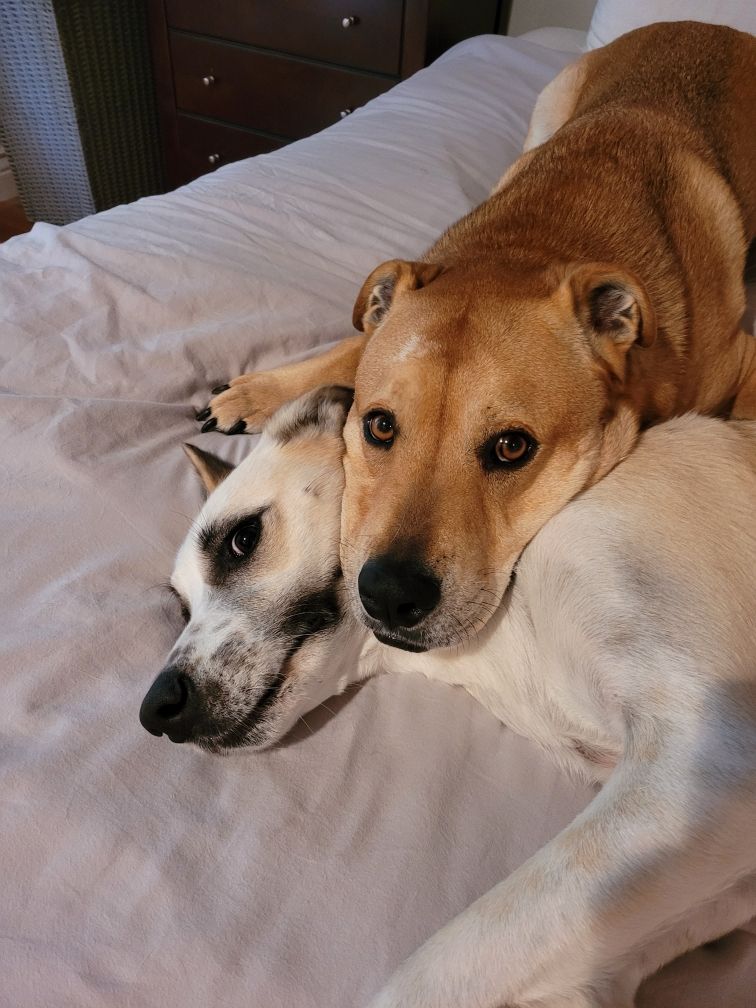
Jaime Olin’s fur babies – Benny 8yo (Dallas Brown Dog) and Lucy 4 yo (Dallas White Dog).
This week in Other Barks & Bites: the Federal Circuit affirms the invalidation of twist drill patent claims because the challenged patent could not claim priority to a parent patent application qualifying as prior art; the Third Circuit unseals its ruling against ROSS Intelligence’s fair use defense indicating some limitations to the decision’s holding in the generative AI context; Apple faces a $5.7 billion verdict after a Southern California jury found infringement of haptic feedback technology patents; Re:Create urges leadership in the U.S. Senate to reject a bill that would remove the Librarian of Congress from important aspects of the U.S. copyright system; the United States maintains its third overall ranking in this year’s Global Innovation Index; the Protect College Sports Act passes the U.S. Senate by a 77-22 vote; and the European Patent Office issues its first set of implementing measures for the fully digital patent granting process going live next April.
Bites
CAFC Affirms Invalidation of Twist Drill Patent for Lack of Valid Priority Claim – On Wednesday, September 30, the U.S. Court of Appeals for the Federal Circuit issued a ruling in Wang v. Viking Drill & Tool, Inc. affirming final written decisions in a pair of inter partes review (IPR) proceedings conducted by the Patent Trial and Appeal Board (PTAB) leading to the invalidation of patent claims directed to a twist drill in which a plurality of composite cutting blades are “formed sequentially and spirally” on a cone portion exterior. The Federal Circuit agreed with the PTAB’s determination that Wang’s patent application from which the challenged patent issued as a continuation-in-part qualified as prior art against the challenged patent because the specification of that previous application contained no written description support for the “formed… spirally” limitation.
Unsealed Third Circuit Opinion Indicates Limits to Fair Use Ruling Against AI Company – On Wednesday, September 30, the U.S. Court of Appeals for the Third Circuit unsealed its opinion issued the day before that affirmed the District of Delaware’s summary judgment ruling entered by Circuit Judge Stephanos Bibas who, sitting by designation in the district court, ruled that Thomson Reuters’ Westlaw headnotes and Key Number System met the originality threshold for copyright protection and that ROSS Intelligence did not show a transformative use of those original works in developing its own artificial intelligence (AI) legal research platform. Footnotes included in the Third Circuit’s completely unredacted opinion acknowledged that fair use issues raised by the U.S. Department of Justice in other copyright cases against AI developers were not present here because ROSS’ AI platform is not generative, and that ROSS’ obvious bad faith in developing a Westlaw competitor weighed against ROSS “to the extent good faith remains relevant” to the analysis.
WIPO GII Rankings Relatively Unchanged in 2026 as Deep Science Startups Valued at $7.6 Trillion – On Tuesday, September 29, the World Intellectual Property Organization (WIPO) published its Global Innovation Index (GII) 2026 showing relatively little change to the top 10 nation rankings, including Switzerland and the United States maintaining their respective 1st- and 3rd-overall rankings from last year’s Index, with the Netherlands and Finland swapping last year’s 7th- and 8th-overall rankings this year, helping the Netherlands advance one spot in the top 10. This year’s GII includes a special thematic section on deep science startups highlighting that the 30,000 such startups established since the year 2000 reached a total valuation of $7.6 trillion this year, with total value for that sector increasing 23% since 2024 alone.
Re:Create Urges Senate Leadership to Reject Copyright Office Reform Bill – On Monday, September 28, copyright policy advocacy group Re:Create sent a letter addressed to U.S. Senate leaders including Sens. John Thune (R-SD), Chuck Schumer (D-NY), Chuck Grassley (R-IA) and Dick Durbin (D-IL) urging them to reject the companion bill to the Legislative Branch Agencies Clarification Act recently passed by the U.S. House of Representatives, which would establish major changes to the structure of operations for both the Library of Congress and the U.S. Copyright Office. Among other concerns, Re:Create argues that the bill would improperly make the Register of Copyrights and not the Librarian of Congress responsible for receiving and managing deposit materials and also remove the Librarian of Congress from the triennial rulemaking process under Section 1201 of the Digital Millennium Copyright Act for approving exemptions for the lawful circumvention of technological protection measures of copyrighted material.
Director Squires Says Agency Mulling Returning Merits Decisions to PTAB Panels at Senate Hearing – On Monday, September 28, the U.S. Senate Judiciary Committee’s Subcommittee on Intellectual Property held an oversight hearing of the U.S. Patent and Trademark Office where Director John Squires was primarily questioned on the importance of Congress renewing fee-setting authority for the agency before it expires on December 12 of this year, as well as the current status of a notice of proposed rulemaking (NPRM) issued last October on revisions to the rules of practice before the Patent Trial and Appeal Board (PTAB). In response to questioning, Director Squires acknowledged that he was considering relinquishing merits decisions to PTAB panels while retaining Director oversight of discretionary denial requests.
Southern California Jury Dings Apple for $5.7B for Haptic Feedback Tech Infringement – On Friday, September 25, a jury verdict entered in the Southern District of California awarded $5.7 billion in damages to California-based haptic technology developer Taction Technology after finding that consumer device giant Apple infringed upon claims of two U.S. patents owned by Taction through Apple’s Taptic Engine platform for creating tapping vibrations. The jury verdict was entered following the Federal Circuit’s vacatur of a previous summary judgment ruling for Apple and remand due to the district court’s abuse of discretion in excluding expert testimony. Multinational litigation funder Burford Capital has stated publicly that it could receive up to $1.4 billion under its funding agreement with Taction Technology should the damages award be upheld following any post-trial motions or appeal.
Barks
EPO Publishes First Set of Implementing Measures for Fully Digital Patent Grants – On Thursday, October 1, the European Patent Office (EPO) published its first set of measures for implementing the agency’s fully digital patent granting process, set to enter into effect on April 1 of next year, clarifying requirements and filing steps for mandatory electronic submissions related to patent applications as well as how notifications will be sent for Patent Cooperation Treaty (PCT) applications in the program.
Bill Codifying NIL Rights for College Athletes Passes Senate 77-22 – On Monday, September 28, members of the U.S. Senate voted 77-to-22 to enact the Protect College Sports Act, which if passed by the House of Representatives and signed by President Trump would codify name, image and likeness (NIL) rights for collegiate athletes and establishing other rules to regulate NIL rights and collegiate athletic conferences.
Kaiser Permanente Calls for Patent Reform to Lower U.S. Drug Prices – On Friday, September 25, American healthcare company Kaiser Permanente published a blog post authored by Mark Hayes, the company’s Senior Vice President for Government Relations, blaming drug manufacturers for causing prescription drug pricing to exceed $1 trillion in 2026, pressing concerns related to “patent thickets” and “product hopping” that are often debunked by statistics and science.
Modulus, Nvidia File Joint Notice of Settlement and Motion to Stay Trademark Case – On Friday, September 25, Modulus Financial Engineering and Nvidia Corporation filed a joint motion to stay all deadlines in their Western District of Texas trademark case over Nvidia’s Modulus AI software, with the motion seeking a 30-day stay while they complete the formal settlement process ending the controversy between the parties.
Authors Guild Calls on Publishers to Share Anthropic Settlement With Authors – On Friday, September 25, the Authors Guild sent out a newsletter that included a call upon publishers to withdraw their claims from the landmark $1.5 billion settlement with Anthropic related to books that have been long out of print as well as relinquishing payouts for works for which the copyright was not timely registered by publishers for their authors to take part in the settlement.
Mickey Mantle IP Estate Files Trademark, Right of Publicity Claims Against Cardsmiths – On Thursday, September 24, Mantle I.P. Holdings, which holds trademark rights and other related IP rights owned by the estate of baseball star Mickey Mantle, filed a lawsuit in the Southern District of New York against collectibles company Cardsmiths for that company’s unauthorized reproduction of Mantle’s 1952 Topps rookie card in violation of Mantle I.P.’s trademark rights and its rights to publicity.
This Week on Wall Street
Ford, Tesla Automotive Sales Exceed Analyst Expectations in Recent Quarter – On Friday, October 2, American automakers Ford Motor Company and Tesla both reported better-than-expected car sales numbers for their recent fiscal quarters, with Tesla delivering 486,532 units over 461,100 units expected and Ford maintaining a slight lead in light-duty truck sales over South Korean rival Hyundai despite concerns that Hyundai would overtake Ford for third in the U.S. sales market.
Micron Q4 Earnings Report Shows Revenues Quadrupling Over Same Period Last Year – On Wednesday, September 30, American memory chip maker Micron Technology reported earnings for its fiscal fourth quarter that posted a major beat on revenues of $54.23 billion versus $51.07 billion expected by analysts, with strong demand for dynamic random-access memory (DRAM) chips helping revenues in that sector increase 343% from the same quarter
![[Advertisement]](https://ipwatchdog.com/wp-content/uploads/2026/10/ClaimHit-Oct-28-2026-sidebar-700x500-1.jpg)
![[Advertisement]](https://ipwatchdog.com/wp-content/uploads/2026/10/Patsnap-Oct-29-2026-sidebar-700x500-1.jpg)
![[Advertisement]](https://ipwatchdog.com/wp-content/uploads/2026/09/Life-Sciences-2026-sidebar-early-bird-ends-Oct-25-700x500-1.jpg)
![[Advertisement]](https://ipwatchdog.com/wp-content/uploads/2024/09/Patent-Prosecution-Training-sidebar-700x500-2025-03-27.jpg)





![[Advertisement]](https://ipwatchdog.com/wp-content/uploads/2021/12/WEBINAR-336-x-280-px.png)
![[Advertisement]](https://ipwatchdog.com/wp-content/uploads/2021/12/Ad-4-The-Invent-Patent-System™.png)





Join the Discussion
No comments yet. Add my comment.
Add Comment