

 1
1 “What we’re considering doing is, I would maintain the discretionary portion of [PTAB decisions] and return the merits portion to the panels.”
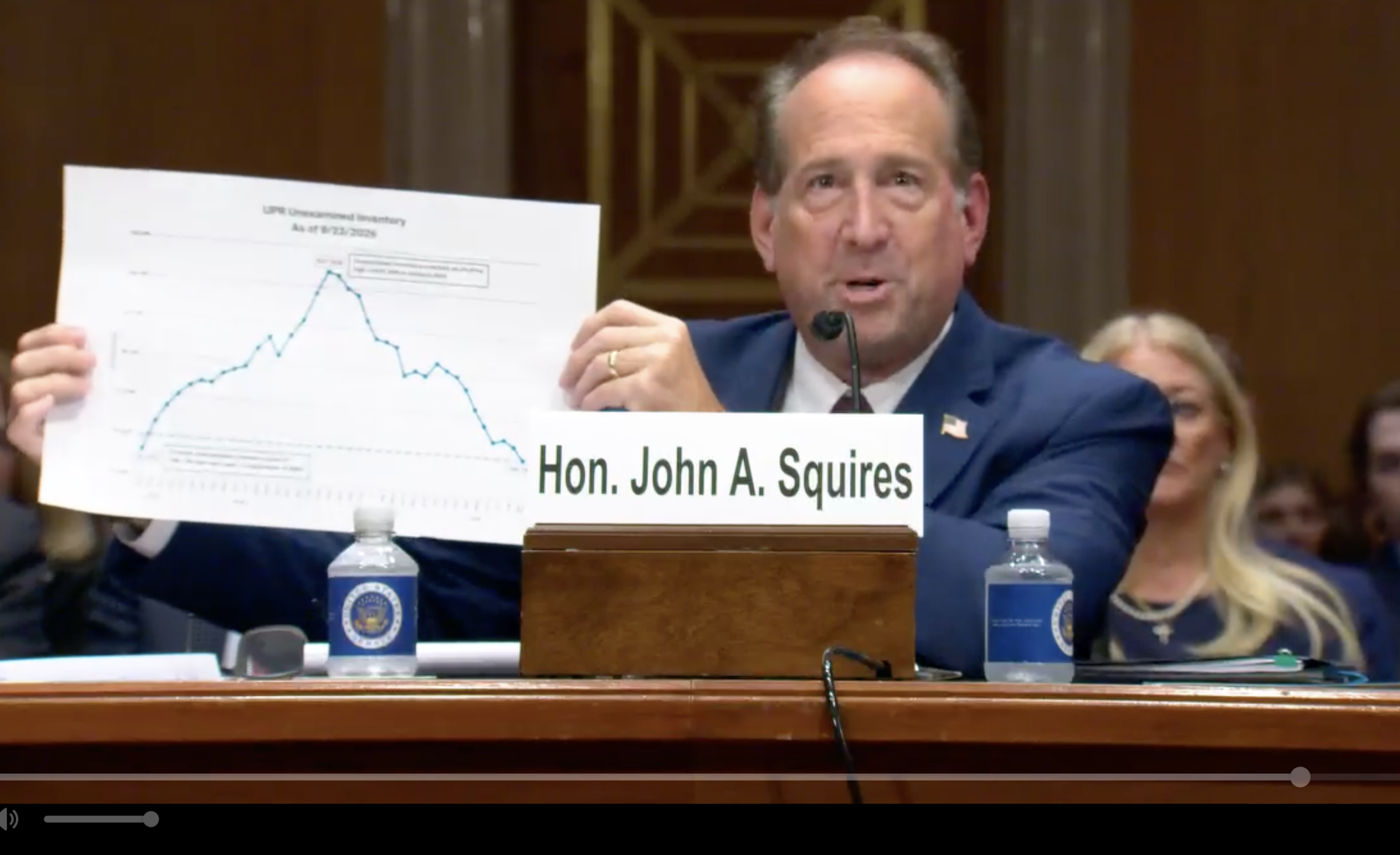 U.S. Patent and Trademark Office (USPTO) Director John Squires faced the Senate Judiciary Committee’s Subcommittee on Intellectual Property Tuesday in an oversight hearing pushing for more information on several of the policy changes his administration has put in place. The hearing was the last over which its current Chairman, Senator Thom Tillis (R-NC), will preside.
Squires, who was the sole witness, touted the agency’s recent success in tackling the backlog, which in April had fallen from a January 2025 high of 837,928 unexamined applications to 776,995. Today it stands at 756,110. “Today I am proud to tell you that we have turned the corner, after inheriting an unheard of backlog crisis, now, for the first time in 10 years, output exceeds intake and we’ve achieved a three-year low on the backlog.”
Several members of the Subcommittee questioned Squires on the status of the Notice of Proposed Rulemaking (NPRM) issued in October 2025, titled “Revision to Rules of Practice before the Patent Trial and Appeal Board.” More than 11,000 comments were received on the NPRM, 2,800 of which were unique Squires said today.
Senators Mazie Hirono (D-HI) and Chris Coons (D-DE) both pushed Squires for a timeline on finalization of that rule, which Squires said is now sitting at the Office for Management and Budget (OMB) following USPTO vetting of the comments. Hirono and Coons urged action on the rule, but also agreed that a legislative, and therefore permanent, solution to the issues addressed in the NPRM would be preferable. The “Promoting and Respecting Economically Vital American Innovation Leadership Act” (PREVAIL Act), which would address many of the same issues presented in the rule, has been stalled in Congress since last term, along with the “Patent Eligibility Restoration Act” (PERA).
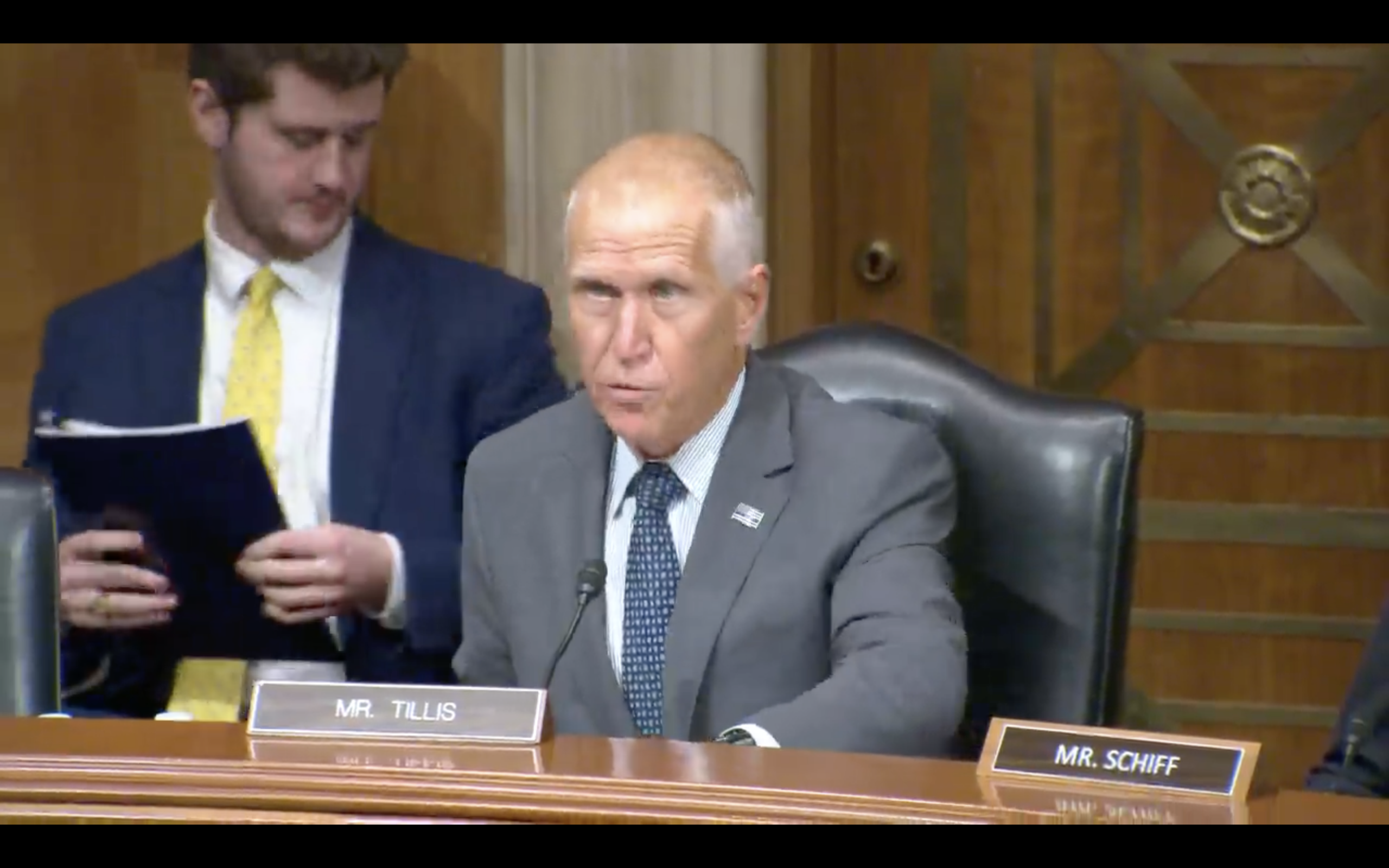 Much of the hearing focused on the USPTO’s need for fee-setting authority, which currently expires on December 12. The House Judiciary Committee’s Subcommittee on Courts, Intellectual Property, Artificial Intelligence, and the Internet held a hearing earlier this month in which Subcommittee Chairman Darrel Issa (R-CA) expressed skepticism about Squires’ recent changes to discretionary denial practice at the PTAB and wondered whether renewal of such authority under the America Invents Act (AIA) should be conditioned on reforms to the agency’s policy.
IPWatchdog sources said that Squires recently informed the PTAB judges that he will be relinquishing decision-making authority on which patent challenges to institute, returning decision making to them, thereby backtracking on his October 2025 memo taking over all decisions. Today, Squires told Coons that “what we’re considering doing is, I would maintain the discretionary portion of it and return the merits portion to the panels.”
Coons also questioned Squires on the continued vacancies on the Patent and Trademark Public Advisory Committees, which Squires said will be filled soon.
Other senators pressed Squires about examination quality, workforce conditions and the Office’s growing use of artificial intelligence. Senator Marsha Blackburn (R-TN) pressed Squires on China outpacing the United States in patent filings. According to Blackburn, from 2003-2007 the U.S. led in 60 of 64 critical technologies while China was leading in three, but today China leads in 57 of the 64. “How can we ensure innovators are going to be able to have prompt consideration of these patent filings?” Blackburn asked.
Squires pointed to the Office’s Artificial Intelligence Search Automated Pilot Program (ASAP!) in response, which was first announced in October 2025 and is meant to “evaluate the impact of sharing the results of an automated search prior to examination of an application.” He also said the agency is “exploring pre-application services” that would utilize AI to help applicants identify where formalities are not met as a means of expediting the application process.
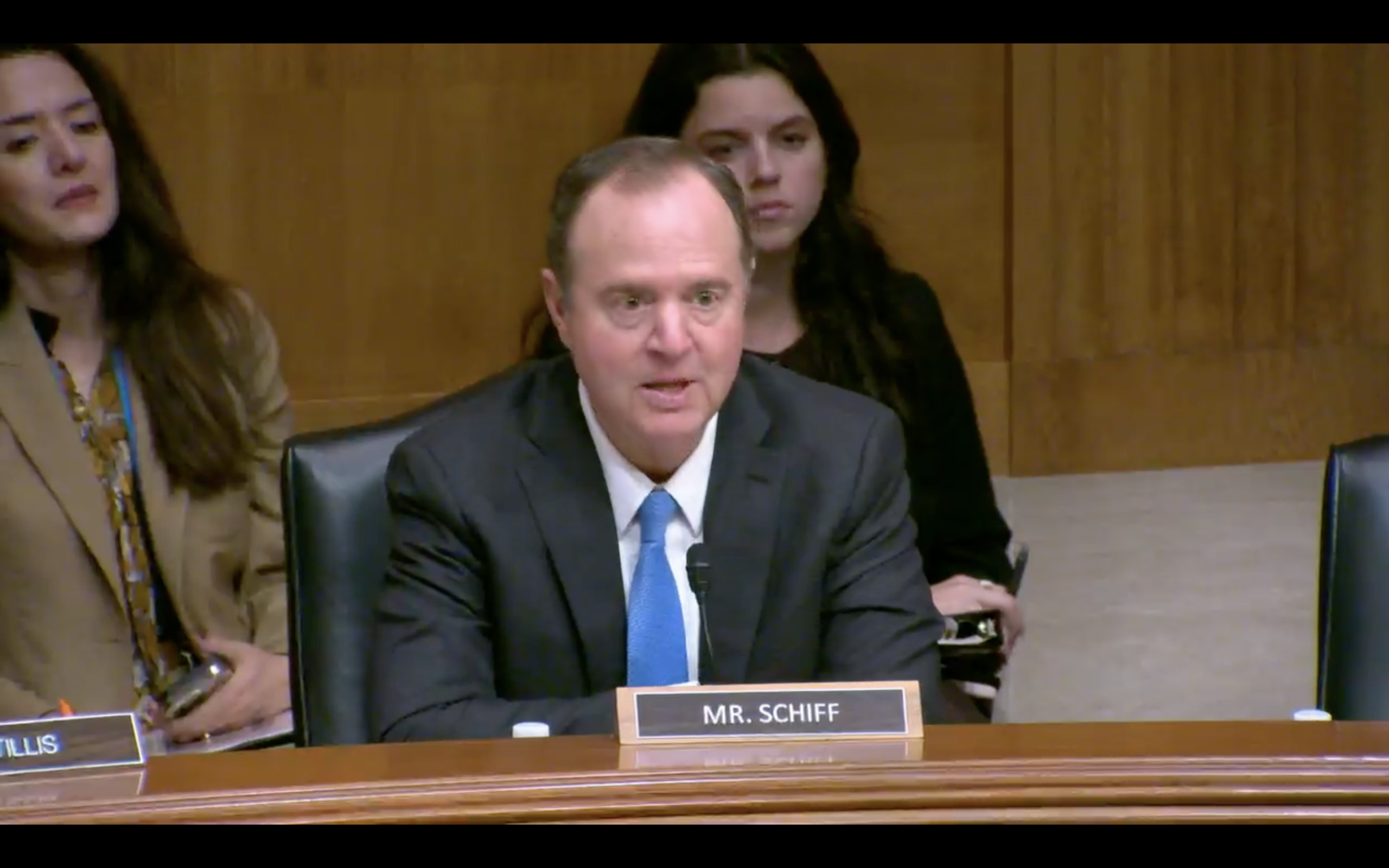 Squires faltered when pushed by Subcommittee Ranking Member Adam Schiff (D-CA) on his reasoning for filing trademark applications on behalf of the Board of Peace. The USPTO came under fire for its role in filing the two trademark applications for “Board of Peace” on behalf of President Trump. In a March House USPTO Oversight Hearing, Squires said that he acted pursuant to his authority under both 35 U.S.C. § 2 and 35 U.S.C. § 3 in advising the President on national IP policy issues and acting as a custodian for trademark rights to prevent fraud, which here involved cybersquatters registering an arguably infringing domain name minutes after President Trump announced the Board of Peace. Squires largely parroted that explanation today.
Raskin at the time called the USPTO’s act in filing those trademark applications “the first step in giving Trump and his subordinates a monopoly in our country on use of the word ‘peace,’” further raising charges under the Emoluments Clause due to Board of Peace investments from foreign governments and private entities.
Schiff asked Squires to provide his explanation in writing, commenting that Squires’ response did not answer his question.
Senators did not raise the question of whether Squires’ one-year anniversary party, which was planned for today but postponed following IPWatchdog’s reporting last week, represents a potential breach of ethics obligations.
![[Advertisement]](https://ipwatchdog.com/wp-content/uploads/2026/10/BlackBox-IP-Oct-20-2026-sidebar-700x500-1.jpg)
![[Advertisement]](https://ipwatchdog.com/wp-content/uploads/2026/10/Questel-Oct-22-2026-sidebar-700x500-1.jpg)
![[Advertisement]](https://ipwatchdog.com/wp-content/uploads/2026/09/Life-Sciences-2026-sidebar-early-bird-ends-Oct-25-700x500-1.jpg)
![[Advertisement]](https://ipwatchdog.com/wp-content/uploads/2026/09/WE-BUY-PATENTS-SIM-IP-Ad-1-revised-on-Sep-28-2026-700x500-1.jpg)
![[Advertisement]](https://ipwatchdog.com/wp-content/uploads/2024/09/Patent-Prosecution-Training-sidebar-700x500-2025-03-27.jpg)



![[Advertisement]](https://ipwatchdog.com/wp-content/uploads/2021/12/WEBINAR-336-x-280-px.png)
![[Advertisement]](https://ipwatchdog.com/wp-content/uploads/2021/12/Ad-4-The-Invent-Patent-System™.png)



Join the Discussion
One comment so far. Add my comment.
ghostndragon
October 1, 2026 09:01 amIt’s odd that Squires pointed to the ASAP! program as an example of US applicants getting prompt consideration of filings. First, it sunsetted in June, so it doesn’t exist. Second, it was a pilot program that had a goal of accepting at least 1600 applications over a period of 6 months. It received only 169 petitions, with 76 acceptances, even after the petition fee was waived and the program was extended by just over a month. Third, it wasn’t designed to get applications “considered.” It was designed to provide a pre-examination automated search report. This doesn’t put any hustle into the USPTO for examination, but rather puts the burden of deciding what to do next on the applicant. Finally, if it was successful, you’d think it would have been continued. IMO, the ASAP! program was designed to get applicants to abandon their cases early, just like the current PIER program, as part of the scheme to reduce the backlog by any means necessary. The bonus on both of these programs is that they were designed to keep the applicant’s money, even if the Patent Office does no work. For the ASAP! program, applicants had to pay extra for an AI search that provided only the top few hits until the petition fee was waived. For PIER program, applicants have to respond to an unsolicited and random notification (you can’t opt in or out – it just randomly happens) from the Patent Office by verifying that proceeding with the included claims takes into account the PCT ISR/WO, or expressly abandon. If you expressly abandon, the USPTO gets to keep your application fee, unlike other reasons for express abandonment. When verifying that the applicant wants to proceed, one option is to request a delayed examination, which tacks 12 months onto the USPTO’s first action window, which is not considered USPTO delay for the purposes of PTA.
Add Comment