
![[IPWatchdog Logo]](https://ipwatchdog.com/wp-content/themes/IPWatchdog%20-%202023/assets/images/temp/logo-small@2x.png)

 11
11 “The results of the automated search may inform a decision on how to proceed with the application.” – USPTO Federal Register Notice

USPTO
The U.S. Patent and Trademark Office (USPTO) will launch an AI search pilot program for utility patent applications and will begin accepting petitions to participate in the program as of October 20, according to a draft Federal Register Notice (FRN) published today. The official notice will be published tomorrow, October 8.
Petitions will be accepted through April 20, 2026, or the date that each tech center (TC) is docketed at least 200 applications accepted, whichever comes first.
The “Automated Search Pilot Program” is meant to “evaluate the impact of sharing the results of an automated search prior to examination of an application.” In the event a petition is granted, the Office will use an AI tool that “uses the classification of the application under the Cooperative Patent Classification (CPC) system, as well as the specification, including the claims and abstract, of the application as contextual information.” Using that information, the tool will then find similar information in public databases including U.S. Patents, U.S. Pre-Grant Publications (PG-Pubs), and Foreign Image and Text (FIT), which “includes publications from a number of foreign patent authorities,” according to the FRN. The results will then be ranked from most to least relevant.
The USPTO will then send an Automated Search Results Notice (ASRN) to the applicant identifying potential prior art issues with the application (up to 10 documents identified by the tool), which the applicant will not be required to respond to, and which is not considered a notification under 35 U.S.C. 132. However, “the results of the automated search may inform a decision on how to proceed with the application,” including a decision by the applicant to file a preliminary amendment, to defer examination, or to file a petition for express abandonment.
Only “original, noncontinuing, nonprovisional utility applications filed under 35 U.S.C. 111(a) on or after October 20, 2025, and on or before April 20, 2026, are eligible to participate in the pilot program.” Continuing applications are not eligible and the application must be filed electronically using the USPTO’s Patent Center. Applicants must also be enrolled in the Patent Center Electronic Office (e-Office).
The program will accept up to 1,600 applications distributed across all TCs that examine utility applications; however, if anyone one TC significantly exceeds 200 applications it may influence a decision to terminate the pilot early.
According to the FRN, the pilot “is designed to evaluate the impact of sharing the results of an automated search prior to examination of a patent application” and will be an opportunity for the Office to assess the effectiveness of ASRNs in making decisions on patentability in the early stages of examination. The Office will also provide an opportunity for feedback during or after the pilot period.
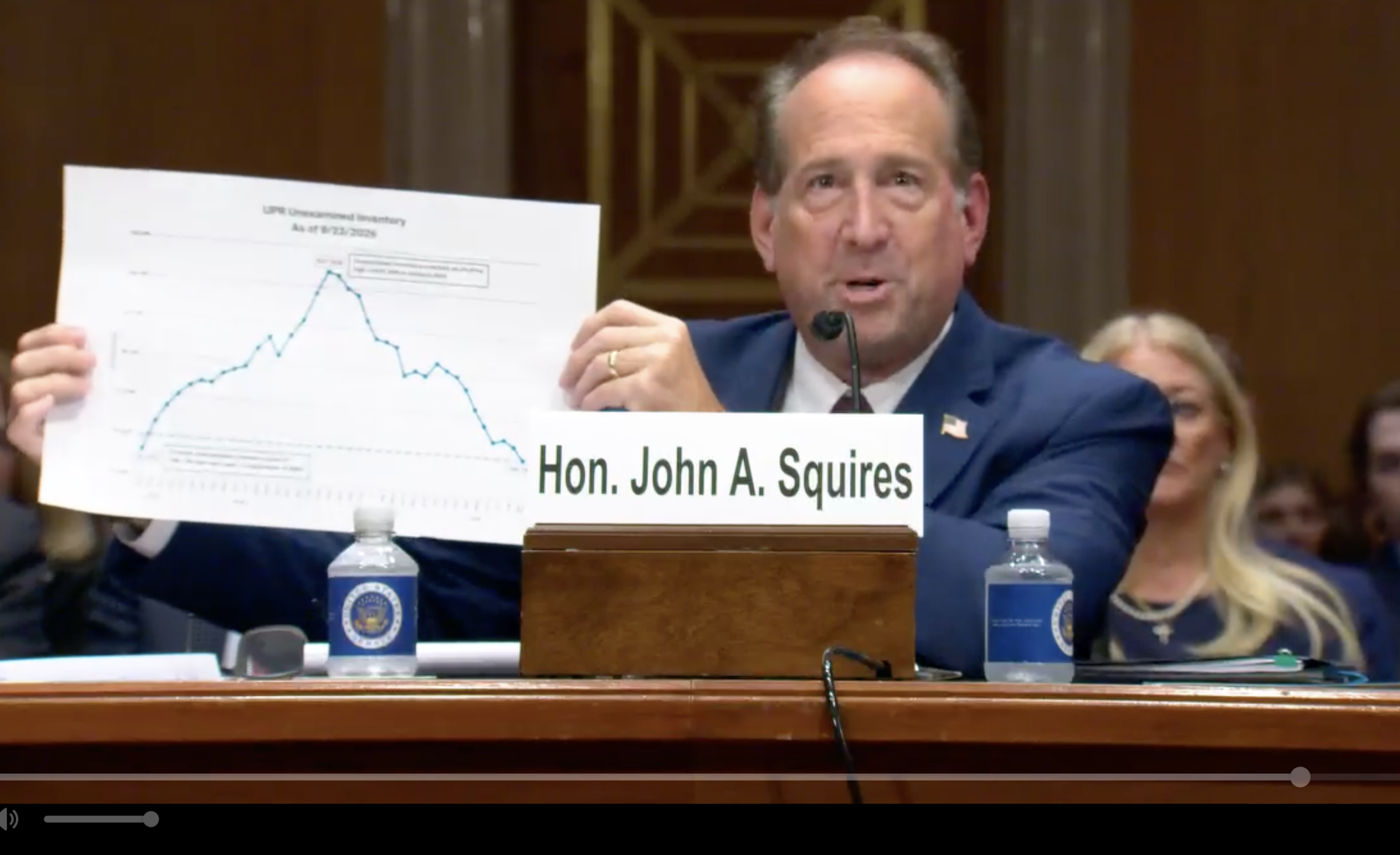
Recently-confirmed USPTO Director John Squires has made the use of AI in creating efficiencies for the Office a top priority of his administration.
![[Advertisement]](https://ipwatchdog.com/wp-content/uploads/2026/09/ClaimHit-Oct-1-2026-sidebar-700x500-1.jpg)
![[Advertisement]](https://ipwatchdog.com/wp-content/uploads/2026/09/MarqVision-Oct-6-2026-sidebar-700x500-1.jpg)
![[Advertisement]](https://ipwatchdog.com/wp-content/uploads/2026/09/Life-Sciences-2026-sidebar-early-bird-date-corrected-700x500-1.jpg)
![[Advertisement]](https://ipwatchdog.com/wp-content/uploads/2026/09/WE-BUY-PATENTS-SIM-IP-Ad-1-revised-on-Sep-28-2026-700x500-1.jpg)
![[Advertisement]](https://ipwatchdog.com/wp-content/uploads/2024/09/Patent-Prosecution-Training-sidebar-700x500-2025-03-27.jpg)




![[Advertisement]](https://ipwatchdog.com/wp-content/uploads/2021/12/WEBINAR-336-x-280-px.png)
![[Advertisement]](https://ipwatchdog.com/wp-content/uploads/2021/12/Ad-4-The-Invent-Patent-System™.png)



Join the Discussion
11 comments so far.
Examiner A, Top Golfer
October 10, 2025 09:01 amlaml,
“Examiner A, you know you’re 100% forbidden from doing the thing you offered to do with your comment, right?”
I think you misunderstood my comment. I was inviting attorneys who are prosecuting an ALREADY-PENDING application to ask for the AI search results of their ALREADY-PENDING application. Any examiner would be more than happy to attach the report to an office action or interview summary. The whole thing can be done with less than ten mouse clicks.
I would *never* conduct a prior art search independent from an application.
Breeze
October 9, 2025 01:16 pm“Oh, look, more nonsense denigrating USPTO examiners from Breeze.”
They do a great job denigrating themselves!!!
Lulz
Anon
October 9, 2025 09:45 amIamI,
“Examiner A, you know you’re 100% forbidden from doing the thing you offered to do with your comment, right?”
Is that in writing? If so, please provide a link or a screenshot.
Thanks.
IamI
October 8, 2025 07:05 pmOh, look, more nonsense denigrating USPTO examiners from Breeze.
Examiner A, you know you’re 100% forbidden from doing the thing you offered to do with your comment, right?
Examiner A, Top Golfer
October 8, 2025 05:59 pmIf this is anything like our internal tool at USPTO, I encourage all of you practitioners to save your money simply run a Google Patents search—your results will be twice as good as the crap this gives you. If any attorney asks me to input their application into our internal tool and send them the results, I’ll gladly do it for free. And I’m willing to bet 80-95% of examiners will do the same. In fact, you’re already getting the internal AI tool results right now! Simply check the search notes of any office action mailed after July, and scroll to the bottom where it says similarity search.
John Smith
October 8, 2025 11:32 am$71.5m of our fees spent as of July 2024 and the PTO now asking us to justify it’s benefits…!
https://www.oig.doc.gov/uspto-should-improve-governance-to-promote-effective-oversight-of-its-artificial-intelligence-tools/
Plain and Tall
October 8, 2025 11:22 amI presume, as Pro Say points out below, that it’s going to be a rare (and perhaps large) applicant with a low-risk/lower value filing that will try this. My only thought as to the benefit of participation is that it feels a little like this train is coming for us practitioners, and that finding a way to view the mechanics of the AI examination (and to be able to provide comment to the office as a past participant) has some advantages.
But I agree with everyone re: the problems here, both for ‘guessing’ at a FAOM which may never be issued by the examiner and for IDS practice. It seems as ‘valuable’ to an applicant as placing the application and claims into that applicant’s own siloed LLM and letting it spit out some references. (Which is to say, counter-productive and dangerous)
And still, if we’re heading in this direction, I’d prefer not to be blind when it is required.
Breeze
October 8, 2025 10:00 amNobody at the PTO knows how to search. I can’t imagine any “AI tool” developed by people who don’t know how to search will know how to search either.
kotodama
October 7, 2025 11:57 pmIt doesn’t sound very worthwhile.
Page 6 of the draft notice (end of Part IV) says the ASRN “will have content similar to the content of Form PTO-892.”
Who is going to bill their client for time spent going through a glorified 892, especially when it’s not even connected to an office action in this instance? Do people normally investigate 892 references that aren’t either directly used in a rejection or at least cited as pertinent art? It doesn’t seem like a good use of time.
This also seems to create extra IDS headaches because the draft notice says the references aren’t necessarily considered by the examiner or listed on the face of the patent unless the examiner actually relies on them or the applicant cites them in an IDS. So the applicant now has dumped on them as many as 10 references that the AI tool says are potentially relevant, but the references are just floating around in no man’s land unless the applicant takes affirmative action. Can the references simply be ignored if the applicant so desires? I don’t think so. How can the applicant not cite them right back to the USPTO in an IDS, considering the USPTO’s own AI tool identified them as possibly relevant? So preparing and filing that IDS creates more work and expense for the applicant. That gets multiplied if the application has related cases where the references also need citing. And of course with the IDS size fees, 10 references can easily push one into the next fee tier.
Of course, at the end of the day, the examiner has no obligation to use the references. So you might end up amending and then an office action is issued that relies on completely different art.
Again, I just don’t really see the point.
Lou Stool
October 7, 2025 09:58 pmJohn Squires is an idiot, and so is anyone who puts any stock in these nonsense AI features. Just another race to the bottom by lazy losers who can’t be bothered to exert any actual human effort
Pro Say
October 7, 2025 09:41 pmHmmm . . . will be interesting to see if any-and-who patent applicants “step up” to see what happens when their apps are “subjected” to this new-fangled AI search tool.
Given who knows what could happen — including potential app- delaying and / or crushing hallucinations — I would think that independent and small company inventors especially need to carefully consider whether or not to subject their apps to AI searches.
At least until the results of such searches are known.