


 0
0 “The CAFC acknowledged that its standing jurisprudence has ‘not always been clear, thereby creating a challenge for district courts applying our precedent.’”
 The U.S. Court of Appeals for the Federal Circuit (CAFC) today issued a precedential opinion authored by Judge Chen that clarified its case law on statutory versus constitutional standing analyses. The decision ultimately reversed and remanded a district court ruling that had dismissed a plaintiff’s patent infringement suit for lack of constitutional standing.
A.L.M. Holding Company (A.L.M.) and Ergon Asphalt & Emulsions, Inc. (Ergon) sued Zydex Industries Private Ltd. and Zydex Inc. for infringement of six patents related to asphalt-paving methods and compositions. Ergon had previously licensed some rights under the patents to exclusive licensee Ingevity, but retained other rights, including the right to shared control of infringement suits in the case of third-party infringement. The license agreement also limits Ingevity’s ability to sublicense the patent rights, requiring review and approval by Ergon first, among other limitations.
After Ergon sued Zydex in 2024, Zydex moved to dismiss the suit for lack of Article III standing. The U.S. District Court for the District of Delaware granted the motion, finding that Ergon’s “reserved usage rights and ability to review sub-licensing terms under the Agreement…were not exclusionary rights…[and that its] royalty rights did not confer constitutional standing.”
Relying on the CAFC’s precedent in Morrow v. Microsoft Corp., 499 F.3d 1332 (Fed. Cir. 2007), as well as Deere & Co. v. Kinze Manufacturing, Inc., 683 F. Supp. 3d 904 (S.D. Iowa 2023), the district court determined that Ergon’s right to sue was not an exclusionary right sufficient to confer Article III standing.
But on appeal to the CAFC, Ergon argued that “their retained rights as patent owner—including the right to sue, sublicensing control, and royalty interests—are collectively sufficient to establish that they retained an exclusionary right required for Article III standing,” and the CAFC agreed.
In a lengthy explanation prior to addressing the present case, the CAFC opinion noted that the court has not previously “enumerate[d] the exclusionary rights afforded by a patent or fully define[d] their scope,” and acknowledged that its standing jurisprudence has “not always been clear, thereby creating a challenge for district courts applying our precedent.”
Article III standing and statutory standing under 35 U.S.C. § 281are separate inquiries, said the opinion. Specifically:
“Article III asks whether the plaintiff has suffered a constitutionally cognizable injury, while Section 281 asks whether the plaintiff qualifies as a ‘patentee’ entitled to sue for infringement—typically by determining whether, in the case of a patent owner, it has transferred away, or in the case of a licensee, it has been transferred ‘all substantial rights’ in the asserted patents.”
Prior to Lone Star Silicon Innovations LLC v. Nanya Tech. Corp., 925 F.3d 1225, 1234 (Fed. Cir. 2019), “many of this court’s opinions had improperly melded the injury-in-fact inquiry with the § 281 inquiry—often performing a combined analysis of the two simultaneously,” wrote the CAFC. That has created uncertainty about whether and when a party has standing to sue for patent infringement where the rights have been divided through licensing agreements. While some district courts have created a bright line between the CAFC’s cases addressing constitutional standing and those addressing statutory standing, “concluding that cases addressing one side of that line have little, if any, relevance to cases on the other side,” today’s opinion clarified that “the two factual analyses can overlap.”
The opinion noted, for instance, that in Intellectual Tech, LLC. v. Zebra Technologies Corporation, the court “cited with approval” Alfred E. Mann Foundation for Scientific Research v. Cochlear Corp., which was a statutory standing case, as part of its analysis determining that the patent owner there had constitutional standing because it retained the right to sue.
Mann further illustrates how a patent owner’s retained right to sue is not “illusory”—i.e., cannot be easily extinguished by its licensee—”where the patent owner maintains meaningful control over enforcement and no other party has the ability to interfere with that enforcement right.”
In light of its analysis as to the proper standing inquiry, the CAFC turned to the present case and found that Ergon’s retained sublicensing veto, which prevents Ingevity from granting sublicenses without Ergon’s consent or without royalty payments, “helps preserve Plaintiff’s exclusionary interest because it prevents the licensee from unilaterally authorizing an accused infringer’s practice of the patents…”
Both Zydex and the district court erroneously treated Mann as being limited to statutory standing because the CAFC “later on in Zebra Technologies expressly cited the facts of Mann to support our constitutional standing analysis there.” And Morrow is distinguished because, there, the plaintiff did not own the patent. Instead, the plaintiff in Morrow’s “right to sue was contractually separated from patent ownership and all other underlying patent rights—the rights to make, use, or sell the patented invention, to license and sublicense the patent, and collect royalties from it—which were held by a different party.”
While Zydex further argued that Ergon’s right to sue is not exclusionary because “they cannot end a lawsuit by granting a license,” the CAFC said Ergon has other means by which to settle litigation, including monetary payments or an agreement by an infringer to cease practicing the patents. “Thus, even in light of Ingevity’s sublicensing rights, Plaintiff retains a meaningful ability to settle the lawsuits they initiate,” said the opinion.
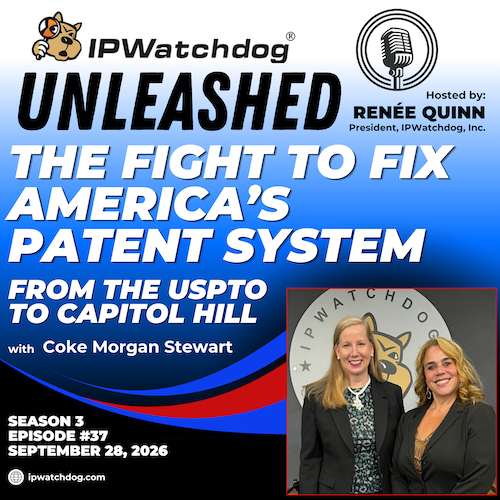
For more on this topic, see IPWatchdog Unleashed, Season 3, Episode 19.
![[Advertisement]](https://ipwatchdog.com/wp-content/uploads/2026/10/BlackBox-IP-Oct-20-2026-sidebar-700x500-1.jpg)
![[Advertisement]](https://ipwatchdog.com/wp-content/uploads/2026/10/Questel-Oct-22-2026-sidebar-700x500-1.jpg)
![[Advertisement]](https://ipwatchdog.com/wp-content/uploads/2026/09/Life-Sciences-2026-sidebar-early-bird-ends-Oct-25-700x500-1.jpg)
![[Advertisement]](https://ipwatchdog.com/wp-content/uploads/2026/09/WE-BUY-PATENTS-SIM-IP-Ad-1-revised-on-Sep-28-2026-700x500-1.jpg)
![[Advertisement]](https://ipwatchdog.com/wp-content/uploads/2024/09/Patent-Prosecution-Training-sidebar-700x500-2025-03-27.jpg)





![[Advertisement]](https://ipwatchdog.com/wp-content/uploads/2021/12/WEBINAR-336-x-280-px.png)
![[Advertisement]](https://ipwatchdog.com/wp-content/uploads/2021/12/Ad-4-The-Invent-Patent-System™.png)







Join the Discussion
No comments yet.