
![[IPWatchdog Logo]](https://ipwatchdog.com/wp-content/themes/IPWatchdog%20-%202023/assets/images/temp/logo-small@2x.png)

 0
0 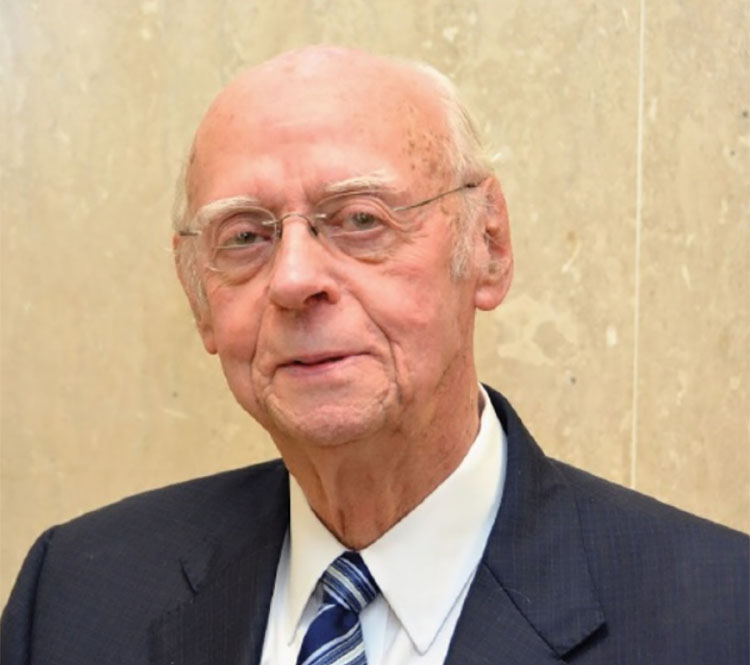
Photo credit: George Mason University.
John F. Witherspoon, who passed away September 25, 2026, had a stellar career in patent law that spanned more than 50 years. He was devoted to private law practice, government service, and law school teaching. He was a beloved mentor to countless students and younger lawyers and an inspiration to all who knew him.
in 1960, he joined the DuPont Co. patent law offices in Washington DC, where he worked full-time while attending night school at Georgetown University. After law school he served as a law clerk to legendary Judge Giles Sutherland Rich, a principal drafter of the 1952 Patent Act, including the nonobviousness standard in section 103. In an article published by IP Watchdog, John wrote about Judge Rich’s celebration on the day in 1966 that the U.S. Supreme Court issued its landmark interpretation of section 103 in Graham v. John Deere Co. It was the most important patent decision of the era and the subject of articles by John.
In 1971, following a stint in private law practice, he was appointed by the President of the United States to be a member of the Patent Office’s Board of Appeals (the forerunner of today’s PTAB). In those days the Patent Act required all appointments to the15-member board to be made by the President with the advice and consent of the Senate. Traditionally, the President drew appointees from the ranks of career Patent Office employees.
John was the first board member appointed from private practitioners. The other board members valued the perspectives of a colleague with private sector experience. It was during John’s tenure as a board member that I first became acquainted with him. John returned to private practice in 1978.
In 1992, he became an adjunct professor and director of the IP program at what is now George Mason University’s Antonin Scalia Law School. He was popular with the students and other professors. He often invited outside speakers to his classes. He taught until 2003 and continued to be involved in law school activities. He was a major financial donor to the school, which established the Witherspoon Legal Scholars program. Years earlier he was a large donor to the Foundation for a Creative America, which organized a year-long celebration of the 1990 Bicentennial of American Patent and Copyright Law.
He maintained a private law practice until his retirement in 2016. He was an expert witness in more than 150 patent trials. He continued to attend meetings of IP associations after retirement. He was a distinguished-in-law member of the Cosmos Club in Washington from 1982 until his death.
John was never one to say he was influential or well-connected. Occasionally he was asked whether he was a descendant of the John Witherspoon (1722 to1794) who was a signer of the Declaration of Independence and the founder of Princeton University. A 17-foot bronze statue memorializing that John Witherspoon stands at the intersection of Connecticut Avenue and 18th and N Streets NW in Washington. John would reply that, yes, the man was the brother of John’s great-grandfather many generations back. Then, John would return to discussing patent law.
![[Advertisement]](https://ipwatchdog.com/wp-content/uploads/2026/09/MarqVision-Oct-8-2026-sidebar-700x500-rev.jpg)
![[Advertisement]](https://ipwatchdog.com/wp-content/uploads/2026/10/IP-Copilot-Oct-13-2026-sidebar-700x500-1.jpg)
![[Advertisement]](https://ipwatchdog.com/wp-content/uploads/2026/10/Junior-Oct-15-2026-sidebar-700x500-1.jpg)
![[Advertisement]](https://ipwatchdog.com/wp-content/uploads/2026/09/WE-BUY-PATENTS-SIM-IP-Ad-1-revised-on-Sep-28-2026-700x500-1.jpg)
![[Advertisement]](https://ipwatchdog.com/wp-content/uploads/2026/09/Life-Sciences-2026-sidebar-early-bird-date-corrected-700x500-1.jpg)
![[Advertisement]](https://ipwatchdog.com/wp-content/uploads/2024/09/Patent-Prosecution-Training-sidebar-700x500-2025-03-27.jpg)




![[Advertisement]](https://ipwatchdog.com/wp-content/uploads/2021/12/WEBINAR-336-x-280-px.png)
![[Advertisement]](https://ipwatchdog.com/wp-content/uploads/2021/12/Ad-4-The-Invent-Patent-System™.png)





Join the Discussion
No comments yet. Add my comment.
Add Comment