
![[IPWatchdog Logo]](https://ipwatchdog.com/wp-content/themes/IPWatchdog%20-%202023/assets/images/temp/logo-small@2x.png)

 0
0 “Corteva confirms that obviousness-type double patenting should not invalidate a child patent that does not extend the family’s exclusivity beyond the original patent’s term, including PTA.”
 Recent developments in ex parte Corteva Agriscience LLC (Reexamination Control 90/019,130; Patent 10,947,555 B2) clarify obviousness-type double patenting (ODP) in the context of patent families with multiple continuations and varying patent term adjustments (PTA). This update builds on our earlier analysis in IPLaw360 of ODP strategies and litigation risks in light of In re Cellect and Allergan USA Inc. v. MSN Laboratories.
Summary of Cellect and Allergan
In In re Cellect, LLC, 81 F.4th 1216 (Fed. Cir. 2023), the Federal Circuit addressed ODP in the context of smartphone camera technology. The court held that the expiration date—including any patent term adjustment (PTA)—controls when determining which patent is the “double patent,” irrespective of filing or issue dates. Cellect held that later-filed, later-issued patents can be used to challenge earlier-filed, earlier-issued patents. This ruling demonstrated the significant consequences of ODP, as the reference patents in Cellect had already expired, making it impossible for the patent owner to file terminal disclaimers to cure the defect. The case underscores the importance of proactive portfolio management and due diligence before asserting patents that may be vulnerable to ODP challenges.
In Allergan USA, Inc. v. MSN Laboratories Private Ltd., 111 F.4th 1358 (Fed. Cir. 2024), the Federal Circuit clarified an important limitation on the Cellect rule: a later-filed continuation cannot be used to challenge a first-filed patent under ODP, even if PTA causes the first-filed patent to expire later than the continuation. This holding establishes that the original patent in a family sets the “maximum period of exclusivity,” and child patents that expire before or at the same time as the original should not be subject to ODP.
Key Holding: No ODP Where Child Patent Expires Before Original Patent (Including PTA)
In Corteva, the Patent Trial and Appeal Board (PTAB) distinguished Cellect and extended Allergan by holding that a child patent (here, the ’555 patent) is not unpatentable for ODP if it does not expire later than the original patent in the family, including any PTA awarded to the original patent. Below is a figure from Corteva:
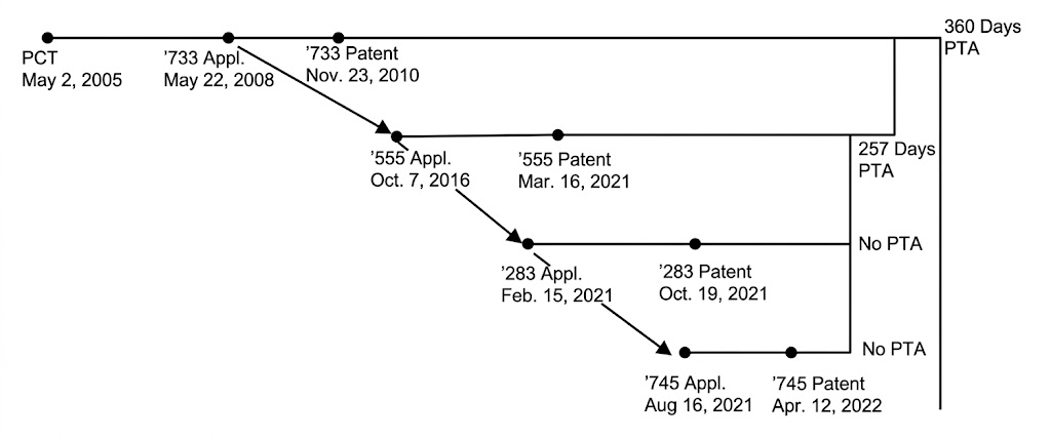
The examiner argued that, under Cellect, the ’555 patent (having 257 days of PTA) was invalid because the ’283 reference patent expired earlier. The patent owner argued that the first-issued patent (’733 patent) had 360 days of PTA; therefore, the ’555 patent was not invalid because it expired before the first-issued patent. The Patent Trial and Appeal Board (PTAB) agreed with the patent owner, finding that, under Allergan, the term of the first patent sets the “maximum period of exclusivity,” and as long as no child patent extends beyond that term, ODP does not apply—even if the child is not the very first continuation in the family.
Implications for Later Children and Other Permutations
While Corteva involved the first child, the Board’s reasoning suggests that the same principle should apply to subsequent children in the family; as long as a child patent does not expire after the original patent (including PTA), it should not be subject to ODP. However, the Board expressly left open how ODP would apply in other boundary cases, such as:
- When a later child receives more PTA than an earlier child: If a second or third continuation receives more PTA and expires after the original patent, ODP could be triggered for that child.
- Permutations of which patent is the “double patent”: The analysis may depend on the specific expiration dates, PTA awards, and whether terminal disclaimers were filed in each patent. The Board noted that the facts of each case could be highly determinative.
- Terminal disclaimers and notice requirements: The Board rejected the examiner’s argument that terminal disclaimers must be filed in every patent in the family, finding that disclaimers in the later-filed patents were sufficient to ensure common ownership and avoid multiple infringement suits. Notably, this appears to contradict MPEP § 804.I.B.1 (“it is not sufficient to file a terminal disclaimer in only one of the applications.”).
Takeaways for Patent Owners and Practitioners
- Portfolio Management: Patent owners should carefully track PTA awards and expiration dates across all family members, especially when filing continuations.
- Prosecution Strategy: Consider filing terminal disclaimers proactively in continuations that could potentially expire after the original patent, but recognize that disclaimers may not be needed if the child expires earlier. Consider challenging an examiner’s requirement to file terminal disclaimers in both the challenged and reference patents. See MPEP § 804.I.B.1.
- Litigation Due Diligence: Assess ODP risks in light of the Corteva and Allergan holdings, focusing on actual expiration dates (including PTA), not just filing or issue dates.
- Safe Harbor: Remember that divisional applications enjoy safe harbor from some double-patenting rejections.
- Freedom to Operate: Cellect, Allergan, and Corteva clarify which situations implementers might challenge blocking patents, possibly through reexamination.
Corteva Provides Some Clarity
Corteva confirms that ODP should not invalidate a child patent that does not extend the family’s exclusivity beyond the original patent’s term, including PTA. While this provides some clarity, many boundary cases remain, and practitioners should stay alert for further developments.
Image Source: Deposit Photos
Author: herminutomo
Image ID: 11934770

![[Advertisement]](https://ipwatchdog.com/wp-content/uploads/2026/09/MarqVision-Oct-8-2026-sidebar-700x500-rev.jpg)
![[Advertisement]](https://ipwatchdog.com/wp-content/uploads/2026/10/IP-Copilot-Oct-13-2026-sidebar-700x500-1.jpg)
![[Advertisement]](https://ipwatchdog.com/wp-content/uploads/2026/10/Junior-Oct-15-2026-sidebar-700x500-1.jpg)
![[Advertisement]](https://ipwatchdog.com/wp-content/uploads/2026/09/WE-BUY-PATENTS-SIM-IP-Ad-1-revised-on-Sep-28-2026-700x500-1.jpg)
![[Advertisement]](https://ipwatchdog.com/wp-content/uploads/2026/09/Life-Sciences-2026-sidebar-early-bird-date-corrected-700x500-1.jpg)
![[Advertisement]](https://ipwatchdog.com/wp-content/uploads/2024/09/Patent-Prosecution-Training-sidebar-700x500-2025-03-27.jpg)





![[Advertisement]](https://ipwatchdog.com/wp-content/uploads/2021/12/WEBINAR-336-x-280-px.png)
![[Advertisement]](https://ipwatchdog.com/wp-content/uploads/2021/12/Ad-4-The-Invent-Patent-System™.png)





Join the Discussion
No comments yet.