
![[IPWatchdog Logo]](https://ipwatchdog.com/wp-content/themes/IPWatchdog%20-%202023/assets/images/temp/logo-small@2x.png)

 1
1 “[F]ailing to consider the effect of [Bad Spaniels’] obvious parody on the likelihood of tarnishment was a critical misstep by the district court, the Ninth Circuit held.”
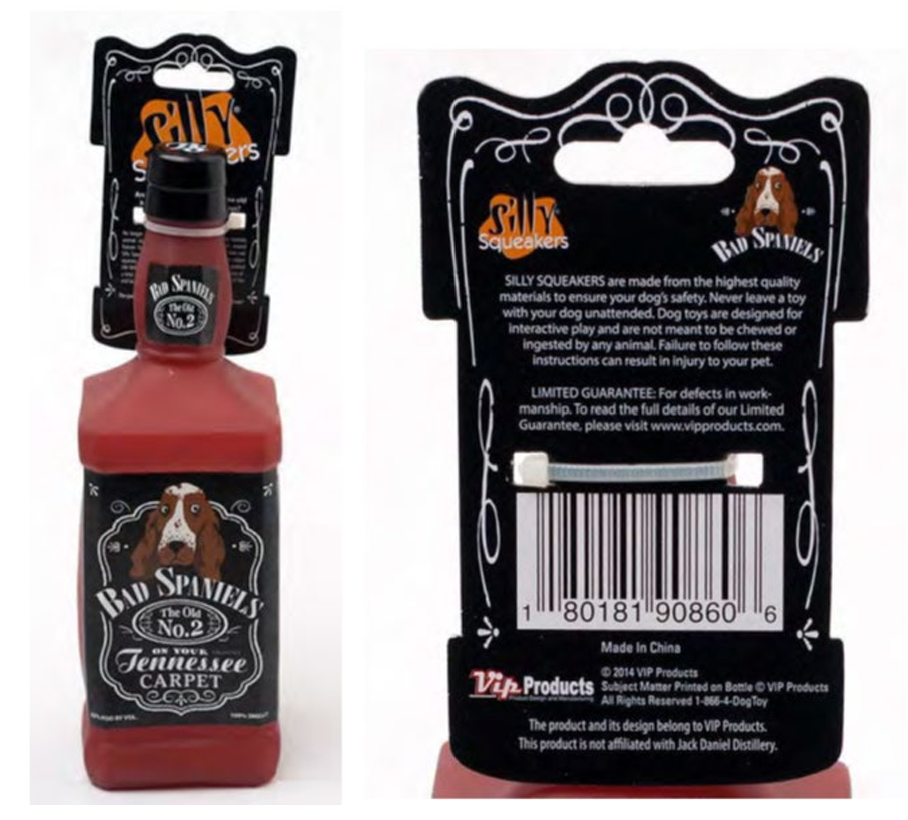 On Tuesday, the U.S. Court of Appeals for the Ninth Circuit issued a published ruling reversing the U.S. District Court for the District of Arizona’s entry of permanent injunction for distiller Jack Daniel’s in the long-running trademark case involving VIP Products’ Bad Spaniels dog toy.
This latest chapter in the decade-plus-long case remands the decision back to the district court with orders to enter judgment in favor of defendant VIP Products after finding that Jack Daniel’s did not meet its burden to show dilution by tarnishment.
This case returns to the Ninth Circuit after the appellate court’s March 2020 ruling that also reversed the district court’s finding that the Bad Spaniels dog toy diluted Jack Daniel’s trademarks. The Ninth Circuit’s ruling was largely struck down by the U.S. Supreme Court, which held in June 2023 that the Ninth Circuit erred in applying the Rogers test to find that the Bad Spaniels toy was entitled to First Amendment free speech protection from trademark infringement claims.
As to dilution by tarnishment, the Court ruled that the Trademark Dilution Revision Act’s (TDRA) non-commercial use exception does not shield parody uses like Bad Spaniels when that use is source-identifying in nature. The case was remanded to the district court, which dismissed Jack Daniel’s’ infringement claims for no likelihood of consumer confusion but entered a permanent injunction against VIP Products on the dilution claim.
Expert Testimony Relied on Overly Broad Consumer Associations, Not Accused Product
At the beginning of its dilution analysis, the Ninth Circuit noted that the district court failed to delineate between the plaintiff’s trade dress and asserted trademarks “Jack Daniel’s” and “Old No. 7” in finding that the asserted marks were famous. While the appellate court found that the “Jack Daniel’s” mark and trade dress met the high burden of household name recognition as required to maintain dilution claims under the TDRA, it held that the record does not independently support the same level of fame for the “Old No. 7” mark and that the district court conducted no separate analysis on the issue.
Limiting the dilution analysis to the trade dress and “Jack Daniel’s” trademark, the Ninth Circuit ruled that VIP Products was unlikely to harm the reputation of Jack Daniel’s’ asserted intellectual property rights. The appellate court largely ruled this way due to what it found was the district court’s faulty reliance on expert witness testimony proffered by Jack Daniel’s showing that the Bad Spaniels toy portrayed dog defecation in a way that would tarnish the asserted marks and trade dress. The Ninth Circuit noted that this expert witness testified on general consumer associations based on the Associative Network Model developed in the 1970s. Using this model as a basis, the expert witness testified that the association of food or beverage with defecation, like the mental association created by Bad Spaniels’ “Old No. 2” marks, tarnished Jack Daniel’s whiskey.
The problem for the Ninth Circuit was that this testimony did not specifically establish that Bad Spaniels’ dog toy itself tarnished the famous “Jack Daniel’s” mark and trade dress. The appellate court found no evidence in the record suggesting that scatological references on a dog toy not meant for human consumption would have the same likelihood of generating disgust as identical references on a consumable product.
Successful Parody Perceived by Consumers Increases Burden for Dilution Plaintiffs
Without completely defying the Supreme Court’s earlier ruling on the dilution claims in this case, the Ninth Circuit found it critical that the challenged expert testimony ignored that Bad Spaniels is an obvious parody. While the High Court found that VIP Products could not rely on the parodic nature of its dog toy to meet statutory exemptions to dilution claims under the TDRA, the Ninth Circuit noted that it agreed with several regional circuit courts that have held that parody can be considered when analyzing dilution claims. Citing to the Second Circuit’s 1996 ruling in Hormel Foods v. Jim Henson Productions, the Ninth Circuit noted that the clarity of parodic intent impacts the likelihood of whether the famous marks are tarnished by association.
When a parody is successful, the Ninth Circuit noted that the differences in source are not particularly subtle as consumers perceive the parody product as the joke it was intended to be, again citing language from Hormel Foods. This conclusion was also supported by the Fourth Circuit’s 2007 ruling in Louis Vuitton Malletier v. Haute Diggity Dog, where the appellate court ruled that a plaintiff had an increased burden to show dilution when the allegedly diluting product creates a successful parody. While expert testimony from Jack Daniel’s established that the point of the Bad Spaniels dog toy was to bring Jack Daniel’s whiskey to mind, the first step of the dilution analysis, failing to consider the effect of the dog toy’s obvious parody on the likelihood of tarnishment was a critical misstep by the district court, the Ninth Circuit held.
![[Advertisement]](https://ipwatchdog.com/wp-content/uploads/2026/10/IP-Copilot-Oct-13-2026-sidebar-700x500-1.jpg)
![[Advertisement]](https://ipwatchdog.com/wp-content/uploads/2026/10/Junior-Oct-15-2026-sidebar-700x500-1.jpg)
![[Advertisement]](https://ipwatchdog.com/wp-content/uploads/2026/09/WE-BUY-PATENTS-SIM-IP-Ad-1-revised-on-Sep-28-2026-700x500-1.jpg)
![[Advertisement]](https://ipwatchdog.com/wp-content/uploads/2026/09/Life-Sciences-2026-sidebar-early-bird-date-corrected-700x500-1.jpg)
![[Advertisement]](https://ipwatchdog.com/wp-content/uploads/2024/09/Patent-Prosecution-Training-sidebar-700x500-2025-03-27.jpg)





![[Advertisement]](https://ipwatchdog.com/wp-content/uploads/2021/12/WEBINAR-336-x-280-px.png)
![[Advertisement]](https://ipwatchdog.com/wp-content/uploads/2021/12/Ad-4-The-Invent-Patent-System™.png)




Join the Discussion
One comment so far. Add my comment.
Anon
August 5, 2026 06:24 pmParody should have ended this case for VIP Products a long time ago.
Add Comment