
![[IPWatchdog Logo]](https://ipwatchdog.com/wp-content/themes/IPWatchdog%20-%202023/assets/images/temp/logo-small@2x.png)

 0
0 “In 2024, workers in IP-intensive industries took home average weekly earnings of $1,897… [t]his wage premium [being] most pronounced in copyright-intensive industries.”
All charts from USPTO study.
Yesterday, the U.S. Patent and Trademark Office (USPTO) issued its latest study detailing the economic contributions of industries heavily reliant upon intellectual property rights, concluding that such IP-intensive industries contributed 44% of the United States’ entire gross domestic product (GDP) in 2024. Despite several key findings reflecting the rising value of IP rights to employee wages and job creation, the USPTO’s report noted significant trade deficits run by the United States relative to their foreign counterparts in commodity exports across several IP-intensive industries.
IP-Intensive Industries Contribute One-Third of U.S. Employment, 44% of GDP
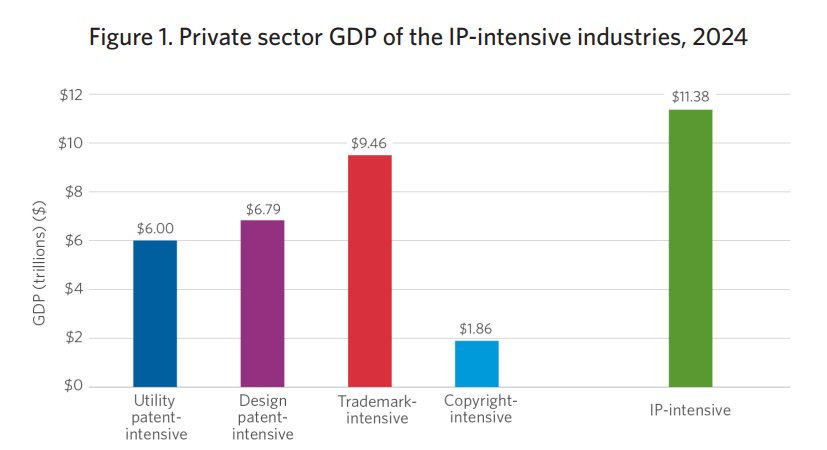
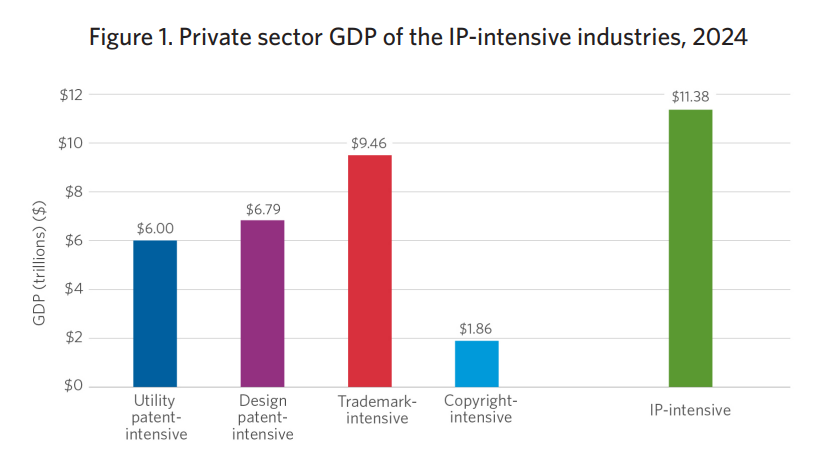
Analyzing economic, employment and IP registration data collected by the U.S. federal government, the USPTO’s study found that in 2024, a total of 128 IP-intensive industries contributed $11.4 trillion to U.S. GDP. This represents a sizable increase from the last IP-intensive industries study published by the USPTO, which found that such industries contributed $7.8 trillion to U.S. GDP in 2019, or about 41% of U.S. economic activity that year.
That increased value to the American economy has led IP-intensive industries toward consistent job growth over successive reports in this series. This most recent report, the fourth in the USPTO’s series on the economic impacts of IP-intensive industries, shows that such industries directly employ 49.6 million workers, one-third of total U.S. employment. This represents a slight increase from 2019’s totals, featured in the USPTO’s third report in the series, which showed 47.2 million workers directly employed by IP-intensive industries. Indirect employment attributable to companies sourcing intermediate goods and services for IP-related industries remained stable, accounting for about 11% of total U.S. employment across both studies.
Workers in IP-intensive industries enjoy sizable wage premiums compared to Americans employed in other industrial sectors. In 2024, workers in IP-intensive industries took home average weekly earnings of $1,897, a 53% increase over the average weekly pay for workers in non-IP-intensive industries. This wage premium was most pronounced in copyright-intensive industries, where workers earned 130% more in average weekly pay than workers in non-IP-intensive industries. While average pay increased from $1,517 per week in 2019, workers in IP-intensive industries earned a wage premium of 60% in the USPTO’s previous study, suggesting this wage premium gap has closed slightly.
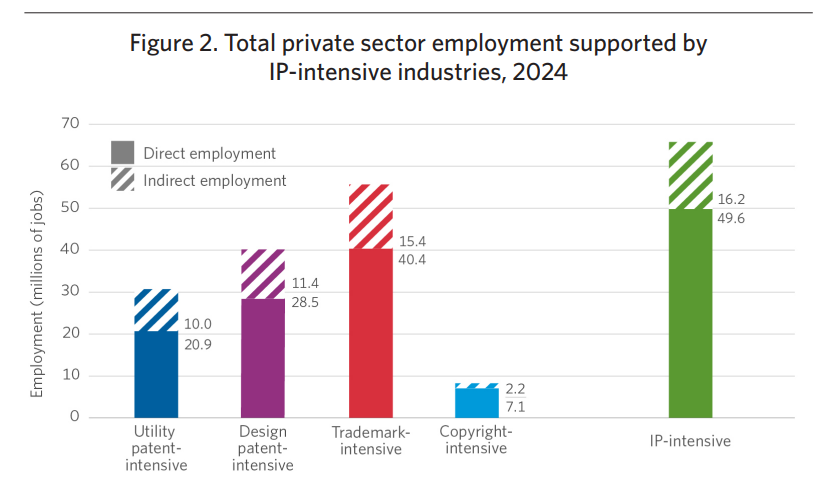
Trademark-intensive industries accounted for 40.4 million jobs in 2024, the highest total among IP-intensive industries of any form, though overall employment numbers dropped slightly owing to a reduction in the number of industries considered to be trademark-intensive. Substantial employment growth was seen in design patent-intensive industries, which increased from 21.6 million jobs in 2019 up to 28.5 million jobs in 2024, but this was similarly owing to an increase in the number of qualifying industries for the recent report. While copyright-intensive industries only employed 7.1 million American workers in 2024, this represented steady growth from 6.6 million jobs in 2019 without any attributable change to the number of qualifying industries.
Trade Deficits Remain in Majority of Commodity-Exporting IP-Intensive Industries
Trademark-intensive industries also accounted for the greatest amount of GDP output among all forms of IP, contributing $9.5 trillion of private sector output during 2024. Design patent- and utility patent-intensive industries, which tend to overlap with trademark-intensive industries, contributed $6.8 trillion and $6 trillion in 2024, respectively. At $830 billion in output, the housing and other real estate industry, which only qualifies as trademark-intensive, was the IP-intensive industry contributing the most to U.S. GDP in 2024, followed by computer systems design and related services ($522 billion) and software publishing ($380 billion).
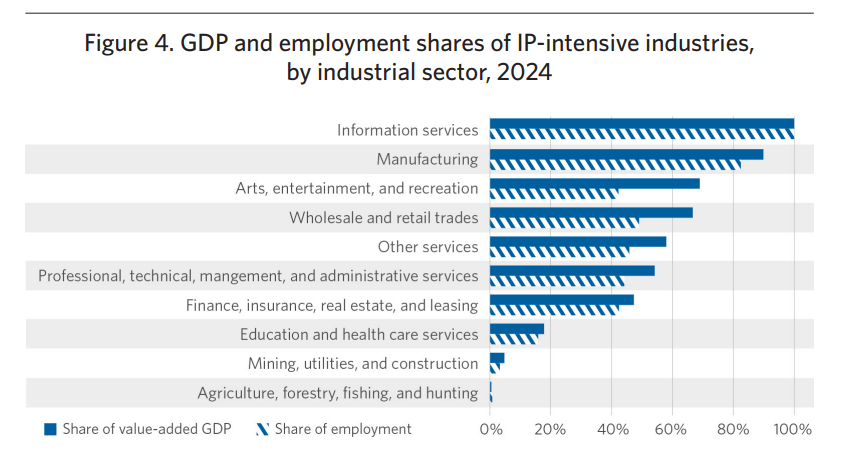
Grouping the entire collection of 210 U.S. industries analyzed by the USPTO into 10 industrial sectors, the recent study shows that IP rights are critical to the information services sector, where 100% of GDP output and employment is attributable to IP-intensive industries. The manufacturing sector ranks second in both categories with about 90% share of value-added GDP and more than 80% of employment attributable to IP-intensive industries. Arts, entertainment and recreation ranks third among industrial sectors for GDP output from IP-intensive industries, while the wholesale and retail trades sector accounted for the third-highest rate of employment attributable to IP-intensive industries.
Although the majority of commodity-exporting industries operating in the United States are considered IP-intensive, concerning trade deficits exist in the majority of those industries. Of the top 20 commodity-exporting industries, 18 are considered IP-intensive, but only four of those saw their exports to foreign countries outpace their imports: aerospace products and parts; petroleum and coal products; basic chemicals; and non-ferrous metal processing. The most significant trade deficits among IP-intensive industries were seen in pharmaceuticals and motor vehicles, both of which imported upwards of $250 billion in commodities during 2024, far outpacing their exports that same year.
![[Advertisement]](https://ipwatchdog.com/wp-content/uploads/2026/07/IP-Author-Aug-6-2026-sidebar-700x500-1.jpg)
![[Advertisement]](https://ipwatchdog.com/wp-content/uploads/2026/07/Juristat-Aug-11-2026-sidebar-700x500-1.jpg)
![[Advertisement]](https://ipwatchdog.com/wp-content/uploads/2026/07/Womens-IP-Forum-2026-sidebar-register-early-bird-now-700x500-1.jpg)
![[Advertisement]](https://ipwatchdog.com/wp-content/uploads/2026/07/ClearstoneIP-Varsity-Ad-2026-Ad-3.jpg)
![[Advertisement]](https://ipwatchdog.com/wp-content/uploads/2026/07/Juristat-Varsity-Ad-2026-IPW-ad-FreeTrial_1-UPDATED-on-Jul-15-2026.png)
![[Advertisement]](https://ipwatchdog.com/wp-content/uploads/2024/09/Patent-Prosecution-Training-sidebar-700x500-2025-03-27.jpg)








![[Advertisement]](https://ipwatchdog.com/wp-content/uploads/2021/12/WEBINAR-336-x-280-px.png)
![[Advertisement]](https://ipwatchdog.com/wp-content/uploads/2021/12/Ad-4-The-Invent-Patent-System™.png)





Join the Discussion
No comments yet. Add my comment.
Add Comment