
![[IPWatchdog Logo]](https://ipwatchdog.com/wp-content/themes/IPWatchdog%20-%202023/assets/images/temp/logo-small@2x.png)
Posts in Copyright
D.C. Judge Pauses Perlmutter Suit as Copyright Office Bill Awaits Senate Action
The U.S. District Court for the District of Columbia issued a minute order on September 18, in Perlmutter v. Blanche, staying the lawsuit brought by Register of Copyrights Shira Perlmutter until December 18, 2026. Judge Timothy J. Kelly pointed to the House of Representatives’ June passage of the Legislative Branch Agencies Clarification Act, H.R. 6028, which would designate the Register of Copyrights as an officer “appointed by the President” with the advice and consent of the Senate.
Schedule A Litigation Is Not the Problem: Online Counterfeiting Is
Online counterfeiting has become ubiquitous. A seller located anywhere in the world can create a digital storefront, copy a brand owner’s photographs and product descriptions, adopt a business name that reveals nothing, and begin selling into the United States before the brand owner even knows the account exists. If the seller is discovered and enforcement begins, the listing disappears, the money moves out of the country and beyond the practical reach of the court system, and a new account surfaces under a different name. Then the entire process repeats.
Groups Slam Issa Bill to Expedite Site Blocking Orders
Representative Darrell Issa introduced the American Copyright Protection Act (ACPA) on Monday, a bill aimed at creating an expedited judicial mechanism for copyright owners to obtain orders blocking access to certain foreign piracy sites. While the official text of the bill has not yet been published, several groups have responded based on their review of a draft of the bill that was circulated to stakeholders in May 2025.
Songwriter Tells SCOTUS to Ignore Music Companies’ Bid to Retain Foreign Copyright in His Song
A songwriter told the U.S. Supreme Court this week to reject an attempt by the four largest music companies in the world to reverse a Fifth Circuit ruling granting him all rights to the 1966 Swingin’ Medallions single, “Double Shot (Of My Baby’s Love).” The U.S. Court of Appeals for the Fifth Circuit issued an opinion in January 2026 in Vetter v. Resnick, affirming the Middle District of Louisiana’s grant of summary judgment declaring that Cyril Vetter, co-author of “Double Shot,” and Vetter’s affiliated companies are the sole owners of the copyright to the song throughout the world.
CAFC Reverses Dismissal of TexasLDPC’s Infringement Suit Against Broadcom
The U.S. Court of Appeals for the Federal Circuit (CAFC) issued a precedential decision today in TexasLDPC Inc. v. Broadcom Inc., reversing a district court’s dismissal of a patent and copyright infringement lawsuit brought by an exclusive licensee that had not joined the patent owner as a co-plaintiff. The court held that TexasLDPC Inc.’s license agreement with Texas A&M University (A&M) did not automatically terminate when TexasLDPC shifted its business to patent enforcement. The agreement conveyed “all substantial rights” in the asserted patents to TexasLDPC, making A&M “not otherwise a necessary party” under Federal Rule of Civil Procedure 19.
DOJ Sides with OpenAI, Warns Obstacles to AI Development Threaten National Security
On September 1, the U.S. Department of Justice (DOJ) filed a Statement of Interest urging the U.S. District Court for the Southern District of New York to hold that using copyrighted written works to train large language models (LLMs) is fair use, arguing that a contrary result would distort copyright law, suppress innovation and weaken U.S. competitiveness and national security. The statement was filed in reference to the multidistrict copyright litigation against OpenAI, although it specifically addressed claims by The New York Times and said its reasoning also applies to the related cases involving book authors and publishers.
WikiHow Files Lawsuit Against OpenAI Over ChatGPT’s Use of Its How-To Library
On August 21, wikiHow, Inc. filed a complaint in the U.S. District Court for the Southern District of New York against OpenAI, Inc. and eight affiliated entities, alleging violations of the Copyright Act and the Digital Millennium Copyright Act (DMCA). The lawsuit centers on claims that OpenAI copied wikiHow’s how-to articles without authorization to train ChatGPT and to ground its outputs, then used that copied content to generate substitutes for wikiHow’s website.
Nigeria Is Building the Next Global Economy: Is Your Intellectual Property Ready for It?
U.S. companies planning to enter Nigeria typically build a careful playbook for market research, distribution, hiring, and regulatory compliance. Intellectual property is often the item furthest down that list, treated as paperwork to handle once commercial activity is already underway. That sequencing is backwards, and it is worth understanding why.
Fifth Circuit Takes First Pass at Several Questions on Architectural Protections Under the AWCPA
On Friday, the U.S. Court of Appeals for the Fifth Circuit issued a ruling answering multiple questions of first impression regarding copyright claims involving building plans, including the scope of protection under the Architectural Works Copyright Protection Act (AWCPA) for constructed buildings and floorplan renderings. Vacating the Western District of Texas’ dismissal of Kipp Flores Architects’ (KFA) copyright infringement claims, the Fifth Circuit affirmed the lower court’s dismissal of KFA’s claims under the Digital Millennium Copyright Act (DMCA) over alleged failures to include copyright management information (CMI) on new floorplans developed from KFA’s technical drawings.
From Testimony to Action: Proposed Legislation to Address Issues Raised by Rights Owners During Recent House Hearing
On June 30, 2026, the House Judiciary Subcommittee on Courts, Intellectual Property, Artificial Intelligence, and the Internet held a hearing titled, “A Midlife Crisis? IP and the Internet After 40,” which examined whether current U.S. intellectual property laws and enforcement mechanisms are effective against Internet-driven infringement and counterfeiting. The hearing focused on online counterfeiting, digital piracy, and AI-enabled or generated infringement and digital replicas. The hearing also considered the difficulty in enforcing rights against overseas operators, and enforcement tools to address these issues, including Schedule A litigation and website blocking.
Latest USPTO Study on IP-Intensive Industries Shows Increasing GDP and Job Levels Attributable to IP Rights
Yesterday, the U.S. Patent and Trademark Office (USPTO) issued its latest study detailing the economic contributions of industries heavily reliant upon intellectual property rights, concluding that such IP-intensive industries contributed 44% of the United States’ entire gross domestic product (GDP) in 2024. Despite several key findings reflecting the rising value of IP rights to employee wages and job creation, the USPTO’s report noted significant trade deficits run by the United States relative to their foreign counterparts in commodity exports across several IP-intensive industries.
Outdated Protective Orders are Impeding Software Code Analysis in Copyright and Trade Secret Cases
As an expert witness on intellectual property litigations, I have noticed over the past few years parties with poor arguments in software copyright and software trade secret cases, both plaintiffs and defendants, have been taking advantage of technologically outdated protective orders to gain an unfair advantage. The U.S. District Court for the Northern District of California, where probably the majority of software IP cases take place, has a Model Protective Order for Litigation Involving Patents, Highly Sensitive Confidential Information and/or Trade Secrets that has become a de facto standard for software IP cases around the country. It is antiquated and needs to be updated.
Seizing the Secret Sauce: How Generative AI is Breaking Government Contracting and IP Law
As government contractors rapidly integrate LLMs and generative AI into their operations, regulators are scrambling to adapt to shifting data ownership requirements. The General Services Administration (GSA) recently proposed a new GSAR clause (552.239–7001) to standardize AI procurement, and the current draft has been met with widespread industry criticism. By asserting expansive government ownership over “data outputs” and “custom development,” the proposed rule inadvertently exposes a fault line between government data protection and commercial IP rights.
Federal Circuit Partially Vacates Court of Federal Claims’ Assessment of Copyright Award
In a precedential decision authored by Judge Hughes on Thursday, the U.S. Court of Appeals for the Federal Circuit (CAFC) vacated-in-part and remanded a decision of the Court of Federal Claims that had awarded 4DD Holdings, LLC, and T4 Data Group, LLC $12,683,065.86 for the U.S. government’s infringement of their copyrighted software TETRA®. 4DD sued the Department of Defense (DOD) and the Department of Veterans Affairs (DVA) for infringement of its copyrighted software, TETRA, which served as an interoperability solution for military healthcare records stored by the two agencies in separate databases (dubbed the “Defense Medical Information Exchange (DMIX) program).
Who Owns the Worldview Inside an AI Model?
A faith-technology company has done something the IP world should notice. Gloo — a Boulder, Colorado, firm that serves churches, ministries, and Christian universities, and now trades on the Nasdaq — built a benchmark it calls Flourishing AI Christian, or FAI-C. The finding is blunt: Today’s leading large language models, tested on questions of meaning, character, and faith, come up short. On a 100-point flourishing scale, the frontier models averaged 61. On the faith dimension, they scored worst of all.
Varsity Sponsors
![[Advertisement]](https://ipwatchdog.com/wp-content/uploads/2026/09/ClaimHit-Oct-1-2026-sidebar-700x500-1.jpg)
![[Advertisement]](https://ipwatchdog.com/wp-content/uploads/2026/09/WE-BUY-PATENTS-SIM-IP-Ad-1-700x500-1.jpeg)
![[Advertisement]](https://ipwatchdog.com/wp-content/uploads/2026/09/Life-Sciences-2026-sidebar-early-bird-price-700x500-1.jpg)
From the IPWatchdog Institute
![[Advertisement]](https://ipwatchdog.com/wp-content/uploads/2024/09/Patent-Prosecution-Training-sidebar-700x500-2025-03-27.jpg)

Latest IPW Posts
Epiq Counsel Client is Seeking a Senior Trademark Paralegal (Global Portfolio | In-House)
September 25, 2026 @ 06:15 amEpiq Counsel Client is Seeking a Patent Paralegal (Global Portfolio | In-House)
September 25, 2026 @ 05:15 amSquires’ Anniversary Celebration Raises Serious Ethical, Legal Questions
September 24, 2026 @ 03:15 pmCoke Stewart Tells Women’s IP Forum It’s Time to ‘Shock’ the U.S. Patent System Into Action
September 24, 2026 @ 01:36 pm
Latest Podcasts



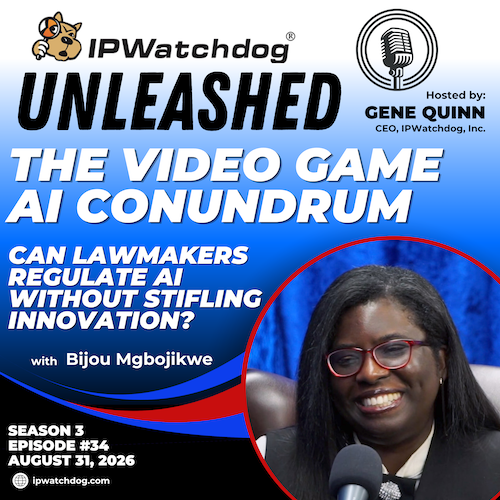
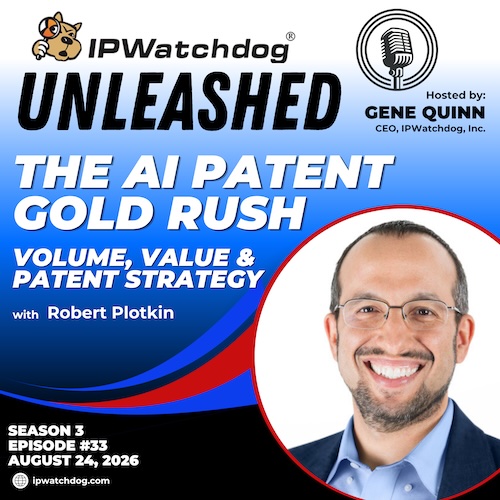
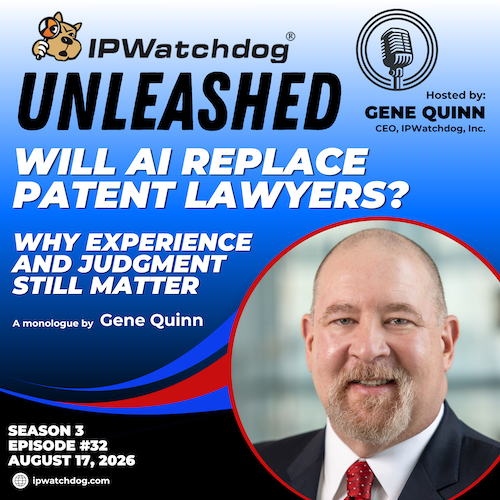
IPWatchdog Events
Webinar: AI for Patent Licensing – Beyond Statistical Triage to Evidence-Grounded Product Analysis
October 1 @ 12:00 pm - 1:00 pm EDTCLE Webinar: Protecting the Product – Mapping Features to Patent Claims and Closing Coverage Gaps
October 13 @ 12:00 pm - 1:00 pm EDTCLE Webinar: How to Prompt AI – University IP Workflows in Action
October 15 @ 12:00 pm - 1:00 pm EDT
Industry Events
AI Skills: A Phased Roadmap for Junior and Senior Attorneys (CLE Webinar)
September 29 @ 1:00 pm - 1:30 pm EDTFrom IPWatchdog
![[Advertisement]](https://ipwatchdog.com/wp-content/uploads/2021/12/WEBINAR-336-x-280-px.png)
![[Advertisement]](https://ipwatchdog.com/wp-content/uploads/2021/12/Ad-4-The-Invent-Patent-System™.png)