
![[IPWatchdog Logo]](https://ipwatchdog.com/wp-content/themes/IPWatchdog%20-%202023/assets/images/temp/logo-small@2x.png)

 0
0 “C4IP found a significantly higher percentage of patent legislation would have a negative impact compared to proposed copyright legislation.”
Today, the Council for Innovation Promotion (C4IP) published the third edition of its Congressional Innovation Scorecard, which provides a measure of each lawmaker in the U.S. Congress in terms of their impact on the nation’s intellectual property (IP) system. Although this year’s scorecard acknowledges higher numbers of pro-copyright bills introduced into Congress, it concludes that members of Congress are still failing to engage fully and effectively on national IP issues to the detriment of America’s future as an innovation leader.
 C4IP is led by several prominent members of the IP community including former U.S. Patent and Trademark Office (USPTO) Directors Andrei Iancu and David Kappos, who lead C4IP as Co-Chairs. Released annually since 2024, the Congressional Innovation Scorecard grades the performance of each federal lawmaker across the past four Congresses, with particular emphasis placed on legislator activities during the 118th and 119th Congresses.
Low IP Engagement in Congress Allows Patent Eligibility, Piracy Issues to Remain Unchecked
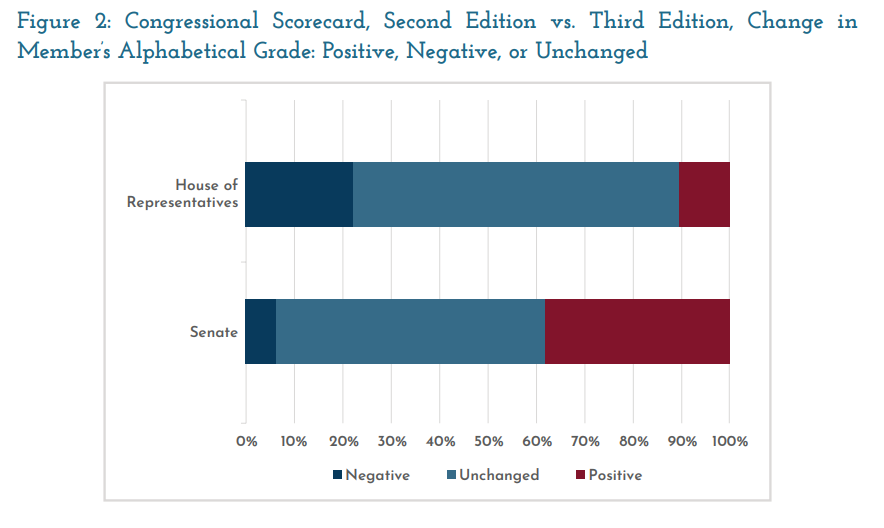
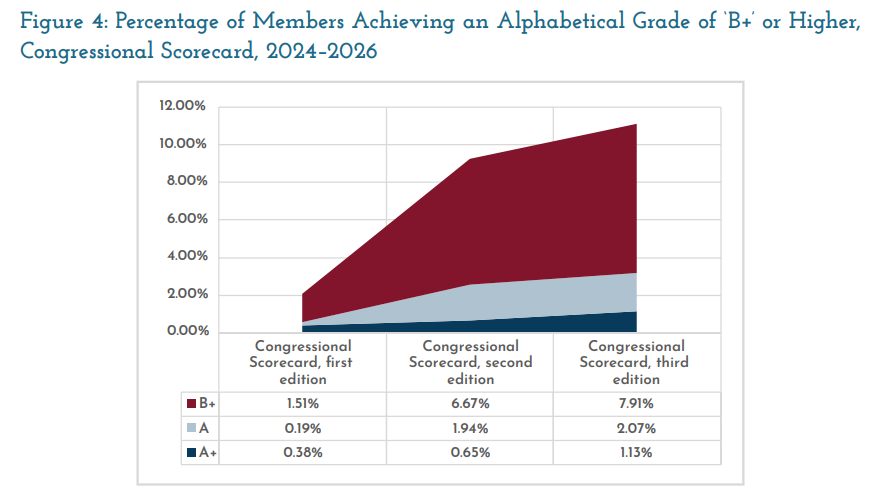
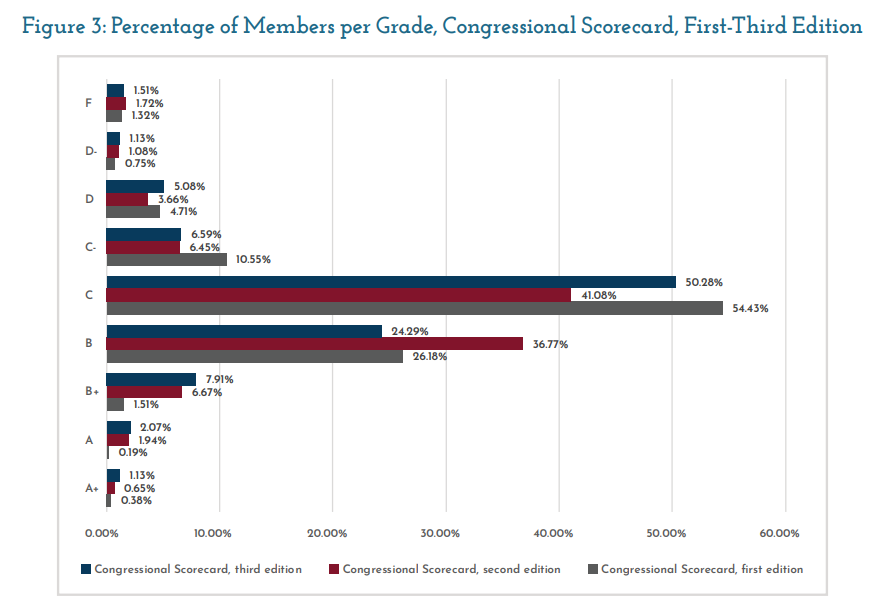
Nearly two-thirds of Congress received a grade of “C” or lower in this year’s scorecard with grades remaining unchanged or even decreasing for more than 80% of the Senators and Representatives included in last year’s edition, with more grades moving negatively in the House of Representatives. While negative scores saw greater movement downward, the percentage of Congressional members achieving a positive grade of “B+” or greater increased over three scorecard editions from 2% in 2024 to 11% this year.
Scorecard results for the House of Representatives have moved closer to the Senate in several ways. While overall activity measured in terms of bill sponsorship and advocacy efforts is lower for House members, widening scores among Representatives suggests higher overall levels of IP-related activity in the House. Although the scorecard assesses proposed legislation and other activities in terms of whether they would have positive or negative impacts on the nation’s IP system, low scores in either direction for half of all Congressional lawmakers indicate only minimal involvement in IP-related matters. Indeed, many federal lawmakers only registered any score this year due to unanimous consent or roll call votes.
 Senators Chris Coons (D-DE) and Thom Tillis (R-NC) remain top performers in this year’s scorecard, both earning “A+” grades for their IP advocacy. Although their numerical scores were higher than any other member of Congress by an order of magnitude, Coons and Tillis were joined by Senators Marsha Blackburn (R-TN) and Mazie Hirono (D-HI) who also registered “A+” grades. Over in the House, only Representatives Nathaniel Moran (R-TX) and Deborah Ross (D-NC) registered “A+” grades, though a growing group of “A” grades were noted in this year’s scorecard. Lawmakers scoring “F” grades for advancing anti-IP bills and policies included Senators Maggie Hassan (D-NH), Bernie Sanders (I-VT), Elizabeth Warren (D-MA) and Peter Welch (D-VT), and Representatives Marie Gluesenkamp Perez (D-WA), Pramila Jayapal (D-WA), Lloyd Doggett (D-TX) and Janice Schakowsky (D-IL).
 By failing to meaningfully engage with IP issues, the majority of Congress allows issues surrounding subject matter eligibility and injunctive relief availability to remain unchanged in the face of landmark U.S. Supreme Court decisions introducing great uncertainty into those legal analyses. Congressional inactivity has also allowed China to creep into the lead in several critical technological sectors including robotics, biotechnology, artificial intelligence, advanced materials and quantum. It further allows piracy and misappropriation issues in digital trade to remain unchecked despite the increasing ease of infringing IP rights.
 Significantly Greater Number of Negative Patent Bills Introduced in Senate
C4IP’s scorecard lauds a trio of bills currently pending before Congress that would provide meaningful improvements to the nation’s IP system. The reintroduction of the Patent Eligibility Restoration Act (PERA) is a “significant breakthrough on the legislative front” addressing long-standing subject matter eligibility uncertainty, according to C4IP. The IP advocacy organization also supports the PREVAIL Act, which would increase standing requirements for parties petitioning for validity proceedings at the Patent Trial and Appeal Board (PTAB), and the RESTORE Patent Rights Act, which would restore the rebuttable presumption that patent owners proving infringement in court should be entitled to injunctive relief stopping the infringement.
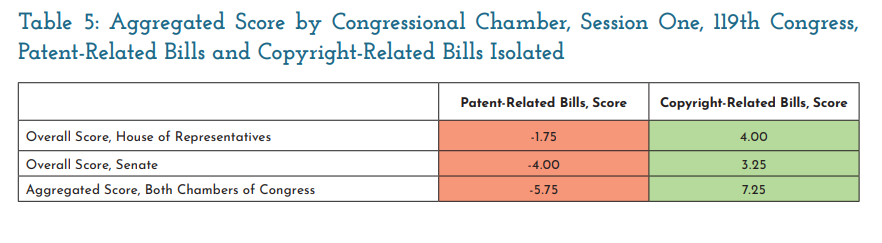
Assessing proposed bills that would likely have negative impacts on the U.S. IP system, C4IP found a significantly higher percentage of patent legislation would have a negative impact compared to proposed copyright legislation. C4IP viewed 60% of patent-related bills currently before Congress as having a negative impact, whereas nearly 70% of pending copyright-related bills would provide positive impacts. When comparing bills introduced into either house of Congress, the Senate has seen a much greater number of negative patent bills than the House of Representatives, and the Senate also trails slightly in its copyright legislation scores.
Patent bills cited by C4IP as posing significant negative impacts include the Medication Affordability and Patent Integrity Act, the Affordable Prescriptions for Patients Act and the Eliminating Thickets to Increase Competition (ETHIC) Act. As C4IP’s scorecard points out, many of these bills embrace false narratives persisting in the life sciences sector that blame patent rights as the purported cause of high drug prices.
Although seemingly every member of Congress claims to be pro-innovation, C4IP notes that the low overall levels of IP engagement among federal lawmakers belies the opportunity that exists to actually engage with IP issues in pro-innovation ways. “The future of U.S. security and prosperity depends” upon urgent and constructive legislative action, C4IP concludes.
All images from C4IP Scorecard.
![[Advertisement]](https://ipwatchdog.com/wp-content/uploads/2026/05/Patent-Masters-2026-sidebar-700x500-rev1.jpg)
![[Advertisement]](https://ipwatchdog.com/wp-content/uploads/2026/05/Protege-in-PatentSight-product-350x250-Ad-A.png)
![[Advertisement]](https://ipwatchdog.com/wp-content/uploads/2026/05/LexisNexis-Jun-11-2026-sidebar-700x500-1.jpg)





![[Advertisement]](https://ipwatchdog.com/wp-content/uploads/2021/12/WEBINAR-336-x-280-px.png)
![[Advertisement]](https://ipwatchdog.com/wp-content/uploads/2021/12/Ad-4-The-Invent-Patent-System™.png)






Join the Discussion
No comments yet. Add my comment.
Add Comment