
![[IPWatchdog Logo]](https://ipwatchdog.com/wp-content/themes/IPWatchdog%20-%202023/assets/images/temp/logo-small@2x.png)

 2
2 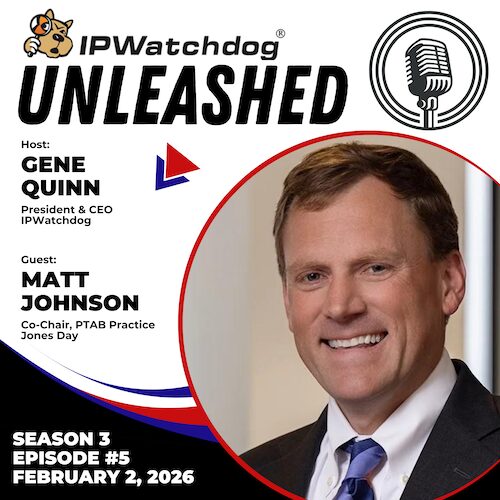 In this episode of IPWatchdog Unleashed, I speak with Matt Johnson, Co-Chair of the PTAB Practice at Jones Day, take an in-depth look at the Patent Trial and Appeal Board (PTAB) nearly a decade and a half after its launch. We discuss the ongoing PTAB reset at the United States Patent and Trademark Office (USPTO) and suggest practical fixes for a better, re-engineered PTAB.
The conversation zeroes in on structural flaws that distort outcomes rather than improve patent quality. Johnson and I discuss obviousness determinations built on excessive combinations of prior art, warning that such analyses blur the line between legitimate hindsight reconstruction and genuine innovation assessment. We also highlight a systemic blind spot: nuisance “ankle-biter” assertions that exploit litigation economics while largely evading PTAB scrutiny. These cases have driven much of the political backlash against patents while remaining functionally untouched by the post-grant review process, leaving operating companies to absorb the cost as a tax on doing business and legitimate patent owners to be vilified as if they are the problem.
The majority of the conversation, however, is devoted to concrete, targeted reform suggestions that would lead to a better functioning PTAB and more streamlined IPR review system. Instead of abstract complaints, Johnson proposes narrowing PGR estoppel to encourage early challenges, moving IPR estoppel to the point of institution to eliminate gamesmanship, separating institution decisions from full merits adjudication to reduce confirmation bias, and rethinking quiet-title concepts to better align notice to implementers with settled expectations of patent owners.
The takeaway is clear: the PTAB does not need to be dismantled—but it does need disciplined recalibration if it is to deliver fairness, predictability, and legitimacy going forward.
Why the PTAB Once Worked—and Why It Drifted
Johnson explains that the PTAB’s early appeal was simple: disputes focused on the merits. Proceedings emphasized prior art, claim scope, and obviousness before technically sophisticated judges—without the procedural gamesmanship and discovery abuse endemic to district court litigation. That design attracted a collegial, expert bar that differed significantly in tone from what one sees with respect to district court patent litigation.
But one of the biggest surprises, which emerged early after the creation of the PTAB, was extremely detailed, quasi-merits institution decisions—often running 40 to 50 pages. Such merits-heavy institution decisions began to lock in outcomes before a full evidentiary record was developed. Both Johnson and I agree this dynamic introduced confirmation bias, contributing to historically high claim-cancellation rates and undermining confidence among patent owners.
Obviousness, Overreach, and the Limits of Error Correction
I raise a longstanding concern with PTAB practice: obviousness determinations built on sprawling combinations of five, six or more references. While legally permissible, both speakers agree such analyses strain credibility and risk collapsing the distinction between genuine innovation and hindsight reconstruction. I argue that the combination of so many references practically proves the claimed invention is not obvious, and that if the PTAB can combine so many references, anything could be found unpatentable.
The conversation also addresses the persistent failure of PTAB proceedings to meaningfully address so-called “ankle-biter” assertions—low-value nuisance demands often untethered from real infringement. These cases, they argue, evade PTAB scrutiny altogether and distort patent policy debates, while operating companies bear the real economic burden. It is hard to say argue the decisions of accused infringers who often choose to settle for $50,000 or even $100,000, but there should be a solution because absent some way to address these nuisance cases it is easy to predict they will keep being filed—which is precisely what has happened and continues to happen.
Concrete Fixes, Not Abstract Complaints
Rather than rehashing grievances, Johnson and I discuss specific, implementable reforms:
- Fix PGR Estoppel: Narrow post-grant review estoppel to claims actually raised, making PGR a viable early-challenge mechanism rather than a litigation death trap.
- Move IPR Estoppel to Institution: Statutorily align estoppel timing with institution decisions to eliminate gamesmanship and streamline proceedings.
- Separate Institution from Merits: Use summary or director-level institution screening, reserving full panel engagement for cases that warrant substantive review.
- Revisit Quiet Title Concepts: Explore notice-based mechanisms that protect settled expectations without blindsiding accused infringers.
- Re-center Merits Review: Limit serial challenges and repetitive reconsideration of patents already vetted by the Office and courts.
The Bigger Risk: Pendulum Whiplash
Both Johnson and I caution that the current sharp contraction in PTAB institutions—illustrated by recent data showing only a handful of merits institutions out of dozens of petitions—risks triggering a political and policy snapback. Overcorrection, they warn, could destabilize the system yet again, reinforcing the need for measured, durable reform rather than ideological swings.
Bottom Line
This discussion underscores a hard truth: the PTAB’s problems are real, but solvable if policymakers focus on incentives, procedure, and institutional design rather than rhetoric. We agree that most stakeholders want the same outcome: a patent system that filters out weak claims without punishing legitimate innovation. This means the path forward is not abolition or blind deference. It is intentional, thoughtful, and disciplined recalibration.
More IPWatchdog Unleashed
You can listen to the entire podcast episode by downloading it wherever you normally access podcasts or by visiting IPWatchdog Unleashed on Buzzsprout. You can also listen to IPWatchdog Unleashed conversations on the IPWatchdog YouTube channel. For more IPWatchdog Unleashed, see below for our growing archive of previous episodes.
![[Advertisement]](https://ipwatchdog.com/wp-content/uploads/2026/06/Womens-IP-Forum-2026-sidebar-register-super-early-bird-now-700x500-1.jpg)
![[Advertisement]](https://ipwatchdog.com/wp-content/uploads/2026/07/Juristat-Varsity-Ad-2026-IPW-ad-FreeTrial_2-UPDATED-on-Jul-15-2026.png)
![[Advertisement]](https://ipwatchdog.com/wp-content/uploads/2026/07/DeepIP-Jul-28-2026-sidebar-700x500-1.jpg)
![[Advertisement]](https://ipwatchdog.com/wp-content/uploads/2026/07/Ankar-AI-Jul-30-2026-sidebar-700x500-1.jpg)






![[Advertisement]](https://ipwatchdog.com/wp-content/uploads/2021/12/WEBINAR-336-x-280-px.png)
![[Advertisement]](https://ipwatchdog.com/wp-content/uploads/2021/12/Ad-4-The-Invent-Patent-System™.png)







Join the Discussion
2 comments so far.
Warren
February 6, 2026 09:52 pmI’ve heard you and others raise the “five or six” reference combinations for obviousness many times (including in your discussion with Stewart at your PTAB Master Conference. Certainly these *do* occur (my recollection is that one of those first very few IPRs had a ground or grounds with at least 4).
But has anyone looked into how *often* they actually occur? From cases I’ve seen, that seems to be very much the exception rather than the rule. Plus, I know some people add references into their obviousness “grounds” that arguably aren’t needed. For example, References A and B are relied on to teach the limitations of the claim; Reference C (which shares some of the same features of A and/or B) is relied on as evidence of a motivation to combine. Some people make that a 2-ref combo, some make it a 3 to guard, particularly to guard against hypertechnicality of some PTAB panels, even though the CAFC has said you don’t have to do that.
Or I have seen grounds that challenge the independent claim with only 2/3 references, but then dependent claims add generally well-known features. (We all know that there are a lot of meaningless dependent claims out there, akin to “wherein the button is green.”) So additional references are cited in the “ground” to challenge those claims. That seems far more common that 5-6 ref combinations, in my experience. Point me to some data otherwise?
Anon
February 3, 2026 12:54 pmCaveat – this is before giving this a listen and just running through the write-up above, but I did not see my number one issue.
Back in the days prior to law, after being an engineer and transitioning to a technical sales and marketing manager, I was involved (due to prior engineering involvement in quality) with the program of turning warranty issues into next generation advances.
The biggest problem that I have seen with all post-grant efforts ‘at quality’ (in quotes – as should be evident why), is that none of the post grant efforts actually feed back into the front end of the process and make any actual improvements to the one aspect under the USPTO’s process control: quality of examination.
Further, the way the AIA ‘worked it’ was the perverse incentive to ‘get paid twice’ and have lower quality during examination that could feed the post grant money income stream.
Not saying that such was on purpose or ever ‘abused’ (not with standing reports on PTAB folk obtaining bonuses on volume), but there was never a reason for this type of temptation in the first instance had those writing the AIA really wanted to focus on what should have been the focus all along.