


 0
0 “U.S. policymakers misled by patent myths and manipulated data seem to be ignoring the economic and technological realities of biopharmaceutical innovation.”
The following is condensed from an Issue Brief published by the Center for American Principles
 America’s $150 billion per year private sector investment in biopharmaceutical research and development (R&D) does more than offer comfort. Increasingly, American innovators are curing or effectively eliminating the medical threat from many diseases and conditions. Witness, cures for Hepatitis C, GLP-1s for weight loss, COVID-19 vaccines, and HIV prevention at virtually 100% effectiveness, alongside stem cell therapies, gene editing, and CAR-T therapies for previously untreatable cancers. For those suffering from rare or untreatable disease, as well as chronic conditions, this is an era of unprecedented hope.
Despite its stunning successes—or perhaps because of them—U.S. biopharmaceutical innovation is under attack on many fronts, from legislation like the anti-patent ETHIC Act, to government price controls, federal funding cuts, IP licensing restrictions, foreign reference pricing, global IP waivers, and forced technology transfers.
According to nonprofit rare disease advocacy and research group Every Cure, “less than 22% of the 18.5K recognized diseases in the world have FDA-approved treatments.” Meanwhile, as ARPA-H Director Alicia Jackson said in a May 2026 interview, “We see many, many U.S. folks going [to China] for their clinical trials network at this point because it’s half the cost and two to five times faster.”
At this moment of unparalleled opportunity to address unmet medical need, and at an historic inflection point for U.S. biotech competitiveness, U.S. policymakers misled by patent myths and manipulated data seem to be ignoring the economic and technological realities of biopharmaceutical innovation and turning against the patent goose that lays the golden innovation eggs.
The Business of Know-How
From his perch at the Smithsonian, Arthur Daemmrich wrote: “[A]fter John J. Powers assumed the presidency of Pfizer in 1965, he invited the respected management consultant Peter Drucker to evaluate the company’s structure and approach. Drucker concluded that ‘Pfizer acted like a classic manufacturer,’ and he advised the firm, ‘What you are making and selling is knowledge, and manufacturing is incidental.’” Policymakers who support price controls and patent restrictions seem to think it’s the other way around, that innovation is incidental and reproduction of a medicine is the only cost borne by industry.
Here’s what the Association for Accessible Medicines, representing producers of generic medicines says:
“Drug research is costly and patent protection gives brand-name manufacturers [time] to recover research & development costs—costs that generic manufacturers do not have to recoup.”
A new medicine approved by the U.S. Food and Drug Administration (FDA) takes on average 10 years and more than $2.5 billion to develop. Only about 12% of potential drugs make it through the rigorous process to become FDA approved.
Where patent rights are sufficiently available and reliable they provide a basis for investment in the long, risky, and expensive work of curing disease. Patent rights to novel inventions and discoveries, rooted in the U.S. Constitution and codified in U.S. law, enable the significant capital expenditures necessary to advance the state of the art at every stage of drug discovery and secure the biomedical outcomes patients desperately need.
Conflating Product and Patent
The perspective that seems to be influencing congressional hostility to patents is that only a single patent should apply to a single product. This view flies in the face of technological, economic, and legal reality, where patents cover inventions and discoveries more-so than end-products. An innovative medicine is more than a single product. It combines solutions to a range of challenges each of which must be overcome in order to safely and effectively deliver a therapeutic benefit to a patient.
Like the mobile phone, which combines thousands of patented inventions, each adding a unique capability or solving a technical problem and collectively enabling the whole phone to work as intended, modern medicines are highly complex. Accordingly, a single innovative therapy may be subject to multiple patents. Unique claims, and limits on their scope, duration and overlap, help illustrate why numerous patents may apply to a single successful medicine.
Innovation doesn’t end with the early-stage discovery of a promising new chemical entity or biologic and its corresponding composition of matter patent, although this milestone does start the innovator’s foundational 20-year term of exclusivity running typically years before a product will be ready to market. The composition of matter is the main stem from which researchers branch out in fruitful directions to develop and test applications.
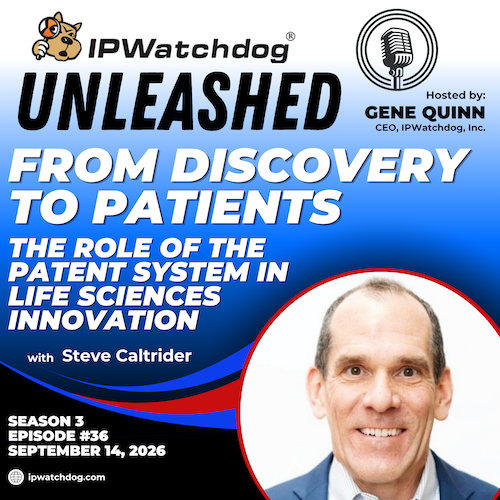
Any subsequent pharmaceutical patent represents a new solution to a specific biomedical challenge. On a recent episode of the IPWatchdog Unleashed podcast, pharmaceutical IP expert Brent Bellows explains that in biopharmaceutical innovation, the patent “claims are anchored tightly to the science: compositions, formulations, methods of treatment, routes of administration and FDA-approved indications.”
The “aha” moments underpinning these discrete breakthroughs often span many years and repeated injections of capital. Each component discovery must function both individually and collectively for a medicine to perform: identifying a chemical or biological remedy that acts on a disease target; matching it with a delivery system that puts it in just the right place—and only the right place—in the body; zeroing in on a dosage perfectly balancing effect against toxicity; and developing the specialized know-how to reproduce and deliver the medicine at scale.
Patents Enable Living Innovation
Innovation doesn’t end with an FDA-approved medicine, either. The misleading criticisms that underpin the ETHIC ACT, and a spate of other patent-hostile legislative proposals, over-simplify, devalue, and dismiss as “obvious,” the difficulty and significance of securing improvements to the methods and mechanics of biopharmaceutical manufacturing, formulation, dosage, and delivery.
Many therapeutically valuable discoveries come from patent-enabled investments that follow the initial launch of a new drug. Post-approval innovations, often dismissed by industry critics as trivial, can be highly advantageous to patients. Investments in post-approval innovation make a medicine safer and more effective for a broader group of patients, enable a medicine’s use in children, or even uncover new conditions for which a given product may have a therapeutic benefit, all through costly research and trials at the innovator’s expense.
These examples of living innovation, which require sustained investment and persistent research, are the ones most often derided in terms of patent “thickets” and “evergreening,” with innovators accused of inappropriately extending patent coverage. Truthfully, like a healthy forest canopy, the biopharmaceutical innovation ecosystem viewed from above may appear impenetrable. A view from the ground, however, reveals a thriving research and investment habitat where discoveries branch one from another yielding new progress and hope for waiting patients.
What’s more, critics ignore the consistent and principled application of U.S. law over many decades. The U.S. Patent and Trademark Office (USPTO) says simply that patents on improvements to existing products, a feature of U.S. patent law since 1790, do not extend the life of the claims made by the original patent; they only cover the specific claims on the improvement.
In a 2024 study, the USPTO provided a clear, empirical analysis that thoroughly debunked anti-patent claims. For its Drug Patent and Exclusivity Study, the Office selected 25 medicines—among them the “most prescribed” and “top grossing” prescription medicines of the study period—that were emblematic of the lifecycle for innovation of new therapies and the subsequent transition to generic competition. The USPTO found that none of the medicines studied was afforded more than 3 to 16 years of total market exclusivity – well short of the 20-year patent term. The report said:
“Such improvements, when deemed patentable, are entitled to patent protection, which is limited in scope to the patentable improvement. Importantly, once the original patent expires, the public may use the technology covered by the expired patent. Patents on the improvements only prevent the public from using the new technology until the new patents expire.” (emphasis in the original)
The inescapable takeaway from the USPTO study is that activists manipulated data to inflate the effects of patents and other exclusive rights on competition. Such findings by the expert agencies charged with implementation and oversight of U.S. law repudiate accusations of patent manipulation that have been made by activists and relied upon by many in Congress to smear a life-saving and world-leading American industry.
The ETHIC ACT and other similar bills that relied on data manipulation and false activist claims should be left on the shelf, not American innovation.
![[Advertisement]](https://ipwatchdog.com/wp-content/uploads/2026/10/BlackBox-IP-Oct-20-2026-sidebar-700x500-1.jpg)
![[Advertisement]](https://ipwatchdog.com/wp-content/uploads/2026/10/Questel-Oct-22-2026-sidebar-700x500-1.jpg)
![[Advertisement]](https://ipwatchdog.com/wp-content/uploads/2026/09/Life-Sciences-2026-sidebar-early-bird-ends-Oct-25-700x500-1.jpg)
![[Advertisement]](https://ipwatchdog.com/wp-content/uploads/2026/09/WE-BUY-PATENTS-SIM-IP-Ad-1-revised-on-Sep-28-2026-700x500-1.jpg)
![[Advertisement]](https://ipwatchdog.com/wp-content/uploads/2024/09/Patent-Prosecution-Training-sidebar-700x500-2025-03-27.jpg)




![[Advertisement]](https://ipwatchdog.com/wp-content/uploads/2021/12/WEBINAR-336-x-280-px.png)
![[Advertisement]](https://ipwatchdog.com/wp-content/uploads/2021/12/Ad-4-The-Invent-Patent-System™.png)







Join the Discussion
No comments yet.