


 0
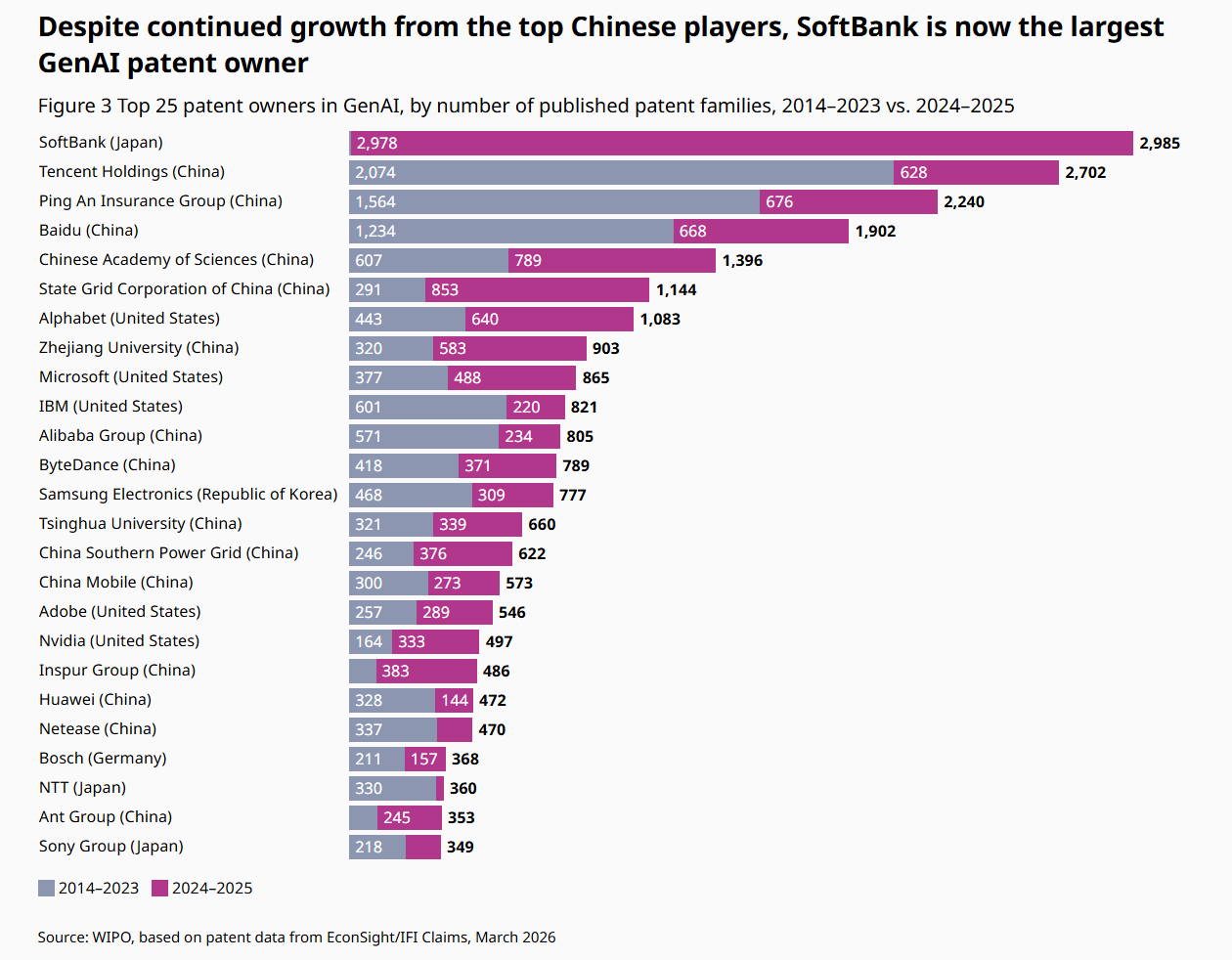
0 “Chinese multinationals and the Chinese Academy of Sciences claim four of the top five spots among generative AI patenting entities, [though] the top spot belongs to Japanese technology conglomerate SoftBank Group.”
 Yesterday, the World Intellectual Property Organization (WIPO) published a report on the global patent landscape for generative artificial intelligence (AI) technologies showing that newly published patent families in the sector increased more during 2024 and 2025 combined than the preceding decade. While the United States has enjoyed greater annual growth rates in published patent families in the sector, six of the top 10 patenting entities are located in China, underscoring the dominant position that country is securing in an incredibly valuable and critical sector of emerging technology.
U.S. Sees High Growth Rate, But China is World’s Largest Source of Generative AI Patents
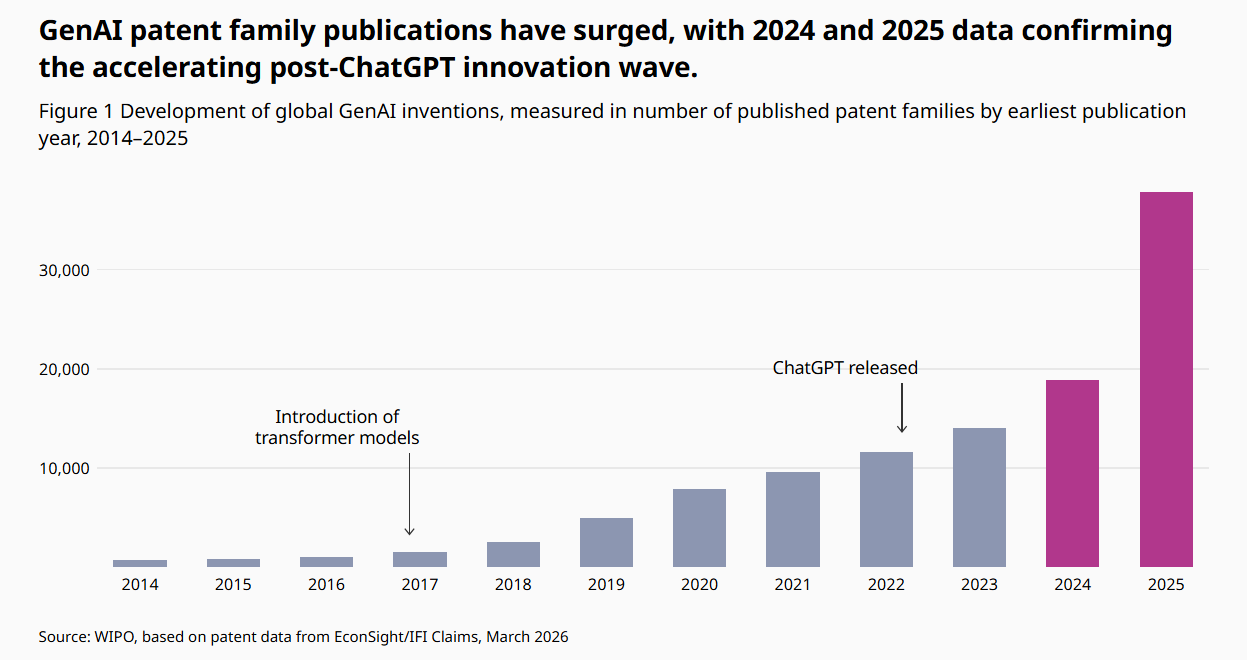
Tracking patent filing data since 2013, WIPO’s patent landscape report shows that 14,000 generative AI patent families were published globally during that year, while new patent families in this sector grew to 37,800 publications in 2025. As a share of overall AI technologies, global patent publications also show generative AI increasing from 4.2% of all AI-related patent families in 2017 up to 8.7% of AI-related patent families during 2025.
While Chinese multinationals and the Chinese Academy of Sciences claim four of the top five spots among generative AI patenting entities, the top spot belongs to Japanese technology conglomerate SoftBank Group. SoftBank has been the source of nearly 3,000 published patent families claiming generative AI technologies since 2013, outpacing Chinese competitors Tencent Holdings (2,702 patent families), Ping An Insurance Group (2,240 patent families) and Baidu (1,902 patent families). Interestingly, nearly all of SoftBank’s patent families recorded in this study were published between 2024 and 2025, contributing a significant portion of the 56,000 total patent families published during those two years, which outpaced the cumulative volume of published patent families from the preceding decade. U.S. companies ranking among the top 10 generative AI patenting entities include Alphabet, Microsoft and IBM.
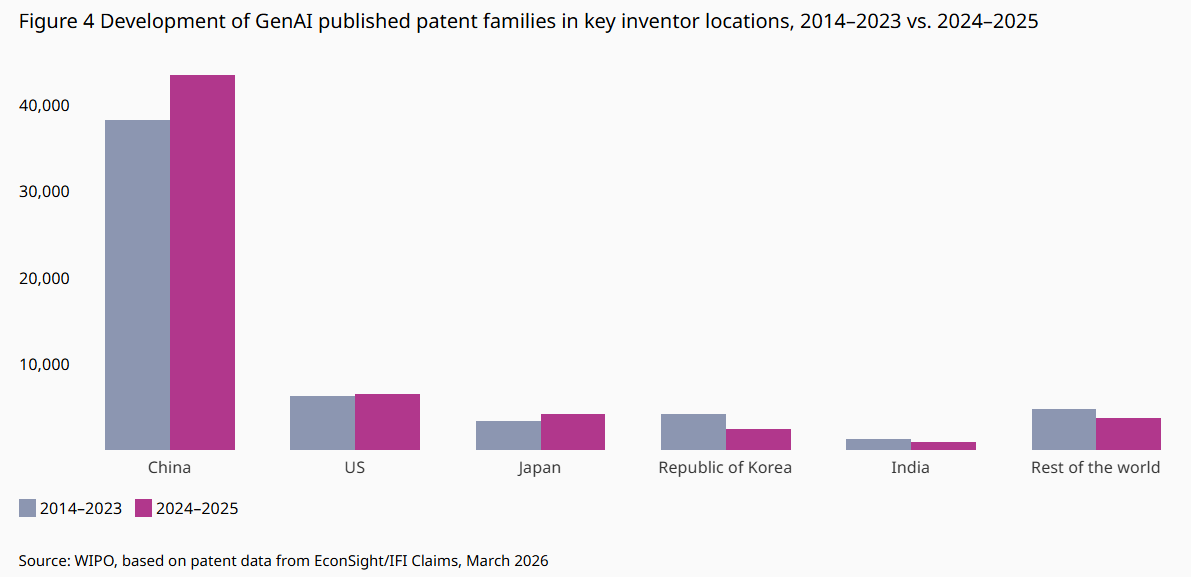
China reigns supreme as the world’s largest source of generative AI patent publications, accounting for more than 43,000 patent families published during 2024 and 2025. While the United States only accounted for 4,380 published patent families during 2025, our nation saw published patent families grow from 2023 to 2025 at a compound annual growth rate (CAGR) of 92%, outpacing China’s 64% CAGR during the same time period. Thanks to SoftBank’s recent explosion in published patent families, Japan experienced a 210% CAGR, the largest increase among any of the top patenting countries in WIPO’s study.
Text-Based LLMs Dominate Models While Image/Video is Primary Generative AI Mode
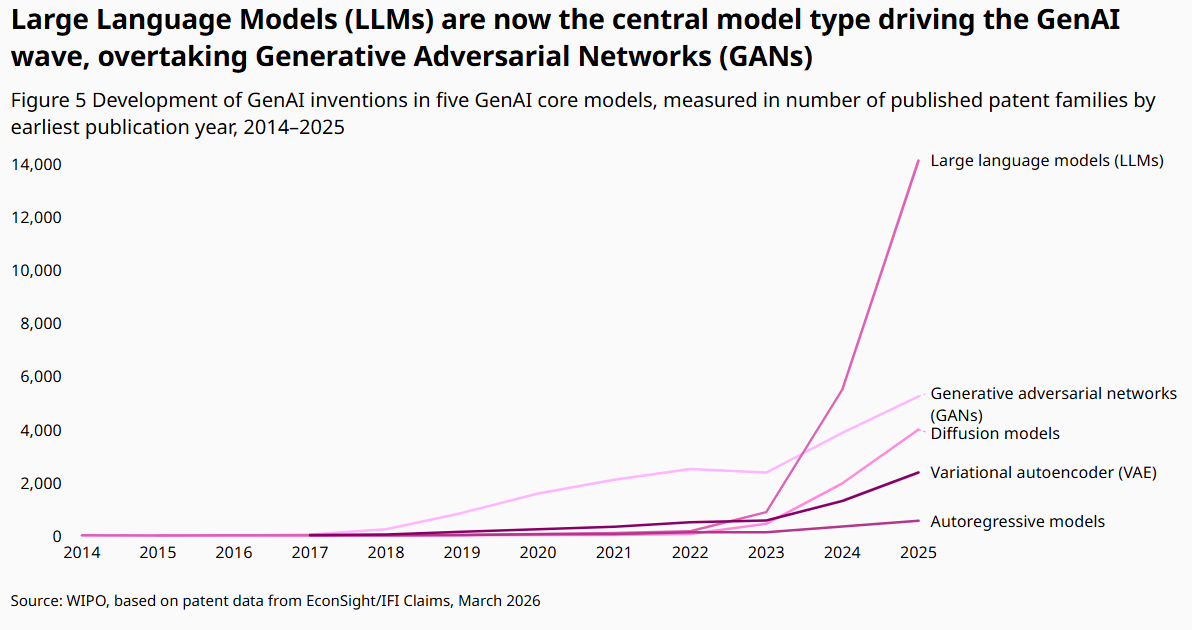
Large language models (LLMs) have largely supplanted generative adversarial networks (GANs) as the generative AI model reflected in the largest number of published patent families. In 2025, LLMs outnumbered GANs nearly three-to-one in their respective shares of generative AI patent families. WIPO’s study suggests that this gap represents a major shift in the central architectures underpinning the current wave of generative AI from image-based GANs useful for image enhancement and synthetic data generation to text-based LLMs trained on statistical patterns in language structure.
Among generative AI modes, which determine the data format of a generative AI model’s inputs and outputs, image/video remains the primary mode featured in about 40,000 generative AI patent families published between 2024 and 2025. As WIPO points out, this finding is not at odds with LLMs becoming the primary generative AI model as image/video modes are employed by LLMs, GANs, diffusion models and other generative AI models. WIPO points out that generative AI patents disclosing text modes have grown significantly in recent years, increasing from 3,400 patent families in 2023 up to nearly 11,800 patent families in 2025, a trend mirroring the increase in LLM model patent families.
WIPO’s patent landscape study confirms that the acceleration in patenting activity first noted in the agency’s 2024 generative AI patent landscape report has developed into a spike in patenting activity that underscores several technological shifts. While Asian entities dominate the top filers in the sector, recent rises in Japan, the European Union and the United States demonstrate that generative AI innovation is being distributed more widely. Further, international patent families account for a small share of overall generative AI filings, indicating that most AI inventions are concentrated in domestic markets without significant global protection strategies. In the future, WIPO expects that research and patenting will evolve rapidly in areas like multimodal systems and AI agents, with the integration of generative AI into sectors like healthcare, finance and energy expected to diversify the field of companies filing patents in this sector.
![[Advertisement]](https://ipwatchdog.com/wp-content/uploads/2026/10/BlackBox-IP-Oct-20-2026-sidebar-700x500-1.jpg)
![[Advertisement]](https://ipwatchdog.com/wp-content/uploads/2026/10/Questel-Oct-22-2026-sidebar-700x500-1.jpg)
![[Advertisement]](https://ipwatchdog.com/wp-content/uploads/2026/09/Life-Sciences-2026-sidebar-early-bird-ends-Oct-25-700x500-1.jpg)
![[Advertisement]](https://ipwatchdog.com/wp-content/uploads/2026/09/WE-BUY-PATENTS-SIM-IP-Ad-1-revised-on-Sep-28-2026-700x500-1.jpg)
![[Advertisement]](https://ipwatchdog.com/wp-content/uploads/2024/09/Patent-Prosecution-Training-sidebar-700x500-2025-03-27.jpg)








![[Advertisement]](https://ipwatchdog.com/wp-content/uploads/2021/12/WEBINAR-336-x-280-px.png)
![[Advertisement]](https://ipwatchdog.com/wp-content/uploads/2021/12/Ad-4-The-Invent-Patent-System™.png)







Join the Discussion
No comments yet.