
![[IPWatchdog Logo]](https://ipwatchdog.com/wp-content/themes/IPWatchdog%20-%202023/assets/images/temp/logo-small@2x.png)

 5
5 AI is changing the economics of patent law firms as clients internalize work, submit AI-generated disclosures, and demand more predictable pricing from outside counsel.
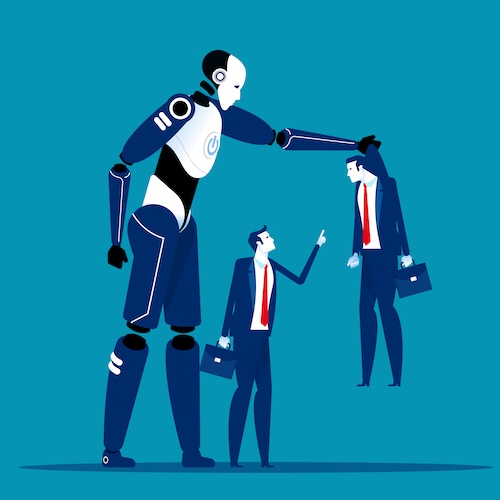
AI vs. the Competition.
For decades, the patent law firm business model rested on a relatively stable premise: companies needed outside counsel because patent work was specialized, labor-intensive, procedurally complex, and difficult to scale. Law firms supplied the expertise, staffing, production capacity, docket management systems, and professional judgment. Clients supplied the invention disclosures, strategic decision-making, and budgets. It was not always an elegant system, and it was certainly not always efficient, but the basic division of labor was well understood. That symbiotic relationship is now under pressure.
As in-house patent teams rethink how work is allocated, the implications for outside counsel are unavoidable. Corporate clients are asking whether work being done by outside counsel is being performed as efficiently as possible and even starting to ask whether it needs to be performed by outside counsel at all. At least some in-house teams are wondering whether the same or better result can be achieved internally using AI-enabled tools. If the answer is yes, then clients can be expected to decrease reliance on outside counsel, looking to law firm attorneys for targeted support, not end-to-end project management.
Artificial intelligence has accelerated this reassessment, but not always in the way many predicted. AI is not simply making patent work faster, cheaper, and easier. It is also creating new friction for outside counsel. A case in point is the creation of initial invention disclosures. Many clients are using AI before they have developed internal processes about what should be generated, what should be sent to outside counsel, and what outside counsel should be expected to do with the output received.
The central question for patent law firms in this new ecosystem is what is the sustainable role outside counsel can and should play in a world where clients can internalize more work themselves? In this environment, law firms cannot assume that historical patterns and internal client practices will continue unchanged. They must be able to explain, with precision, where their expertise creates value that AI technology and available internal client resources cannot reliably and repeatedly replicate.
What Work Remains Defensible?
Some categories of work will almost certainly remain highly defensible for patent law firms, but other work is vulnerable and increasingly likely to be in-sourced. Initial drafting, routine prosecution, and preliminary searching are increasingly being commoditized. Clients are less willing to pay premium rates for work they perceive capable of being completed with technology-enabled support. What this means is firms that continue to treat every task as bespoke attorney labor will face stiff client resistance.
Of course, clients are not always right about what is routine or easy, or honest about what it is that they can contribute. For example, most patent practitioners do not like working with or for independent inventors or patent novices because they routinely convince themselves that patent professionals add little value and truly arduous tasks can be completely in only an hour, maybe two. How often has an independent inventor sent a rambling 40 page “draft” application and wanted to hire a patent attorney to spend a single hour reviewing the draft and modifying the application to make it file-ready? As every practitioner knows, it would take orders of magnitude longer than an hour to understand the invention and cut through the largely irrelevant description provided to be able to offer any edits or recommendations of value. And even that would be without reviewing and considering the known prior art.
Increasingly corporate clients who are desperate for budgetary relief and unrealistic about the role AI plays in the end-to-end patent process are sounding like that novice inventor who has absurd expectations.
Every practitioner, whether in-house or outside counsel, knows that a routine-looking amendment can create prosecution history estoppel. A minor wording change can unacceptably narrow claim scope. A careless characterization of prior art can entirely doom enforcement years later. But that is what happens when the end-to-end patent project becomes commoditized and impractical expectations are set based on the fiction that AI dramatically reduces the time necessary to be spent on each step in the invention to patent workflow.
The Illusion of AI Efficiency
At the same time, clients’ use of AI is creating a new problem: the illusion of efficiency. Historically, outside counsel often struggled because inventors and internal business teams provided too little information. Prior to adoption of AI tools, it was all too common for a disclosure to be incomplete, conclusory, or missing critical technical detail necessary to support any patent application. Now, some firms are confronting the opposite problem. Some clients are now submitting extensive AI-generated invention disclosures that are lengthy, dense, repetitive, poorly structured, and filled with material that might sound plausible but simply doesn’t work.
A patent application must describe what was actually invented by an inventor, who must be a natural person not a machine. Patents must support claims that can survive examination and withstand validity challenges, and that hopefully also map to business-relevant embodiments that create enterprise value. If AI expands an invention disclosure by adding hypothetical or speculative implementations not conceived or contemplated by the inventor, or technical variations that the inventor did not invent and that may not work, an enormous problem has been created. Not only will any resulting patent be worthless, but precious capital will also have been wasted pursuing rights that never had a chance from the beginning.
More Content Is Not Better Content
The same issue arises during application review after a nearly final draft has been provided to the client for review. Rather than providing clean marked-up revisions or focused comments, some clients are beginning to send sprawling feedback documents generated by AI. For outside counsel, best case scenario is that these voluminous AI critiques transform what should be a bounded review process into an exercise that requires substantial professional judgment merely to determine what the client is trying to communicate. Even worse, the entire focus of the invention can shift, which will require significant edits. And the worst case is the revision becomes unbounded, necessitates a substantial re-write, and what gets incorporated are contributions that cannot be verifiably connected to the conception of a real person.
AI-generated content may look polished, but patent professionals know that polished writing is not the same as technical correctness. A tool that produces acceptable answers for a general business audience can produce materially wrong or misleading output in a specialized patent context where precision matters above almost all else.
Not only is there a risk that untethered use of AI will cause efficiencies to evaporate, but it is also entirely possible that the use of AI by in-house teams will increase the amount of work needed and without improving quality. If inventors can generate longer disclosures more easily, the number of submissions is all but certain to rise. If business teams can generate critiques more easily, the number of review comments will increase. If internal teams can produce prior art summaries more quickly, outside counsel will receive more material to evaluate. But more content is not the same as better content. A larger pile of information creates the appearance of diligence while merely increasing the burden on the attorney who must now separate what matters from what is irrelevant or outright wrong.
Fixed Fees Cannot Absorb AI-Generated Work
This has direct consequences for pricing. Fixed fees only work when scope is predictable. If a firm agrees to draft or prosecute a patent application on a fixed-fee basis, but the client then submits voluminous AI-generated disclosures with unstructured feedback and sprawling technical commentary, the economics break down quickly. The firm is no longer merely drafting or revising. Instead, it is interpreting and attempting to integrate AI-assisted client work product, which probably was not created or reviewed by the inventor. That is an entirely different project that requires much greater time and effort, which should influence pricing.
Most fixed-fee patent arrangements were not designed to cover exaggerated invention disclosures or voluminous comments. Fixed fees assume a manageable disclosure, a reasonable review cycle, and client feedback that is targeted enough to process efficiently. When AI disrupts those assumptions, the pricing model must evolve. Otherwise, firms will be trapped between client demands for lower costs and workflows that require more attorney time, which is untenable.
The best way for law firms to respond is by tightening procedures and defining expectations, obligations and responsibilities between and among the parties. Engagement letters and fee arrangements should be updated to specify what is included for a particular fixed fee, and what types of client-generated work product will trigger hourly billing or an additional fixed fee that takes into account scope adjustments. Obviously, the intent should not be to nickel-and-dime clients but rather to impose fully informed operational discipline. A client’s desire for predictable pricing is entirely justified, but that requires a predictable workflow and expectations commensurate with the scope of work. A flat fee cannot become an open-ended commitment for outside counsel to work as much as necessary to perfect a filing regardless of how much is being paid and how much AI-generated material the client submits.
The Firms That Lead on Process Will Win
Ideally, outside counsel should not wait until a client sends a 50-page AI-generated invention disclosure and then complain that the project is not economically feasible within the previously negotiated flat fee arrangement. Firms should be proactive, developing client guidelines and protocols that address AI-generated work product. The firms that lead on process will be better positioned than firms that passively absorb the chaos that could easily upset even well-established relationships.
Ultimately, AI is forcing a more disciplined conversation about value. AI will not eliminate the patent law firm, but it is forcing patent law firms to reevaluate everything. Firms that cling to labor-intensive workflows, vague scope definitions, and opaque pricing will lose ground and become overwhelmed with unbillable work. The winners will be the firms that demonstrate that their use of AI produces better outcomes, stronger patents, and more consistently predictable economics.
Image Courtesy of DepositPhotos.com
Author zentro
ID: 340635204
![[Advertisement]](https://ipwatchdog.com/wp-content/uploads/2026/07/IP-Author-Aug-6-2026-sidebar-700x500-1.jpg)
![[Advertisement]](https://ipwatchdog.com/wp-content/uploads/2026/07/Juristat-Aug-11-2026-sidebar-700x500-1.jpg)
![[Advertisement]](https://ipwatchdog.com/wp-content/uploads/2026/07/Womens-IP-Forum-2026-sidebar-register-early-bird-now-700x500-1.jpg)
![[Advertisement]](https://ipwatchdog.com/wp-content/uploads/2026/07/ClearstoneIP-Varsity-Ad-2026-Ad-2.jpg)
![[Advertisement]](https://ipwatchdog.com/wp-content/uploads/2026/07/Juristat-Varsity-Ad-2026-IPW-ad-Solo_2.png)
![[Advertisement]](https://ipwatchdog.com/wp-content/uploads/2024/09/Patent-Prosecution-Training-sidebar-700x500-2025-03-27.jpg)








![[Advertisement]](https://ipwatchdog.com/wp-content/uploads/2021/12/WEBINAR-336-x-280-px.png)
![[Advertisement]](https://ipwatchdog.com/wp-content/uploads/2021/12/Ad-4-The-Invent-Patent-System™.png)






Join the Discussion
5 comments so far. Add my comment.
Jonas McDavit
May 29, 2026 08:07 pmYou comment on fixed fees for patent prosecution work. You state, persuasively, that “Fixed fees assume a manageable disclosure, a reasonable review cycle, and client feedback that is targeted enough to process efficiently.” It sounds as if you are advocating the use of detailed engagements that litigators have been using for a long time, with various points built in, if necessary, to reassess the scope of work.
Pro Say
May 18, 2026 07:38 pmAnon: “What exactly are the metrics that will show such results and how soon will those metrics be visible?”
That.
“To me, they sound more in mere virtue signaling at this point.”
And that.
The coming AI shake-out isn’t going to be pretty.
Your company / firm doesn’t want to be swimming in that pool when the drain blows out.
Anon
May 18, 2026 09:04 amDavid Hoyle (and Gene),
What exactly are the metrics that will show such results and how soon will those metrics be visible?
To me, they sound more in mere virtue signaling at this point.
To me, the field remains far too much in flux (with shake-outs still looming). Is it prudent to lock in a long term contract with enterprise level ‘protections’ or are hidden default ‘switches’ within embedded contracts and Terms of Service pass-throughs still a mine field as Agentic AI is not even close to being settled?
And what of tools that can move – en masse – most all of the value add to be within firms, making law firm models suspect as a profitable model?
This will NOT be driven by mere automation (so the analogy to the past of placing PCs on the desks of others is limited – at best).
David Hoyle
May 15, 2026 11:37 amGene You said a mouthful with this, “The winners will be the firms that demonstrate that their use of AI produces better outcomes, stronger patents, and more consistently predictable economics.”
Just this week, Claude came out with Legal plugins, some who tested them said they were sorely lacking, but it did force me and my new company to adopt a new plugin strategy.
If that’s not enough to convince you that AI for legal is here to stay then consider this. All the tools the Legal profession now uses have or are including the use of AI.
It’s not going anywhere. It’s like when computers first came onto the scene. Some of us old geezers remember in the office when we had to place computer on the desk of a secretary who knew shorthand. hah! They were mortified.
Anon
May 15, 2026 08:56 amGee, if only we had a national system that promoted innovation in business methods…
/s
Add Comment