

Posts in IP News
GAO Report: USPTO’s Backlog Reduction Goals Unsustainable if Workforce Strain, Examiner Attrition Continue
Today, the U.S. Government Accountability Office (GAO) published a report on efforts at the U.S. Patent and Trademark Office to reduce the current backlog of unexamined U.S. patent applications at the agency, which announced its intention to reduce the backlog to fewer than 599,000 patent applications last September. The GAO’s report casts a pall on those efforts, which have been contributing to patent examiner attrition that, left unchecked, could prevent the USPTO from reaching its backlog reduction goal within the next five years.
Second Circuit Follows Third Circuit in Applying Broad ‘Use’ Definition for DTSA Misappropriation Claims
Yesterday, the U.S. Court of Appeals for the Second Circuit reversed and remanded the Southern District of New York’s dismissal of trade secret misappropriation claims filed against fintech company Arcesium by rival SS&C Technologies. Deciding that a broad definition of “use” under the Defend Trade Secrets Act (DTSA) was consistent with Second Circuit case law, the appellate court held that the district court erred in finding no misappropriation of SS&C’s alleged trade secrets and improperly credited Arcesium’s explanation of emails attached to SS&C’s complaint at the motion to dismiss stage.
CJEU Advocate General Outlines Copyright Limits for AI News Summaries
Advocate General Maciej Szpunar of the Court of Justice of the European Union (CJEU) issued an opinion on Tuesday in the first case on generative AI to reach the Court. The opinion ultimately held that “the retrieval and reuse, in real time, of online press publications by AI chatbots in order to generate answers to user queries may, in certain circumstances, infringe the rights of press publishers.” The opinion is nonbinding on the CJEU.
Rare Disease Treatment Patents after Amgen: Can Claims Cover Untested Genetic Mutations?
On October 14, 2026, the Food and Drug Administration (FDA) announced the Rare Disease Framework Initiative. The goal of this effort is quite essential for patients with rare (orphan) diseases – to develop an approach for assessing medicines for orphan diseases with a focus on the evidence that can be gathered for this assessment. The FDA proposes to include disease characteristics, patient needs, patient population size, and characteristics of orphan medications. The initiative does not itself establish new approval standards. Although the initiative relates to regulatory evidence matters, it also raises a separate legal question about the evidence needed to support patent claim scope.
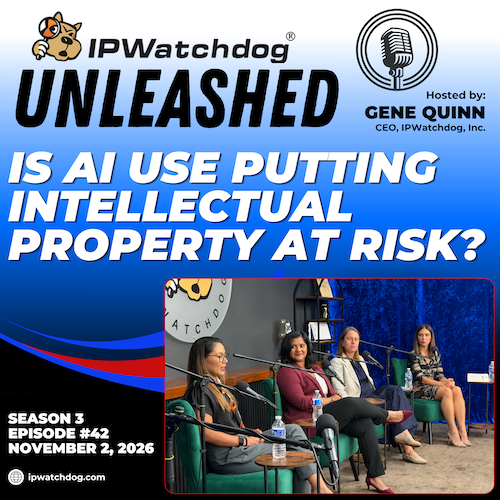
When AI Adoption Outpaces IP Protection: The Risks Companies Must Address | IPWatchdog Unleashed
This week on IPWatchdog Unleashed, we have a discussion about the IP risks associated with AI use and adoption, with Stephanie Curcio, Marlene Valderrama, Kendra Ervin and Rinat Shangeeta. The discussion reveals a consequential gap with how businesses are deploying AI. Many companies are moving faster to adopt AI than their governance, contracting and IP review processes can accommodate. For those responsible for protecting innovation and confidential information, the challenge is ensuring that enthusiasm for AI adoption does not obscure the consequences of how these tools are actually used.
Streaming Coalition Urges Squires to Support Enforcement Against Abusive SEP Licensing Practices
A coalition of ten streaming, broadcasting, and audiovisual media organizations, including the Motion Picture Association (MPA) and the Streaming Innovation Alliance, sent a letter today to U.S. Patent and Trademark Office (USPTO) Director John Squires, urging him to “support strong public and private sector enforcement against abusive SEP licensing practices.” The signatories said that abuse of standard essential patents (SEPs) was undercutting the open process of setting standards for the video streaming technologies their members use.
The UPC Marks the Edge of Its Own Jurisdiction in Sandoz v. Novo Nordisk
In a procedural order dated October 22, 2026, the Milan Central Division of the Unified Patent Court (UPC) delivered a short ruling in Sandoz v. Novo Nordisk (UPC_CFI_2221/2026) that deserves more attention than its procedural posture suggests. The operative holding is a single sentence: the UPC has no jurisdiction to entertain a claim seeking a declaration that a composition, independently of a specific patent right, was obvious at a given priority date. Behind that line sits a question the court will keep meeting as it matures: what, exactly, is this court for, and where does its competence stop?
OpenAI Touts Briefs Backing Fair Use for AI Training
OpenAI published a post on Friday, titled “Fair use benefits everyone,” featuring excerpts from 20 filings that urge the U.S. District Court for the Southern District of New York (SDNY) to find that training large language models (LLMs) on copyrighted works is fair use. All but one are amicus briefs filed on or before the October 30 deadline in In re OpenAI, Inc. Copyright Infringement Litigation, the multidistrict litigation (MDL) that combines copyright lawsuits filed against OpenAI and Microsoft by The New York Times and other news publishers, Ziff Davis, and a group of authors, led by the Authors Guild, seeking to proceed as a class.
Six Months of Patent Owner Pre-Order Statements in Ex Parte Reexamination
Since April 5, 2026, a patent owner can file a paper opposing a request for ex parte reexamination (EPR) before the U.S. Patent and Trademark Office (USPTO) decides whether to order it. Six months in, patent owners use the paper in about two of every five requests, requesters try to respond in most of those, and the Office keeps almost every response out. None of it has measurably changed how often reexamination is ordered. The order rate was already falling before the procedure began, and the small further decline since is not statistically significant.
CAFC Reverses $9.1 Million Exceptionality Award, Holding Myriad Did Not Foreclose Patent Owner’s 101 Argument
The U.S. Court of Appeals for the Federal Circuit (CAFC) on Friday reversed a district court’s award of attorneys’ fees to Elysium Health, Inc., holding that the lower court erred in assessing the substantive strength of ChromaDex’s Section 101 position. The appeal is rooted in the CAFC’s 2023 decision affirming the U.S. District Court for the District of Delaware’s grant of summary judgment for Elysium Health that the asserted claims of ChromaDex’s patent on an isolated form of vitamin B3 were directed to unpatentable subject matter under Section 101.
Federal Circuit Affirms Summary Judgment of Non-Infringement for Sonos in Google Patent Case
The U.S. Court of Appeals for the Federal Circuit (CAFC) issued a decision Friday in Google LLC v. Sonos, Inc., affirming a summary judgment of non-infringement entered by the U.S. District Court for the Northern District of California. The CAFC agreed with the district court’s constructions of the claim terms “utilized” and “private key,” each of which resolved one of Google’s two infringement theories.
Venable LLP is Seeking a Trademark Associate (Mid-Level)
Venable LLP’s Intellectual Property Group is seeking a mid-level associate with five to seven years of substantive U.S. trademark experience in a law firm setting to join our practice in Washington, D.C. Our team advises and represents clients across the full spectrum of trademark and brand protection law, including prosecution, clearance, enforcement, portfolio management, and proceedings before the Trademark Trial and Appeal Board (TTAB).
Other Barks & Bites for Friday, October 30: CAFC Reverses Attorney’s Fee Award in Section 101 Case; IFFRO Releases Study on AI’s Negative Impacts on Creators; and Fifth Circuit Reverses Patent Agreement Production Order to UPC
This week in Other Barks & Bites: the Federal Circuit reverses an exceptionality determination after finding that the patent owner raised Section 101 arguments requiring more than a simple application of Myriad; the Seventh Circuit rules that copyright ownership to a compilation of unpublished psychotherapy articles cannot prevent the otherwise authorized publication of a single article included within the compilation; and more.
Federal Circuit Affirms PTAB’s Unpatentability Finding for Palo Alto Networks
The U.S. Court of Appeals for the Federal Circuit (CAFC) on Thursday affirmed a Patent Trial and Appeal Board (PTAB) ruling that held certain claims of a patent for network intrusion monitoring and detection unpatentable as obvious. The opinion was authored by Judge Chen. U.S. Patent No. 7,895,641 is owned by BT Americas (BTA). Palo Alto Networks, Inc. petitioned for inter partes review (IPR) of the ‘641 patent, and the PTAB ultimately determined claims 1–7 and 15–17 would have been obvious in view of two prior art references.
C4IP Urges Treasury to Reconsider Proposed Rule to Extend COINS Act Investment Restrictions to Biotech
The Council for Innovation Promotion (C4IP) issued a statement Tuesday expressing concern about a rule recently proposed by the U.S. Department of the Treasury to enact the Comprehensive Outbound Investment National Security (COINS) Act, which was itself enacted as part of the Fiscal Year 2026 National Defense Authorization Act.
Varsity Sponsors
From the IPWatchdog Institute


Latest IPW Posts
CAFC Affirms Dismissals of Patent Infringement Lawsuits Against Apple, Amazon Web Services and Netflix
November 19, 2026 @ 04:28 pmPERA: Where Patent Law and Healthcare Issues Collide
November 19, 2026 @ 02:15 pmThe Intangible Investor: What You Can See Everything Reveals About Invention
November 19, 2026 @ 12:15 pmEnforcing IP Rights in Brazil: Why Litigation Is Not Always the First Step
November 19, 2026 @ 07:15 am
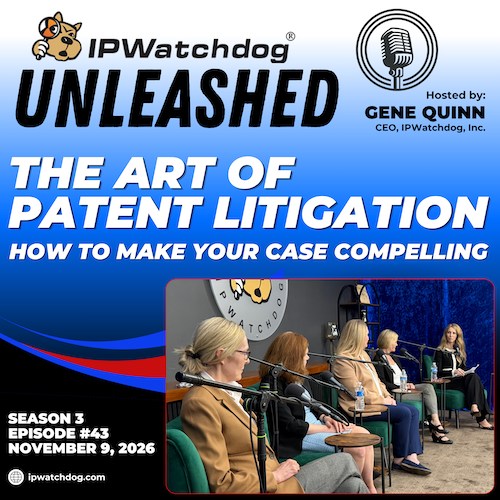
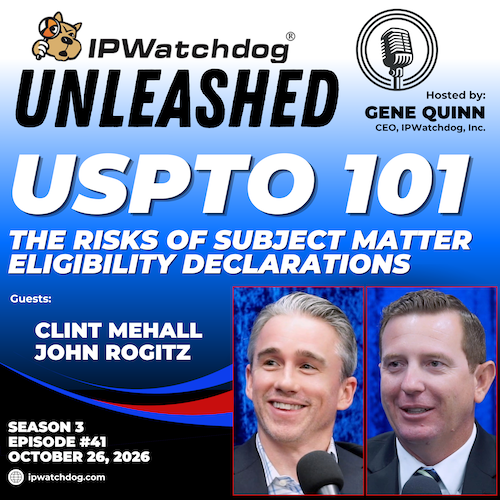
Latest Podcasts

IPWatchdog Events
Webinar: Pharmaceutical Salts, Cocrystals, and Other Solid Forms – The Latest Lessons for the Life Sciences Practitioner
December 8 @ 12:00 pm - 1:00 pm ESTWebinar: In-House Patent Strategy – Capturing Innovation, Controlling Costs, and Building Portfolio Value
December 10 @ 12:00 pm - 1:00 pm ESTIPWatchdog LIVE 2027 at the Renaissance Arlington Capital View
April 4, 2027 @ 1:00 pm - April 6, 2027 @ 7:00 pm EDTFrom IPWatchdog

