


 0
“Fuller explanations from OPLA of its rulings on requester petitions would give both sides more guidance on how to use the pre-order procedure.”
The EPR request grant and denial rates since 2023, and the data concerning the pre-order patent owner statement under the new process after April 5, 2026, are based on documents published on the USPTO Open Data portal.
 Since April 5, 2026, a patent owner can file a paper opposing a request for ex parte reexamination (EPR) before the U.S. Patent and Trademark Office (USPTO) decides whether to order it. Six months in, patent owners use the paper in about two of every five requests, requesters try to respond in most of those, and the Office keeps almost every response out. None of it has measurably changed how often reexamination is ordered. The order rate was already falling before the procedure began, and the small further decline since is not statistically significant.
The Central Reexamination Unit (CRU) has three months to decide whether a request raises a substantial new question of patentability (SNQ) and, if so, to order EPR. Before April 2026, a patent owner could not be heard until EPR was ordered. For requests filed on or after April 5, the “pre-order paper” disputes whether the request raises an SNQ. While a requester “may not ordinarily file a paper in response,” it can petition under 37 C.F.R. § 1.182 for a response “to address alleged misrepresentations of fact or law or other improper arguments that materially impede the determination of a substantial new question.”
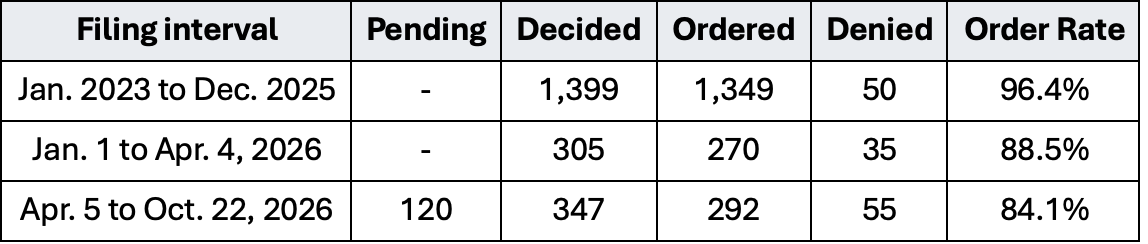
In the three years ending December 31, 2025, the CRU ordered EPR on over 96% of requests. The rate fell to 88.5% for those filed between January 1 and April 4, 2026, and stands at 84.1% for those filed between April 5 and October 22, with 120 still pending (Table 1). The fall from the 2023 to 2025 rate is statistically significant. The further decline since April 5 is not (Appendix, Table A1).
Table 1: EPR order rates (requests filed between January 2023 and October 2026).
The record so far shows how each participant has used the procedure: the patent owner, the requester petitioning under § 1.182 to respond, the Office of Patent Legal Administration (OPLA) deciding those petitions, and the CRU deciding whether to order EPR. Whether a statement or a response changes the order rate is another matter.
Patent Owners File a Statement in Two of Five Requests
Of the 467 requests filed in the six months since April 5, the CRU has decided 347 and ordered EPR in 292 (84.1%).
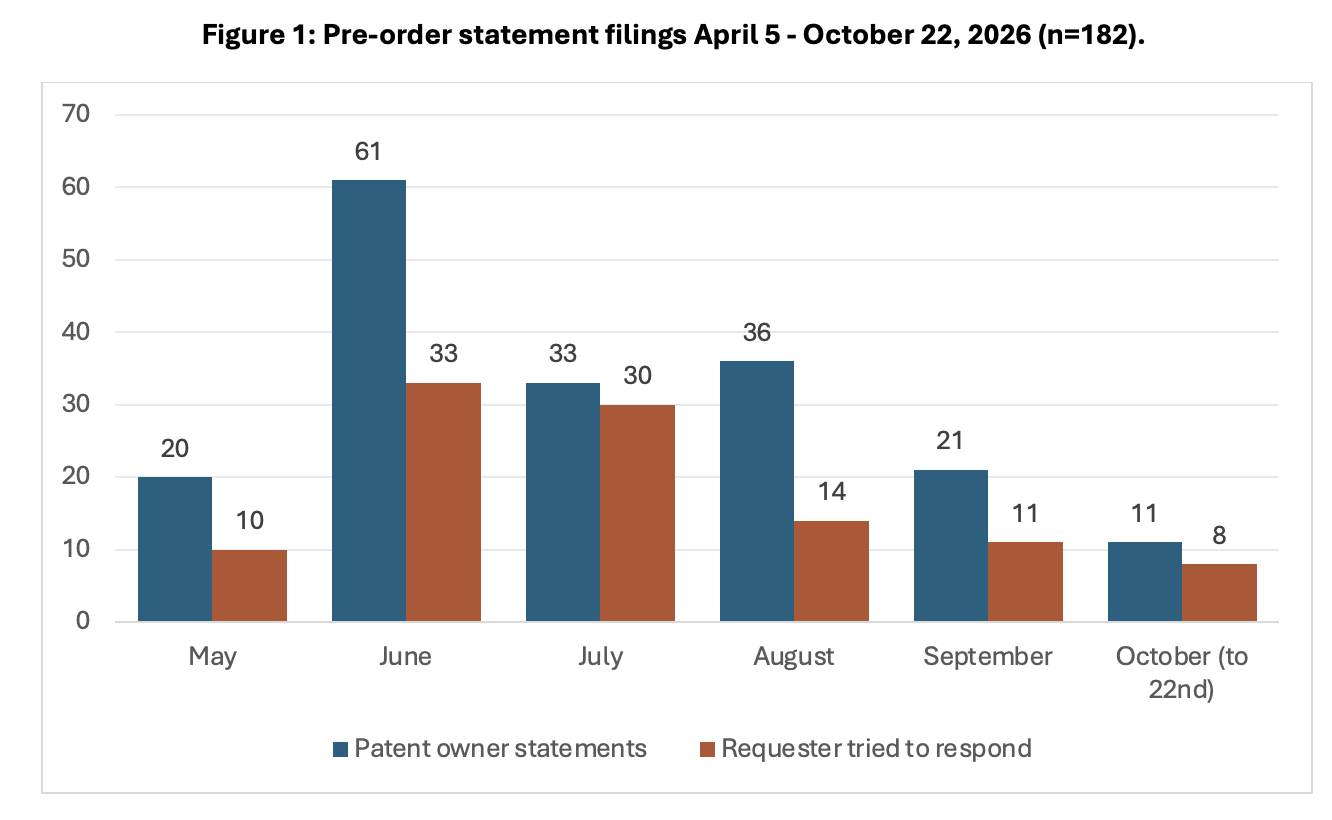
Of those 467 requests (Figure 1):
- Patent owners filed a pre-order statement in 39% (182 of 467).
- Requesters tried to respond in 58% of those statement cases (106 of 182).
Requesters Try to Answer in Three of Five Statement Cases
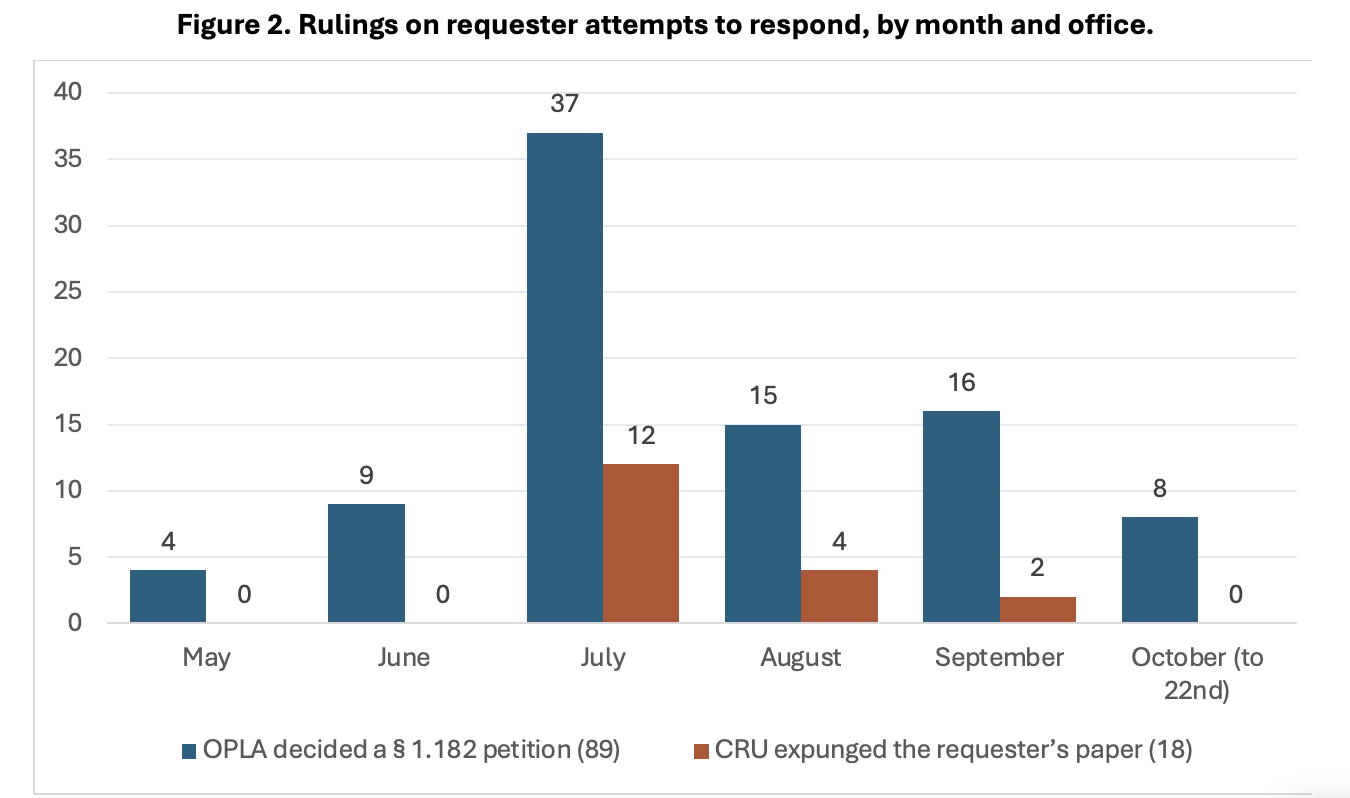
Through October 15, OPLA had decided 89 of the 106 attempts, in 88 cases. The CRU itself expunges, by form letter, any response filed without a separate petition, the fee, or proper service. Rulings peaked in July (Figure 2).
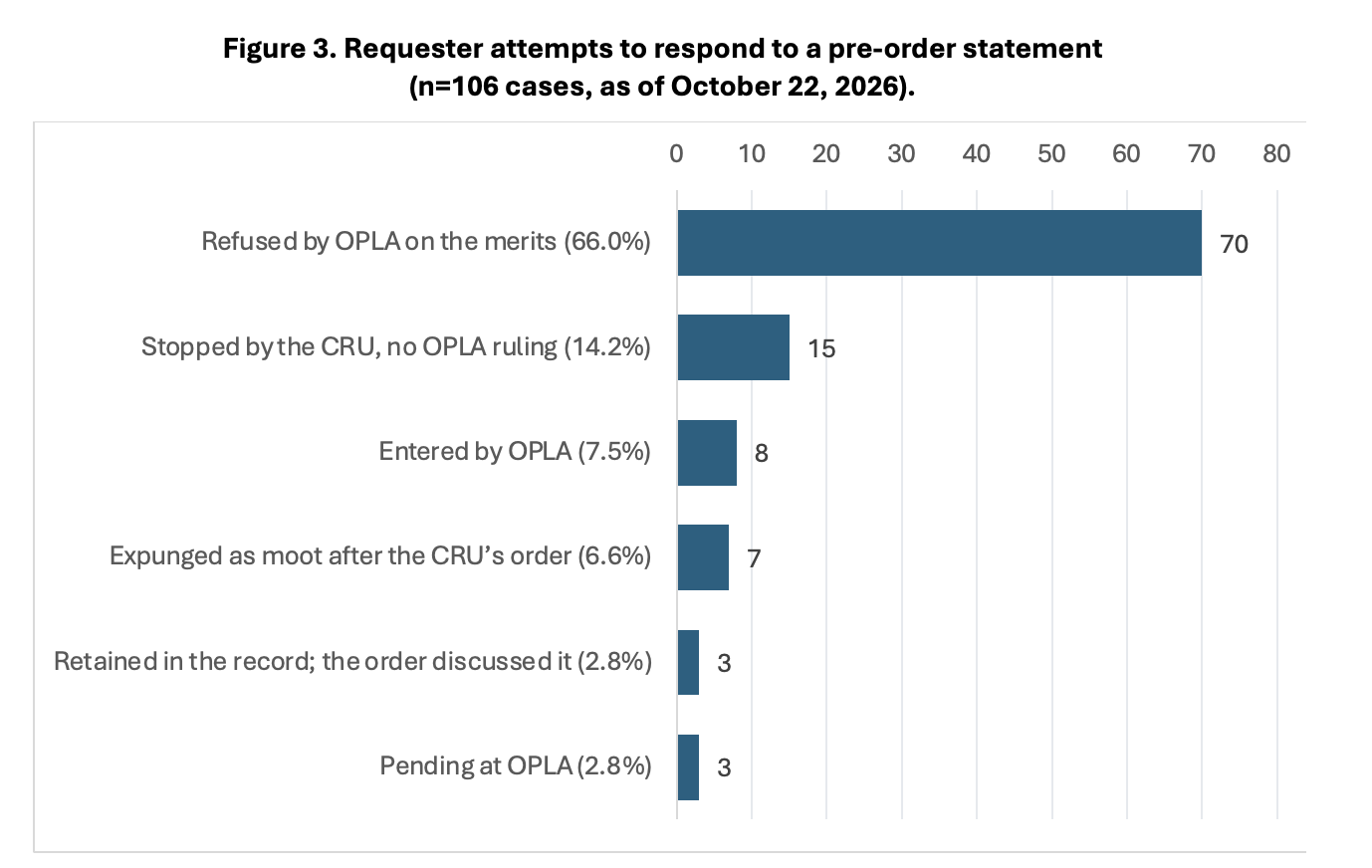
OPLA refused the requester’s petition in 70 of the 88 cases it has decided (Figure 3). It granted eight (90/016,254, 332, 338, 339, 396, 419, 529, and 532) and entered the responses. In three more cases the CRU’s order addressed the response before OPLA ruled, so the paper stayed in the record (90/016,212, 320, and 321).
OPLA’s Refusals Come in Three Forms
Those refusals—71 decisions in 70 cases because one requester petitioned twice—rest on three boilerplate grounds (Figure 4).
- Mere disagreement over the prior art.
Forty-seven decisions reject the petition on its merits. For example, in 90/016,172 (July 7, 2026), OPLA dismissed what the requester called an “alleged misrepresentation” by the patent owner as “mere disagreements over the scope and content of the prior art, and over interpretation of the controlling law and its application to the facts in the request.” It found that “such routine discourse does not rise to the level of an exception that would materially impede the examiner’s determination of substantial new question in this instance.” OPLA put it more bluntly in 90/016,282 (July 7, 2026) and eleven later decisions: “This is routine discourse between a patent owner and requester in a reexamination proceeding.”
- Complaints of improper argument.
Thirteen decisions reject requester complaints that the patent owner’s paper broke the notice’s own rules by arguing discretionary denial, newness, or the merits. The decision in 90/016,242 (July 1, 2026) is representative: “contentions regarding alleged improper arguments in patent owner’s pre-order SNQ paper do not amount to an exception.”
- Petitions with no basis of their own.
Thirteen decisions turn on the petition itself. In 90/016,311 (July 20, 2026), the petition was a cover sheet pointing to the attached response, and OPLA would not read the response to decide whether to enter it. The petition “merely refers to the responsive paper to support the petition” and “provides no basis or justification in the petition itself for the Office to find the petition to be ‘grantable.’”
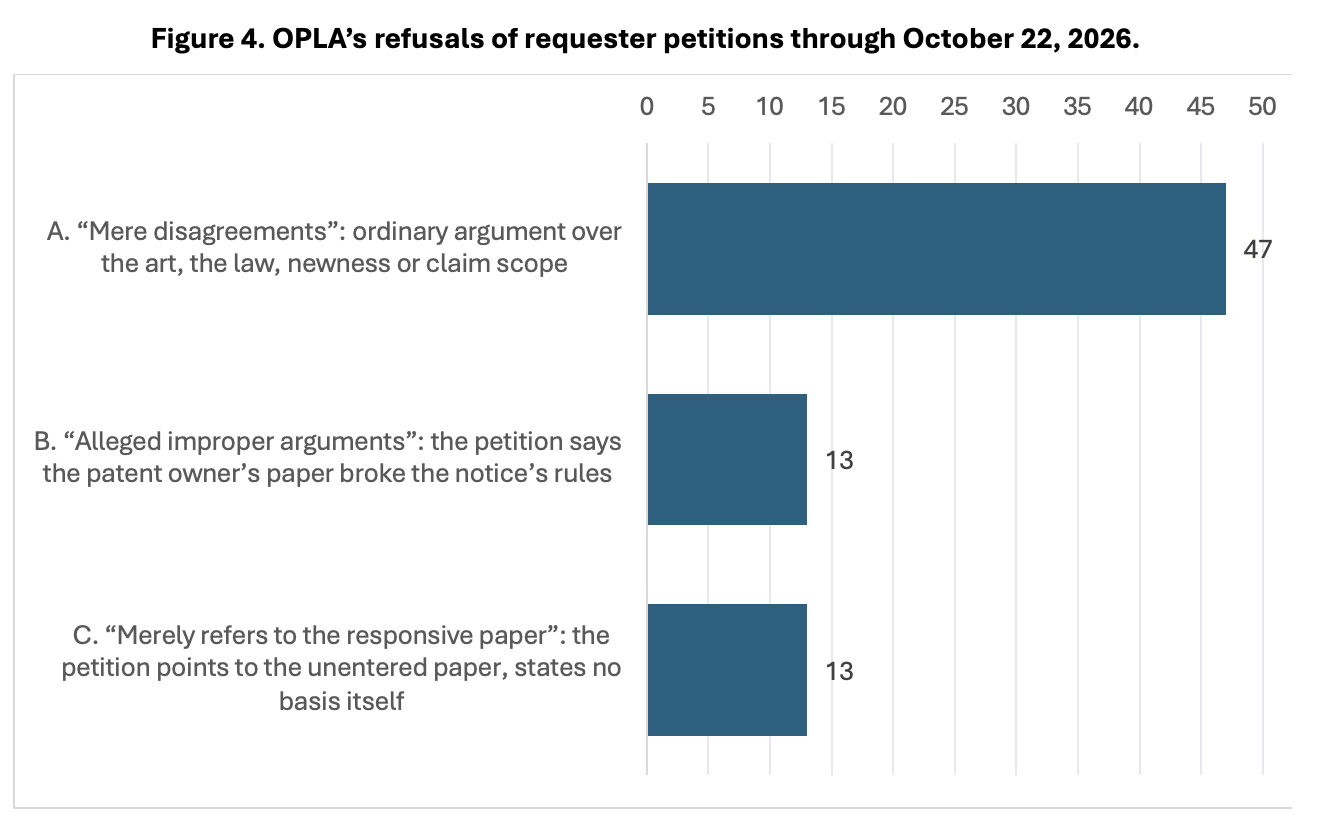 How to read the bars: 71 decisions in all. Sixty-seven state one ground (A 45, B 12, C 10), three state two (A and C in 90/016,491 and 90/016,502; B and C in 90/016,388), and one states none of the three, a second 90/016,387 decision rejects a 37 C.F.R. § 1.181(b) argument. Each decision is counted under each ground it states, so the bars add to 73. Eleven of the 13 B decisions answered two batches of near-identical petitions mailed July 1 to 9.
OPLA’s Eight Grants Explain Little
All eight grants use one formula: the requester’s contentions “if true, provide adequate basis for entry.” Where OPLA gave a reason, the response concerned a fact the examiner could not check against the request. For example, in 90/016,529 (October 7, 2026), the requester alleged that the statement omitted the part of its own exhibit that established the key reference’s publication date. Without the response, OPLA wrote, “the current record would not provide a sufficient basis to determine the public availability date” of the reference. In 90/016,532, the requester responded to an alleged misstatement of the reasons for allowance.
Of those eight cases, the CRU ordered EPR in six (90/016,254, 332, 338, 339, 396, and 532), denied it in one (90/016,419), and has one pending (90/016,529). The 90/016,419 denial adopted the patent owner’s paper and noted that the requester’s response “has also been considered.”
Neither a Statement Nor a Response Measurably Alters the Order Rate
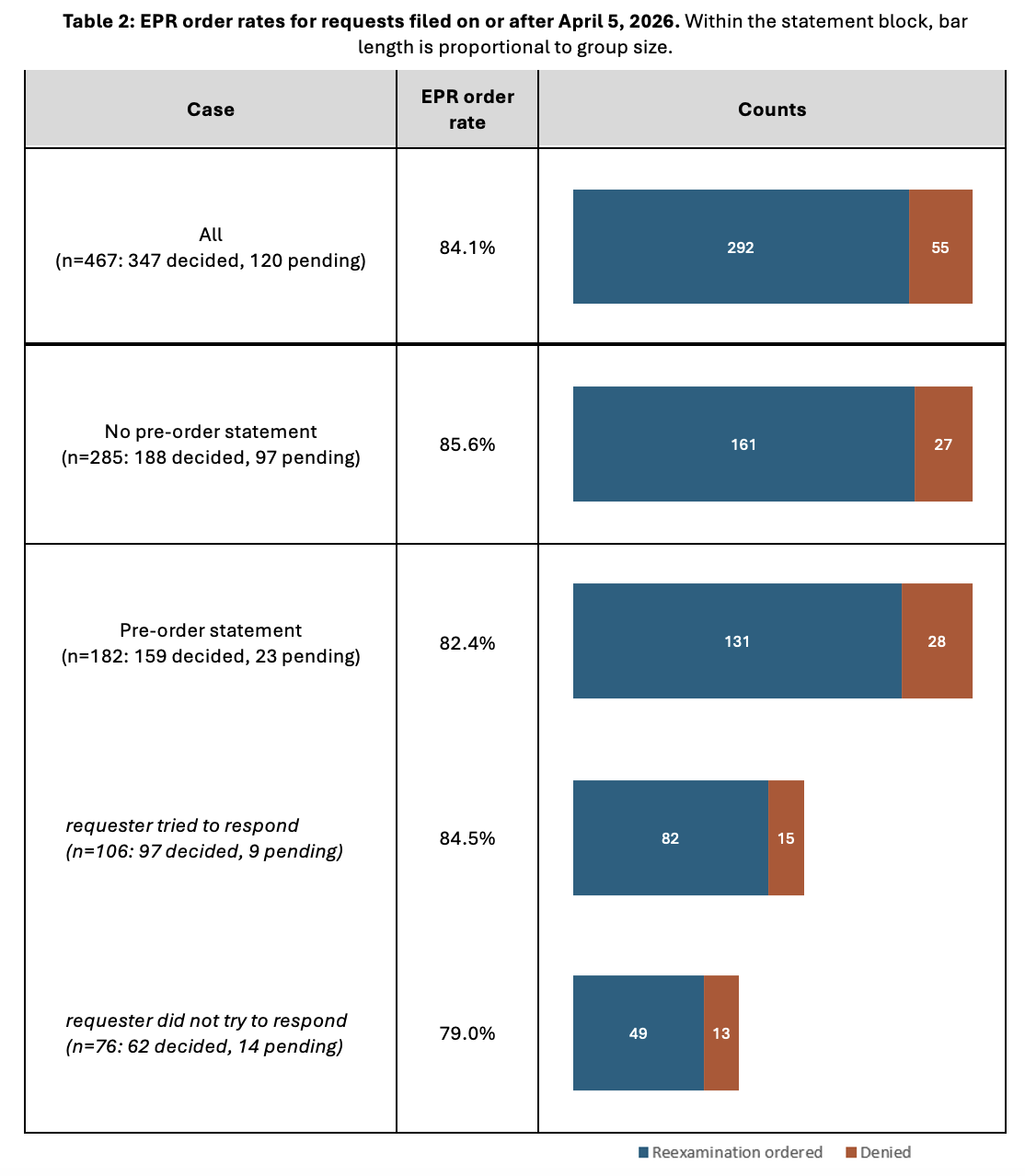
Among requests filed since April 5, 2026, the order rate is 85.6% without a pre-order statement (n=188) and 82.4% with one (n=159). In the 159 cases with a pre-order statement, where the requester tried to respond (n=97), it is 84.5%. Where the requester did not try to respond (n=62), it is 79.0% (Table 2). None of the differences is statistically significant. At these sample sizes, only differences of roughly 12 to 19 percentage points would be detectable. The tests are reported in the Appendix (Table A1).
When Reexamination is Denied, the Denial Often Uses the Patent Owner’s Terms
In the 28 statement cases in which the CRU denied EPR, the examiner expressly agreed with at least one of the statement’s arguments in 12 cases, adopting the patent owner’s position outright in six and in part in six more. One discussed the statement without adopting it. Nine acknowledged it in a sentence, three as moot. Six never mentioned it, though in two of those the CRU had expunged the paper and had nothing to consider (Figure 5).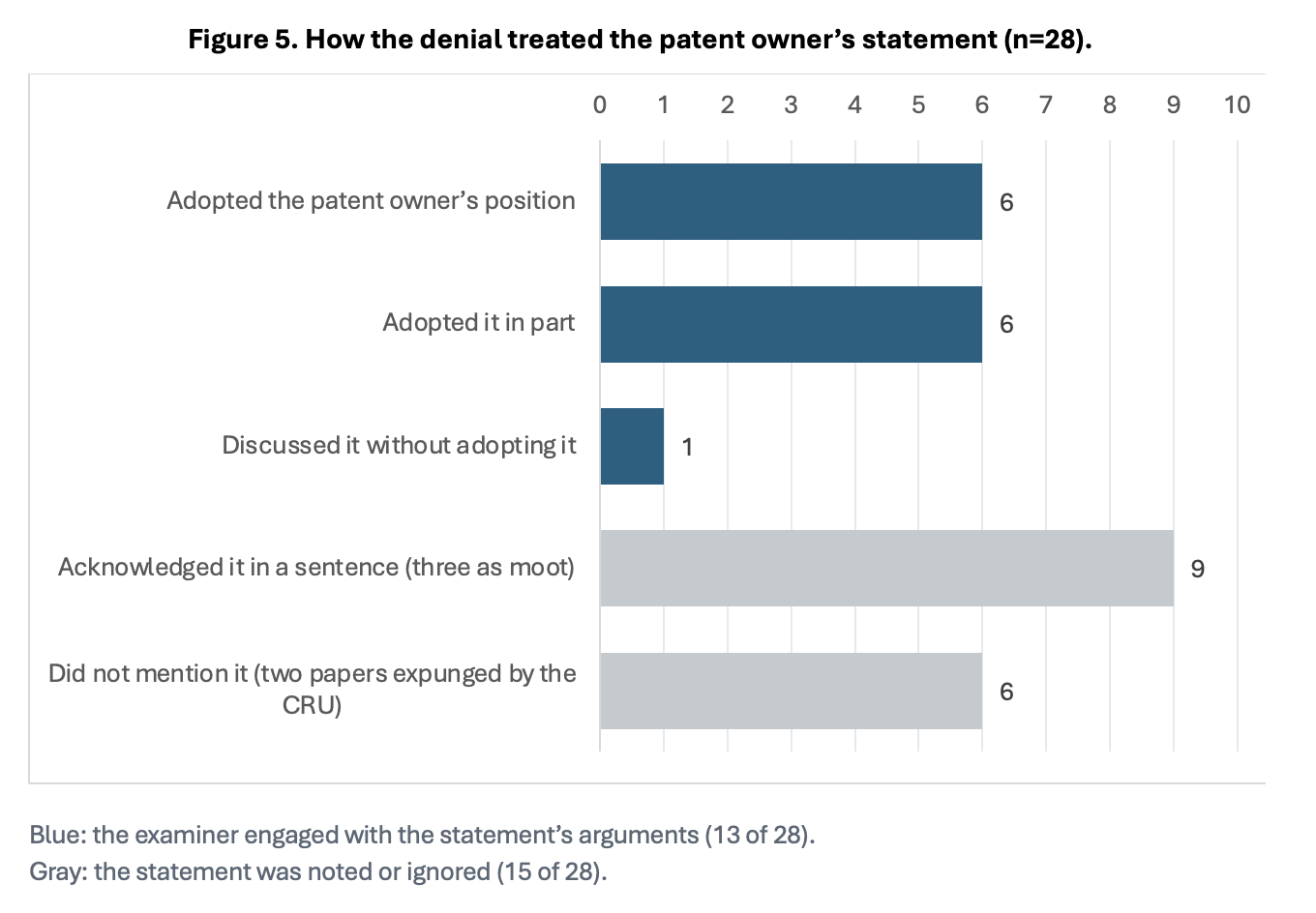 In the adopted cases, the statement typically made a narrow point verifiable from the record. In 90/016,256 it showed that the request’s principal reference was not prior art. In 90/016,418 it argued, and the examiner agreed, that the request added only cumulative references to a reexamination already granted on the same patent.
Where That Leaves Us
The EPR order rate was falling before the procedure began: 96.4% for requests filed in 2023 to 2025, 88.5% for those filed in the first three months of 2026, and 84.1% for requests filed since April 5. Within that last group the rate is about the same with a pre-order statement, without one, and whether or not a requester tried to respond. Six months of data cannot yet say whether the statement, or the attempt to answer it, changes the outcome.
Fuller explanations from OPLA of its rulings on requester petitions would give both sides more guidance on how to use the pre-order procedure. Until then, the statement carries no fee, and the requester’s answer rarely gets in.
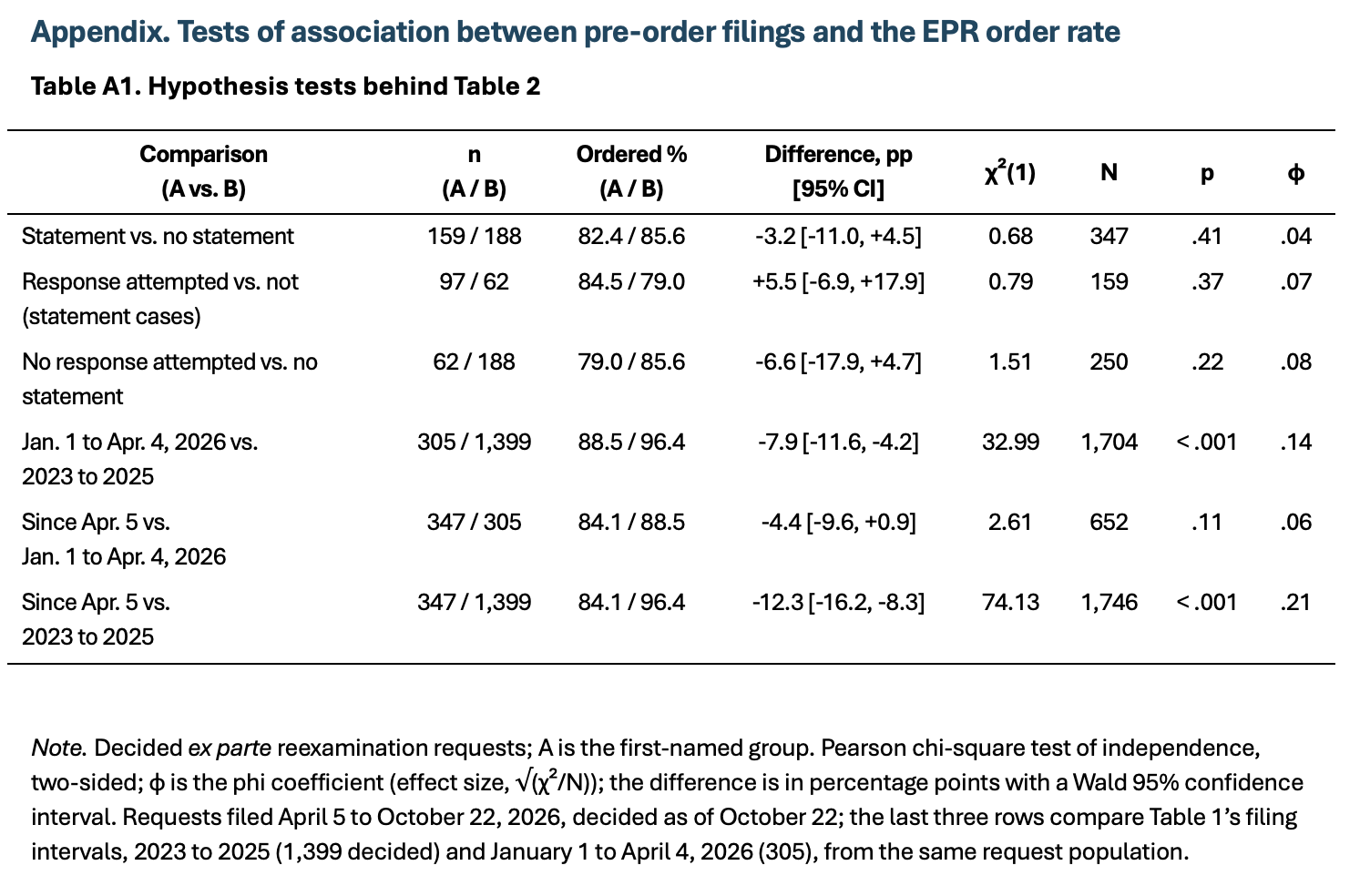
Image Source: Deposit Photos
Author: Wavebreakmedia
Image ID: 81996574















Join the Discussion
No comments yet. Add my comment.
Add Comment