


 0
“USPTO data shows 7.6% examiner attrition as a 12-month average through this August.”
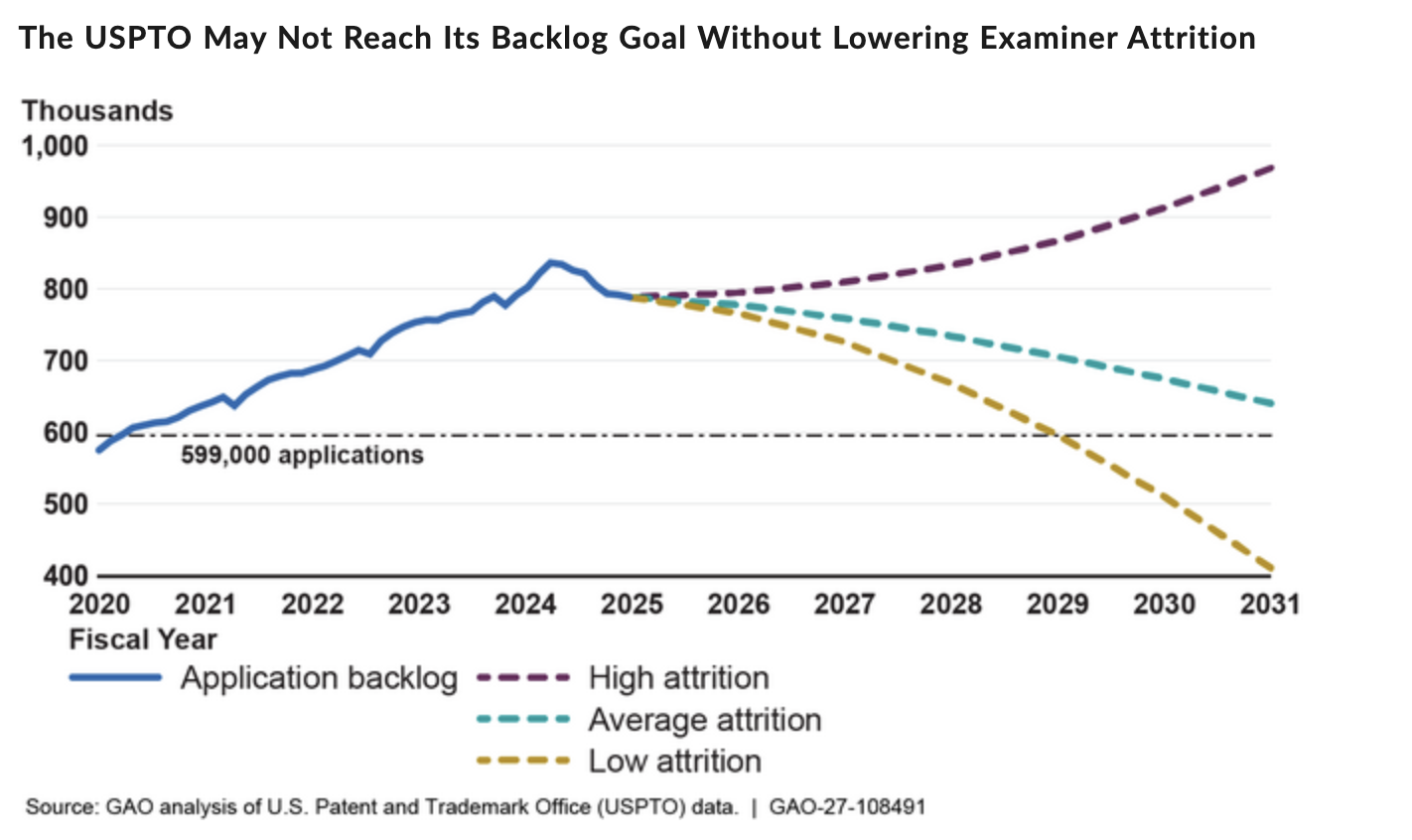 Today, the U.S. Government Accountability Office (GAO) published a report on efforts at the U.S. Patent and Trademark Office (USPTO) to reduce the current backlog of unexamined U.S. patent applications at the agency, which announced its intention to reduce the backlog to fewer than 599,000 patent applications last September. The GAO’s report casts a pall on those efforts, which have been contributing to patent examiner attrition that, left unchecked, could prevent the USPTO from reaching its backlog reduction goal within the next five years.
Current Examiner Attrition Rates Too High To Achieve Agency’s Intended Backlog Reduction
The unexamined patent application backlog at the USPTO reached an all-time high of about 838,000 patent applications in January 2025, the same month that Coke Morgan Stewart was named Acting Director of the USPTO in one of the earliest appointments of President Donald Trump’s second term. Addressing the patent application backlog became a major theme of Acting Director Stewart’s tenure, continuing through the confirmation of current USPTO Director John Squires who told the Senate IP Subcommittee this September that the patent application backlog had reached a three-year low of about 756,000.
Addressed to Representatives Jamie Raskin (D-MD) and Hank Johnson, Jr. (D-GA), respectively the Ranking Members of the Senate Judiciary Committee and the Senate IP Subcommittee, the GAO’s report includes analysis from interviews with examiners, patent attorneys and former USPTO officials as well as review of congressional testimony, USPTO budget submissions and agency fiscal data from 2020 to 2025. Although the GAO sought information directly from the USPTO, the agency’s General Counsel stated in a December 2025 letter that the USPTO would not participate in the report because the GAO lacks authority to conduct audit work requested by ranking members of congressional committees. The GAO responded that it has ample authority pursuant to 31 U.S.C. § 117 to conduct audit work on the initiative of the Comptroller General, and the USPTO did provide comments in response to an August 2026 statement of facts sent by the GAO.
While the agency had not set a timeframe for accomplishing its backlog reduction goal, the GAO’s report notes that the patent application backlog was last at 599,000 patent applications in 2020. According to Director Squire’s remarks at September’s Senate subcommittee hearing, the agency was able to reduce its backlog by about 82,000 patent applications over a 19-month period. Even then, the GAO notes that the USPTO’s average pendency times for patent examination indicated that, as of this August, most U.S. patent applications are waiting about 18 months to be assigned to a patent examiner.
Hampering the USPTO’s backlog reduction efforts are patent examiner attrition rates, which hit a high of 7.6% during the 2025 fiscal year. The GAO notes that attrition rates are particularly high among junior examiners, about 40% of which left the agency’s workforce during their first year of employment between 2021 and 2023. Analyzing examiner productivity levels, the GAO report concludes that the USPTO would need to reduce examiner attrition below the 4.8% average attrition rate observed from 2020 to 2025 to achieve backlog reduction goals. However, USPTO data shows 7.6% examiner attrition as a 12-month average through this August.
Ineffective AI Search Tools, Eliminated Training Causing Examination Quality Issues
Of particular note, the GAO concludes that several measures implemented to address the USPTO’s unexamined patent application backlog have strained the examiner workforce, contributing to high attrition rates. For instance, artificial intelligence (AI) tools adopted by the USPTO are not yet effective at improving examiner effectiveness, according to examiner and patent applicant interviews conducted by the GAO. Respondents reported issues including the production of prior art search results that were irrelevant to the patent application at issue, and extra time spent by examiners on verifying search results.
Respondents identified a list of work environment factors that could further strain the patent examiner workforce if left unchecked. Increased examiner workloads and new timeliness requirements added this year have resulted both in examiners leaving the agency and fewer examiners seeking promotions to higher grades with even greater output expectations. Reductions in initial training for new patent examiners from 16 weeks to eight weeks, the elimination of any training hours for subject matter eligibility, and less remote work flexibility for agency employees were cited both by former agency officials and Patent Office Professional Association (POPA) representatives.
The GAO’s report also highlights several examination quality review mechanisms that have been paused or eliminated by the USPTO, reducing the information available to inform reviews of examination quality. This includes the USPTO’s 2024 decision to stop publishing results of internal and external quality surveys, pausing the external survey altogether in 2026, ending the use of quality reviews to inform examiner training, and holding only two Patent Public Advisory Committee (PPAC) meetings since January 2025, limiting stakeholder opportunities to provide input on examination quality and timeliness.
The GAO’s report concludes that the USPTO has not demonstrated the identification or analysis of risks of pursuing a maximum reduction in the patent application backlog. Those efforts may be unsustainable if they result in higher examiner attrition or lower examination quality, the GAO notes. The GAO recommends that USPTO Director John Squires address the risks posed to examiner retention and examination quality by the agency’s backlog reduction efforts, and added that the USPTO provided no response to this recommendation.
















Join the Discussion
No comments yet. Add my comment.
Add Comment