
![[IPWatchdog Logo]](https://ipwatchdog.com/wp-content/themes/IPWatchdog%20-%202023/assets/images/temp/logo-small@2x.png)

 2
2 “Patent rights should be reliable, and early challenges are better than later challenges, but the agency should take into account the economic reality for both sides.” – Coke Stewart

Coke Stewart at the Inventors’ Hall of Fame induction ceremony, May 8, 2025.
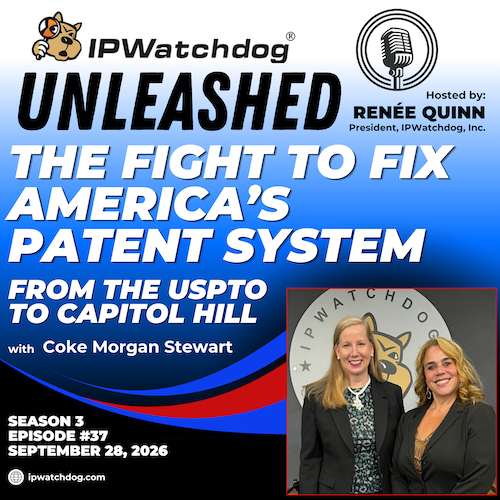
Former Deputy Director of the U.S. Patent and Trademark Office (USPTO), Coke Morgan Stewart, has joined the Council for Innovation Promotion (C4IP) as President and CEO, effective today.
Stewart most recently served first as Acting Director (January 20, 2025, through September 18, 2025) and then as Deputy Director (September 18, 2025, through July 31, 2026) of the USPTO, before announcing her departure mid-term last month. In an email sent to USPTO executive staff on July 27, Stewart informed the Office that she would be leaving the Office to return to the private sector.
C4IP said in an announcement that Stewart’s appointment “marks a new chapter for C4IP as it expands its reach and advocacy for strong and secure intellectual property rights.”
Stewart was widely seen as a pro-patent/ pro-IP leader at the Office, where she held various senior management roles over more than a decade, ranging from Senior Advisor to Acting Deputy Solicitor to Acting Chief of Staff and ultimately, after the conclusion of the first Trump term, functionally serving as Deputy Director, with her title then officially having been “Performing the Functions and Duties of Deputy Undersecretary of Commerce for Intellectual Property and Deputy Director of the USPTO.”
Soon after taking on her role as USPTO Acting Director, Stewart implemented an aggressive agenda of change that was not welcomed by all. At IPWatchdog’s 2025 Women’s IP Forum, she told IPWatchdog President, Renee Quinn, that “we reached terminal velocity early.” Facing an unprecedented backlog and operational challenges heightened by the aftermath of the pandemic, she explained that her mandate was to take proactive steps to align with the expectations of the Trump administration.
This included return to office policies and changes to examination timelines that were unpopular among the examining corps.
Commenting on her decision to join C4IP, Stewart said in a statement sent to IPWatchdog that she is “excited to make the case for modern intellectual property policies that protect American ingenuity, strengthen our economy, and ensure America leads the world in innovation.”
In a phone interview with IPWatchdog, Stewart indicated that her work with C4IP will be full-time, much of that work being focused on investing more resources to expand the organization’s reach and strengthen its voice in support of a strong and balanced IP system. “It’s particularly important for us that strength and balance is part of the discussion,” Stewart said, requiring a nuanced understanding of stakeholder views Stewart feels she has acquired over 12 years of employment at the USPTO, across multiple administrations.
While serving as Acting USPTO Director, Stewart helped establish settled expectations doctrine, which has become a critical aspect of discretionary denial decisions at the Patent Trial and Appeal Board (PTAB). “Patent rights should be reliable, and early challenges are better than later challenges, but the agency should take into account the economic reality for both sides,” Stewart said, adding that petitioners have ways of developing settled expectations in their own business operations during PTAB proceedings.
Stewart was optimistic about C4IP’s ability to achieve consensus on patent law issues on the legislative front, noting broad support for bills like the PREVAIL Act which are also supported by C4IP. “There’s a lot of common ground and I think we have the opportunity to bring people together on common sense reforms,” Stewart said, adding that agreement on every single issue isn’t necessary to make progress on improving certainty in patent rights.
Frank Cullen, C4IP executive director, said Stewart will help the organization to drive home its message advocating for strong IP rights. “Her leadership will help us expand our reach, strengthen our bipartisan coalition, and make the case more forcefully than ever that strong intellectual property rights are essential to American innovation and economic growth,” Cullen said.
C4IP was launched in 2022 with the aim of educating on the importance of innovation to the U.S. economy at a high level, and to fill the void its creators felt exists with respect to clarifying the often-negative public narrative about the role of IP in access to innovation.
The C4IP Board of Directors includes former U.S. Patent and Trademark Office (USPTO) Directors Andrei Iancu and David Kappos; Retired U.S. Court of Appeals for the Federal Circuit (CAFC) Judge Kathleen O’Malley; Retired CAFC Chief Judge Paul Michel; Former Governor of Washington, U.S. Ambassador to China, and U.S. Secretary of Commerce, Gary Locke; and Former U.S. Representative for the 21st District of Texas and House Judiciary Chairman, Lamar Smith.

![[Advertisement]](https://ipwatchdog.com/wp-content/uploads/2026/09/MarqVision-Oct-6-2026-sidebar-700x500-1.jpg)
![[Advertisement]](https://ipwatchdog.com/wp-content/uploads/2026/09/Life-Sciences-2026-sidebar-early-bird-date-corrected-700x500-1.jpg)
![[Advertisement]](https://ipwatchdog.com/wp-content/uploads/2026/09/WE-BUY-PATENTS-SIM-IP-Ad-1-revised-on-Sep-28-2026-700x500-1.jpg)
![[Advertisement]](https://ipwatchdog.com/wp-content/uploads/2024/09/Patent-Prosecution-Training-sidebar-700x500-2025-03-27.jpg)




![[Advertisement]](https://ipwatchdog.com/wp-content/uploads/2021/12/WEBINAR-336-x-280-px.png)
![[Advertisement]](https://ipwatchdog.com/wp-content/uploads/2021/12/Ad-4-The-Invent-Patent-System™.png)


Join the Discussion
2 comments so far. Add my comment.
Jimmy McSkill
August 27, 2026 04:42 pmWhat exactly were the goals of the Trump admin wrt to patents and the USPTO? Sabotage?
Pro Say
August 17, 2026 02:55 pmCongratulations. Things go better with Coke.
Because it would do nothing more than exchange one eligibility morass for another, PREVAIL (as currently written), however, is fatally flawed and must not become law.
Must not.
Instead, simply either eliminate the unnecessary Section 101 from the patent laws (the best solution) or abrogate the innovation-killing Alice and Mayo decisions and eliminate all exceptions to patent (claims) eligibility . . . letting Sections 102, 103, and 112 do the job for which they exist.
Add Comment